





 Portuguese
  English
  Spanish
  6 min of reading
  0 comments


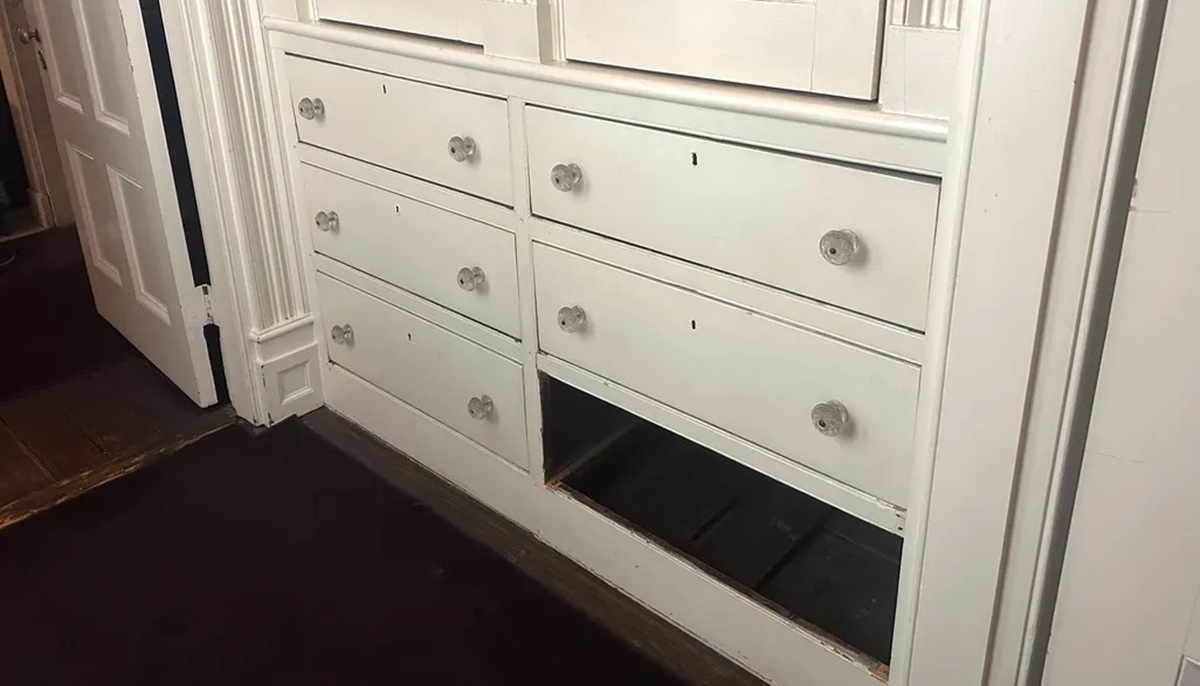
Discovery of a Secret Passage Hidden Under the Drawer of a Chest in a House Built in 1832, Today Part of the Merchant’s House Museum in Manhattan, Reveals Tunnel About 4.5 Meters Deep and Reinforces Hypothesis of a Connection with Hideouts Used in the Underground Railroad to Protect Fugitives from Slavery
A secret passage hidden under the bottom drawer of a built-in chest on the second floor of the Merchant’s House Museum in Manhattan has been identified by historians as a possible part of the Underground Railroad used nearly two centuries ago.
The opening is concealed beneath a loose wooden panel located below the bottom drawer of a built-in chest. When removed, the panel reveals a secret passage narrow enough to descend about 4.5 meters below floor level.
The structure was found within the townhouse that currently houses the Merchant’s House Museum, a historic building located in Manhattan. The residence is nearly 200 years old and preserves original elements of 19th-century architecture.
-
Brazilian city neighboring Paraguay becomes a ‘magnet’ for people seeking quality of life and high standards with exceptional growth and commutes of up to 15 minutes.
-
A rare storm transformed part of the Gulf into an unlikely scene of hail, extreme rain, and tornado risk in the middle of the desert, with volumes that exceeded the annual average in a single day.

-
Brazil catches the world’s attention with ships powered by ethanol and biodiesel that have lower emissions, an unprecedented certification with advantages in chartering, and a revolution in cabotage.

-
A couple who only has Sundays free has built a hand-dug pool, a hamburger joint, a dance hall, and a playground in their own home without hiring a mason, and even with breaks due to accidents and the pandemic, the work has never truly stopped.


According to journalist Cheryl Wills from Spectrum News NY1, who initially reported the discovery, the passage was described as a carefully concealed structure. For those responsible for the museum, the tunnel demonstrates an unusual level of concealment within the historic residence.
Discovery of Secret Passage on the Second Floor of the Merchant’s House Museum
According to Emily Hill-Wright, operations director of the Merchant’s House Museum, the secret passage is unlike any similar structure found in homes in the area. Architectural historians who analyzed the site also stated they had never seen anything like it in houses from the same period.
Hill-Wright stated that the structure stands out from other residences in the neighborhood and examples examined by specialists. For her, the discovery represents an unusual case within the study of 19th-century domestic architecture.
The house where the tunnel was identified was designed and built in 1832 by Joseph Brewster, a hat maker originally from Connecticut. A few years after construction, Brewster sold the property to merchant Seabury Tredwell.
The Tredwell family lived in the house for nearly a century. Decades later, a distant cousin of the family acquired the property in the 1930s and later opened the site to the public as a museum.
History of the House Built in 1832 and Preserved as a Historic Landmark
Today, the Merchant’s House Museum houses around 3,000 items that belonged to the Tredwell family. The preserved objects provide visitors with a detailed view of the life of a wealthy merchant family and their Irish employees in Manhattan during the 19th century.
The house also received official recognition throughout the 20th century. In the 1960s, the building was protected by the New York City Landmarks Preservation Commission and designated as a National Historic Landmark.
Although the secret passage had been known to the museum staff for some time, its original function remained uncertain for years. According to curator Camille Czerkowicz, those responsible knew of the structure’s existence but did not understand its purpose.
Among the hypotheses initially considered were the possibility of a laundry chute or even a tunnel intended for children’s play. However, these interpretations began to be revisited after a discovery made during historical research.
Research Reveals Connection Between Secret Passage and Abolitionist Activities
About two years ago, historian Ann Haddad found records indicating that Joseph Brewster was an abolitionist. The discovery led the museum team to initiate a research project focused on Brewster’s activities in New York City.
During the investigation, Haddad identified documents indicating that Brewster had ordered the construction of a false floor in a church located a few blocks from the Merchant’s House. This detail caught the researchers’ attention.
According to Emily Hill-Wright, the record indicates that Brewster had an architectural pattern when creating hideouts in buildings associated with him. The presence of this type of structure reinforced the hypothesis that the secret passage was also part of this practice.
For the researchers, the evidence suggests that Brewster employed architectural resources to create places of concealment. This pattern helped associate the house’s structure with the network known as the Underground Railroad.
Structure of the Secret Passage Required Hidden Access and Descent by Stairs
Hill-Wright explained that the secret passage had no evident domestic function. To access the tunnel, it was necessary to completely remove the drawer from the chest and take off the wooden cover that concealed the opening.
After this process, the person needed to enter the narrow space feet first and descend by stairs. Access required a specific sequence of actions, reinforcing the idea that the system was designed to remain hidden.
According to reports by the New York Times, enslaved people may have hidden in this space when slave hunters patrolled the area. The location could also serve as a temporary refuge during visits to the house.
After remaining hidden, these people could continue their journey north. This dynamic corresponds to the known operation of the Underground Railroad, a clandestine network that assisted fugitives from slavery.
Historical Context Shows Risks Faced by African Americans in the City
When Brewster built the house in 1832, slavery had been practically abolished in New York. Nevertheless, pro-slavery individuals still engaged in actions to capture fugitives or kidnap free black people.
These individuals could be returned to slave owners in the southern United States or sold again. The environment represented constant risks for African Americans living in the city.
According to Hill-Wright, individuals associated with the abolitionist movement were also targets of threats. Anyone with known ties to the abolition of slavery could become a target for persecution.
For this reason, places associated with the Underground Railroad were kept in extreme secrecy. Few intact examples of this type of hideout have survived to this day.
Architecture of the House Reveals Additional Indications of the Secret Passage
Another architectural detail of the house reinforces the presence of the secret passage. Pocket doors separate the living room from the dining room, installed within an uncommonly large space between the walls.
According to Hill-Wright, doors of this type are usually designed to save space. However, in the case of the Merchant’s House, the walls have greater thickness precisely to accommodate the hidden passage.
The passage is located exactly within this expanded space between the walls. This architectural arrangement allowed the tunnel to remain concealed within the house’s structure.
The museum team continues to research the origin of the secret passage and the details of its architectural design. Researchers are also looking to identify possible collaborators who may have participated in the construction.
Exhibition About Secret Passage Will Be Presented to Visitors
While studies continue, the Merchant’s House Museum is preparing an exhibition dedicated to the discovered structure. The secret passage can already be seen by visitors during guided tours conducted at the site.
Historian Kellie Carter Jackson, coordinator of the African Studies department at Wellesley College, stated she has seen hideouts of the Underground Railroad in different locations. Among them are attics, basements, and areas beneath false floors.
However, Jackson stated she had never seen a hideout installed inside a chest drawer. For her, the case draws attention due to the creativity used to conceal people within a residence.









-

-

-

4 pessoas reagiram a isso.