





 Portuguese
  English
  Spanish
  5 min of reading
  0 comments


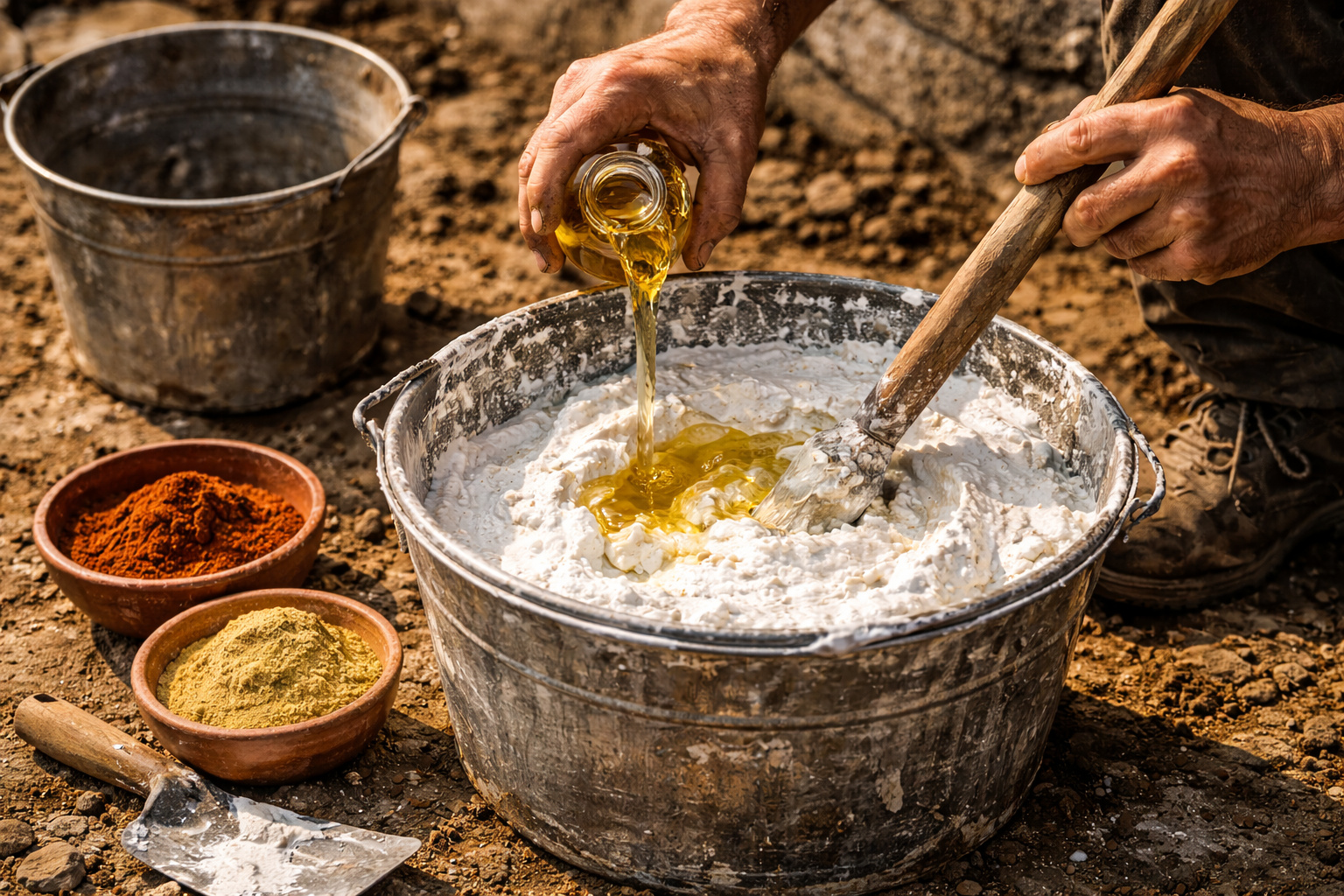
Hydrated Lime Mixture, Linseed Oil, and Mineral Pigments Create Traditional Hydrophobic Coating That Protects Walls Against Infiltrations, Fungi, and Moisture, Keeping the Plaster Breathable for Decades.
In many regions of Brazil, especially in rural areas or historic cities, it is still possible to find houses with walls painted with lime that have remained preserved for decades. Before the popularization of industrial acrylic paints, this was one of the most common methods of protecting exterior walls. A variation of this traditional technique combines hydrated lime, linseed oil, and mineral pigments, creating a coating that forms a hydrophobic film on the wall surface. The result is a layer capable of reducing infiltrations, allowing the plaster to “breathe,” and offering protection against fungi and moisture.
This solution, known in some regions as oily mineral paint or modified lime paint, has been rediscovered in restoration works, sustainable architecture, and also in low-cost home renovations.
The Origin of the Lime Waterproofing Technique
The use of lime in construction is millennia old. Ancient civilizations used this material for coatings and paints. Historical records show that:
-
Goodbye, concrete: a new trend in civil construction reduces the weight of the structure by up to 30%, accelerates projects by up to 40%, cuts costs on steel and labor, and improves thermal insulation with EPS.
-
Russian engineers create an innovative propeller blade for aircraft that could completely change the way airplanes and helicopters operate.

-
Couple finishes building PVC chalet on the beach on the last day, with air conditioning and curtains, but discovers the bathroom drain is inverted: water escapes from the drain, risking breaking the floor, and the rush continues before the trip.
-
Niterói surprises with a mega project of R$ 34 million and advances in the new Caramujo Bus Terminal, promising to revolutionize urban mobility by 2027.
- The Romans used lime in plasters and exterior paints
- Mediterranean cities have maintained lime-washed facades for centuries
- Similar techniques were brought to America during the colonial period
In Brazil, lime was widely used in rural houses, churches, and historic constructions. In many colonial towns, the characteristic white paint of facades was made exclusively with hydrated lime.
The problem with pure lime is that it can wear away quickly when exposed to constant rain. To increase its durability, traditional builders began adding natural ingredients that improved the coating’s resistance.
One of the most commonly used additives was linseed oil, extracted from flax seeds. When mixed with lime, it creates a surface that is more resistant to water.
How the Mixture Forms a Barrier Against Moisture
The basis of the technique lies in the chemical reaction between the materials. Hydrated lime is primarily composed of calcium hydroxide, an alkaline material that reacts slowly with the carbon dioxide present in the air.


This process, called carbonation, transforms lime back into calcium carbonate — basically the same material found in limestone. When linseed oil is added to the mixture, it acts as a hydrophobic agent, meaning it helps repel water.
The result is a coating that presents two important characteristics:
- Allows water vapor to escape from the wall
- Hinders rainwater penetration
This balance is important because many modern impermeable coatings completely block the wall’s breathing, which can cause blistering or peeling of paint.
Mineral Pigments Allow for a Variety of Colors
In addition to its protective function, the mixture can receive natural pigments to create a colored finish. The pigments used are typically mineral oxides, which have high resistance to solar radiation and do not fade easily.
Some of the most common pigments include:
- Red iron oxide
- Yellow iron oxide
- Brown iron oxide
- Mineral black
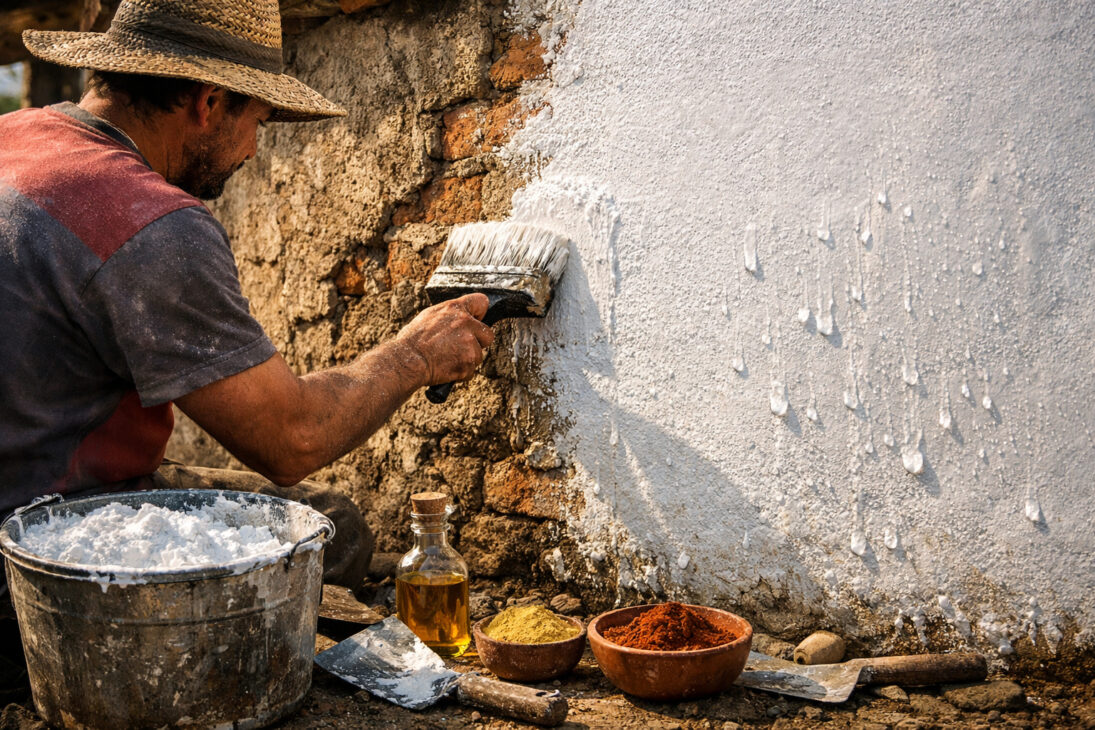
These pigments are widely used in the paint industry and can be incorporated into the lime mixture. Unlike organic dyes, mineral pigments have better resistance to sun and rain exposure. This allows for the creation of colored facades that maintain their appearance for many years.
Materials Used in Preparing the Mixture
The preparation of the waterproofing paint requires few materials. Typically, the following are used:
- Hydrated lime
- Water
- Linseed oil
- Mineral pigment (optional)
The ratio may vary depending on the type of application and the desired finish. A common formulation includes:
- About 10 liters of water
- Approximately 1 kg of hydrated lime
- Small amount of linseed oil
- Mineral pigment according to desired color
Once mixed, the materials form a mineral paint that can be applied with a brush or roller.
Preparing the Wall Before Application
Before applying any coating, it is necessary to prepare the surface. The wall must be:
- Clean
- Free of dust
- Without loose paint
- Free of grease or mold
If there is any old peeling paint, it is ideal to remove it with a steel brush or spatula. On very dry or porous walls, it is recommended to lightly moisten the surface before application. This helps the lime penetrate better into the plaster.
Application of Modified Lime Paint
- The application is usually done in two or three coats.
- The first coat is often more diluted to facilitate penetration into the plaster.
- Once the first coat dries, the second coat is applied with a more concentrated mixture.
- Drying occurs through a chemical reaction with air and can take several hours depending on the temperature and humidity.
- During this process, the carbonation of lime occurs, which hardens the coating.
- The result is a mineral surface integrated with the plaster.
Where This Technique Is Commonly Used
The mixture of lime with linseed oil appears in various contexts of construction. It is frequently used in:
- Restoration of historic buildings
- Rural houses and farms
- External walls
- Simple plaster walls
- Adobe or rammed earth constructions

In sustainable architecture projects, the use of mineral materials has also been increasing. This is because these solutions have less environmental impact compared to synthetic coatings.
Limitations of the Technique
Despite the advantages, mineral paint does not replace all types of coatings. Some limitations should be considered.
In regions with very heavy rain, for example, periodic maintenance may be necessary. Additionally, very smooth surfaces or those with old acrylic paint may require additional preparation before application.
Another important point is that the final finish tends to have a rougher and more mineral appearance, different from the uniform look of industrial paints. In many constructions, however, this visual effect is precisely the aesthetic goal of the project.
Traditional Technique Remains Present in Construction
Even with the evolution of industrial paints, traditional methods based on lime continue to be used in various parts of the world. Architects, restorers, and builders recognize that these coatings have unique properties, especially when applied over mineral plasters.
The mixture of hydrated lime, linseed oil, and mineral pigments is an example of a technique that has crossed centuries and can still be applied in contemporary projects.
In historic buildings, economical renovations, or sustainable architecture initiatives, it demonstrates that simple solutions can remain relevant in the protection and finishing of exterior walls.









-

-

-

-

-

22 pessoas reagiram a isso.