





 Portuguese
  English
  Spanish
  5 min of reading
  1 comment


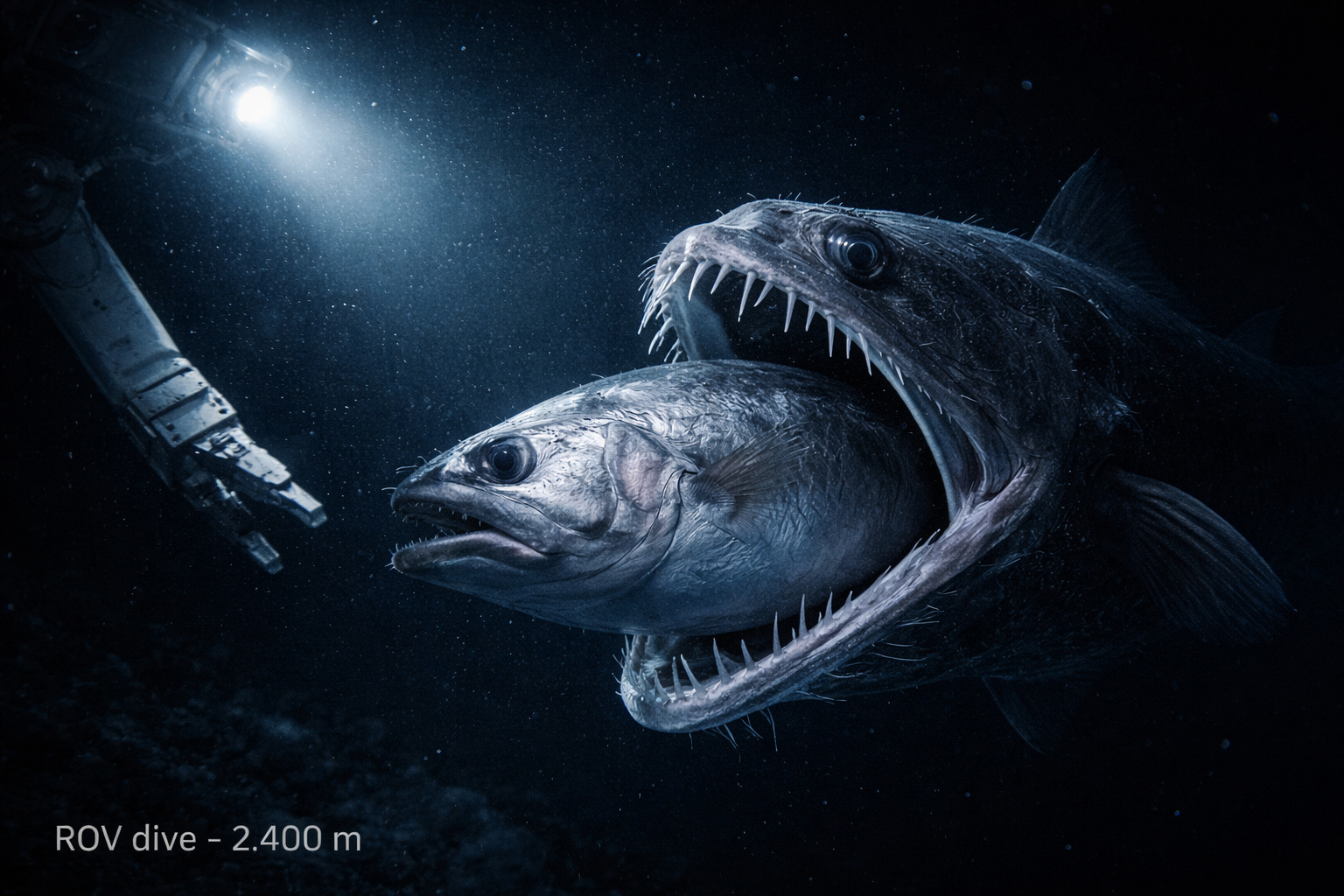


Robots Film Deep-Sea Fish With Transparent Teeth And Retractable Mouths That Swallow Large Prey, Revealing Extreme Adaptations.
Few people imagine, but some of the most surprising predators on the planet do not live in savannas, forests, or tropical reefs, but in the darkness of the deep sea. Thousands of meters below the surface, where sunlight doesn’t reach and the temperature drops to a few degrees above freezing, live fish with such unusual morphologies that they redefine what we understand as “possible” in biology. It was in this environment that robotic vehicles — like ROVs (Remotely Operated Vehicles) and AUVs (Autonomous Underwater Vehicles) — recorded creatures with transparent teeth, retractable mouths, and elongated bodies that allow them to swallow proportionally large prey.
Among the most studied groups are the blackdragon, fangtooth, and “gulper” species, which carry a collection of impressive adaptations. Instead of brute force or speed, these animals’ weapons are often a combination of camouflage, energy efficiency, and extreme anatomy — vital strategies in an environment where food is scarce and mistakes can mean starving to death.
The Deep Zone And Environmental Pressure
To understand why these fish have developed so many unusual adaptations, one must look at the environmental context. From 1,000 meters of depth, we enter the bathyal zone, and below approximately 2,000 to 4,000 meters, we reach abyssal regions. At these levels:
-
With a cost per shot close to zero, the DragonFire laser could change naval warfare in 2027 and provide British ships with nearly unlimited defense against drones.

-
A British startup creates tires that generate electricity in electric vehicles when passing over potholes, speed bumps, and cracks.

-
Scientists have created robots made with living cells that have their own nervous system, swim on their own, explore the environment, and self-organize without any genetic engineering, and now they want to do the same with human cells.

-
Students create a solar-powered ambulance that operates without a plug, without fuel, and still keeps medical equipment running in remote areas.


- there is no sunlight,
- pressure can exceed 300 atmospheres,
- water remains at about 2 °C,
- food is rare and unpredictable.

Without light, there are no plants or photosynthesis. Thus, organisms mainly depend on debris that falls from the surface (the so-called “marine snow”), organisms that migrate vertically, or occasional carcasses. In this scenario, any expended energy needs to be worthwhile, and predation strategies have evolved to maximize efficiency, discretion, and utilization.
It is within this evolutionary filtering that fish with transparent teeth, retractable mouths, and elastic structures that impress researchers arise.
Transparent Teeth And Functional Invisibility
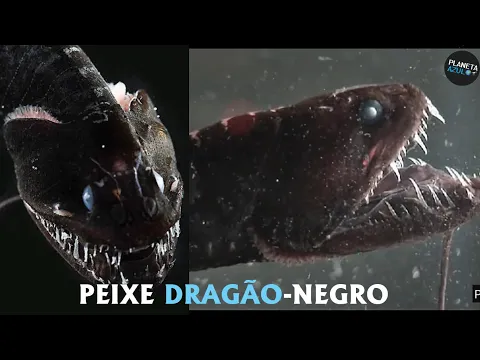
One of the best-known examples in this category is the blackdragon, an elongated and dark fish that lives in the mesopelagic and bathypelagic layers. It has extremely thin and nearly transparent teeth, a trait that may seem an aesthetic detail but holds practical value: it makes the prey incapable of sensing the approach of the bite, especially since visibility in the deep sea depends on reflections and bioluminescence.
When light is minimal, opaque teeth would reflect signals and reveal the predator’s presence. Transparent teeth, on the other hand, reduce the visual signature and increase the chance of capture. This transparency is related to the composition and how the proteins and minerals of the tooth are organized, creating a structure that allows light to pass through and reduces shine.
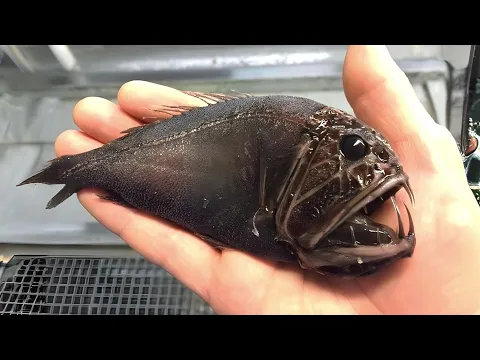
This does not mean that the animal has fragile teeth. On the contrary, studies of biological materials indicate that these teeth are highly efficient at cutting and retaining prey, even being so discreet.
Retractable Mouth And Anatomy To Expand
Another striking characteristic of deep-sea fish is the retractable mouth. At the surface, we think of mouths only as fixed openings, but at extreme depths, this configuration would not be so efficient. Retractability — which involves ligaments, cartilages, and elastic tissues — allows for an increase in the mouth’s internal volume at the moment of capture, enhancing suction area and capacity to swallow prey larger than the body appears to allow.
This mechanism resembles, to some extent, some snakes that can enlarge their skulls to accommodate prey. In the case of fish, however, the adaptation occurs more frequently through expansion of the oral cavity and esophagus, rather than by lateral opening of the jaw.
In “gulper” fish, which belong to groups like Eurypharyngidae, the mouth can reach extreme proportions, forming almost a “balloon” capable of capturing significantly voluminous organisms. This does not mean that the fish always devours giant prey; the advantage lies in capitalizing on opportunities — if a large prey appears, it is worth swallowing it, even if the process is slow.
Fangtooth, Blackdragon, And The Diversity Of Strategies
Despite the shared traits, there is not just one “model” of deep-sea fish. The fangtooth, for example, is visually robust, with long teeth and a compact body. Instead of extreme transparency, it relies on visible and powerful teeth. The blackdragon, on the other hand, combines discreet teeth with a dark elongated body, along with bioluminescence at some stages. The “gulper” group prioritizes mouth volume over robust teeth.
These differences show that the deep sea is not a biological desert with a single type of predator, but a mosaic of complementary evolutionary strategies, all responding to the same challenge: competing in an environment where food may appear only a few times a week.
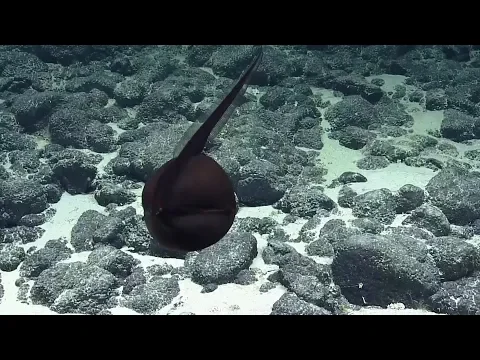
The most curious thing is that many of these fish do not need to be large to seem impressive. The scale that intrigues scientists is not the length of the animal, but the relationship between size and ingestion capacity. In simple terms, they swallow more than the body suggests is possible, which changes our perception of anatomical limitations.
Robots, Sensors, And The Advancement Of Scientific Observation
Much of what we know about these fish does not come from fishing or nets, but from footage taken by robots. This is because many deep-sea organisms are gelatinous, fragile, or sensitive to pressure, and disintegrate or deform when brought to the surface. Therefore, seeing these creatures in their habitat depends on dedicated technology.
Scientific institutions like the NOAA and research centers like the Monterey Bay Aquarium Research Institute (MBARI) use ROVs and sensors to monitor water, record images, and collect data without harming the animals. These recordings have confirmed previously unknown behaviors, such as:
- mouths expanding rapidly to capture prey,
- transparency of teeth that only appears under controlled light,
- slow and economical movements,
- bioluminescence used as attraction or camouflage.
The combination of video, chemical sensors, and digital modeling allows scientists to study anatomy and behavior without removing the animals from their environment.
What Still Needs To Be Understood
Even with advanced technologies, there are many gaps about deep-sea fish:
- there are no definitive data on life expectancy,
- little is known about reproduction,
- diets vary by species and depth,
- geographical distribution is not fully mapped.
These gaps are natural because the deep sea is the largest physical environment on the planet and also the least explored. Less than 20% of the ocean floor has been mapped with high resolution, and only a minimal fraction has been visually observed.
The lingering question is: if the deep ocean harbors creatures that we have only known for a few decades, how many unprecedented adaptations still remain invisible in the darkness that covers most of the Earth?









Amazing findings..there must other species yet to b discoveref.
thank u for awsome visual