





 Portuguese
  English
  Spanish
  6 min of reading
  0 comments


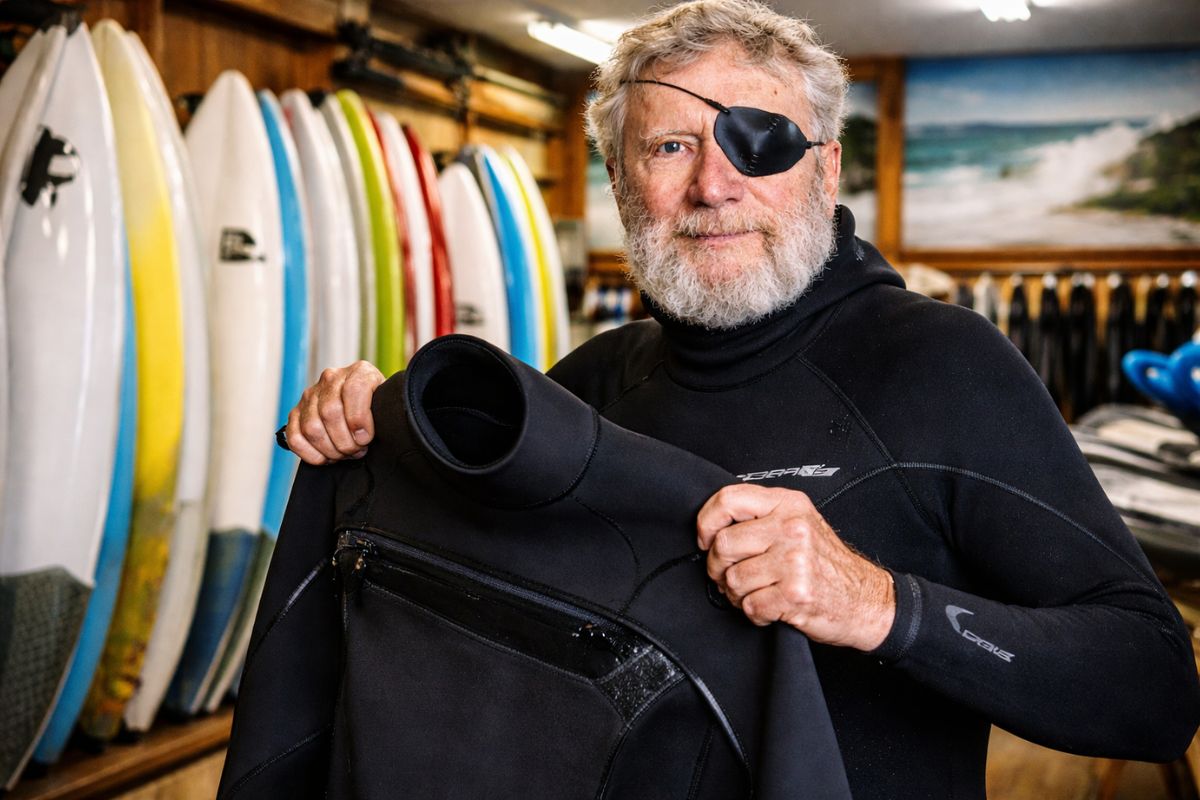
Surfer Jack O’Neill, Born in 1923 and Shaped Between Southern California and San Francisco, Opened a Small Shop in 1952, Created Early Versions of Neoprene Wetsuits, Improved Nylon and Zigzag Stitching in the 60s, and Transformed O’Neill into a Leader of the Global Surf Industry.
The surfer Jack O’Neill built his path long before becoming a symbol of a global brand. Born in Denver in 1923 and raised in Southern California, he started bodysurfing at seven and, already in San Francisco, divided his life between jobs as a fisherman and a seller of aluminum and fire extinguishers, always escaping to the sea when he could, even with the cold water.
This insistence on entering the ocean despite the cold was the practical problem that would eventually change his life. In 1952, when he opened a small surf shop in a garage near the beach in San Francisco, Jack began to test solutions to stay in the water longer. The impulse was simple, but the effect would be enormous, because from there would come some of the first neoprene answers to a sport that was still nascent as an industry.
From Cold Water to the Garage That Became the Starting Point

Before founding O’Neill as the central name in surfing, Jack amassed jobs that didn’t seem to point directly to that destination.
-
A gigantic dam project in the Himalayas could solve one crisis but silently create another for millions of people.

-
Nikola Tesla said that intelligent people tend to have fewer friends, and now science partially confirms this: a study with over 15,000 people showed that for the more intelligent, socializing too much can even reduce life satisfaction.

-
A superyacht worth US$ 17 million is delivered in impeccable condition, sets out to sail, and hits a bridge in the Bahamas just two hours later.

-
Residents of Australia woke up to a sky completely red like blood before the arrival of Cyclone Narelle, which hit the coast with winds of 250 km/h, tearing off roofs and lifting iron dust in a scene they described as apocalyptic.


In San Francisco, he worked as a fisherman and sold aluminum and fire extinguishers, among other things. What tied these activities together was the sea, always present as an escape and a personal obsession.
It was in this environment that he opened, in 1952, his first store, simply called Surf Shop.
The space operated in a garage in front of the beach, near Ocean Beach, at a time when surfing was still far from the commercial scale it would later achieve.
The store was small, but the intuition was great, because Jack didn’t just want to sell equipment, he wanted to solve a concrete limitation for those facing cold water.
A few months after opening, he conceived a first neoprene vest, still quite rudimentary.
The piece was not refined or close to the standards that the market would later recognize, but it indicated the way. Instead of accepting the cold as an inevitable barrier, Jack treated the discomfort as a technical problem.
This reasoning was decisive. Surfing, until then, depended heavily on the physical limits of the body against the water temperature.
By seeking a solution, Jack wasn’t just creating an accessory, he was creating a new relationship with time in the ocean.
Those who could stay in the water longer had more waves, more training, and more space to transform leisure into sports culture.
The Neoprene That Helped Extend Summer

In the early 1960s, Jack moved the store further south, to Santa Cruz, where the water was warmer and the waves were better.
The move coincided with the surfing boom in the United States and a clear increase in demand for suits that could make the practice more accessible and less dependent on individual resistance to cold.
It was in this scenario that O’Neill began to address two central issues.
The first was to prevent the neoprene from tearing easily. The second was to make the suits easier to put on and take off. To achieve this, Jack introduced nylon into the material composition and adopted zigzag stitching.
The advancement was not only in the material but in its actual use, in the way the body could finally wear, take off, and endure that equipment without turning it into torment.
The effect was swift. As more people wanted to surf, the market needed more functional, durable, and replicable solutions.
By the end of the 1960s, Jack was already being regarded as a leader in the industry. The name O’Neill was no longer just that of a beach store but began to circulate as a reference of product, performance, and technical adaptation.
This helps to understand why his story became so central to global surfing. Jack not only kept pace with the sport’s expansion, he gave concrete shape to one of the tools that allowed for that expansion.
Without the right suit, surfing would remain restricted to a much harsher climate limit. With it, staying in the ocean gained another scale.
The Accident, the Public Image, and the Expanding Brand


In 1971, Jack lost sight in one eye after being hit by a leash that broke. The irony is that the accessory had been created by his own son, Pat, the year before.
The episode marked the personal journey of the founder and also helped to solidify a public image that would become inseparable from the brand.
The patch over his eye and the long beard made Jack an instantly recognizable figure. To many, he looked like a pirate; to others, he resembled Poseidon, god of the seas.
This image was not manufactured in an agency; it was born from real life, and perhaps that’s why it became so strong both in and out of surfing.
At that moment, O’Neill was already beginning to transform into an international empire.
As the company scaled, Jack hired top managers to spend more time in Santa Cruz, surfing.
This detail says a lot about the type of founder he was. Although he ran a growing business, he kept the sea as the center of gravity in his own life.
A man of little media exposure, Jack attributed success to “just good timing.”
The reading from those following the industry, however, was broader. He was seen as an exemplary businessman, calm and assured, to the point of being referred to by a journalist as the “Rubber Baron.”
The nickname is exaggerated, but it reveals the size of the influence his name already carried.
Family, Team, and the Recognition of a Pioneer
The story of O’Neill also involved Jack’s son. In the mid-1980s, Pat O’Neill took over as the company’s CEO and played an important role in building Team O’Neill, which over the years included names like Shaun Tomson, Dane Kelahoa, Shane Beschen, Cory Lopez, Jordy Smith, Bobby Martinez, and John John Florence, among others.
This movement further increased the brand’s presence in surf culture. It was not just about selling suits or equipment, but about associating the name O’Neill with athletes, performance, and the global circulation of image.
When a brand starts to dress champions and engage with different generations of surfers, it ceases to be a product and becomes a language.
Institutional recognition followed. Jack was inducted into the International Surfing Hall of Fame in 1991 and the Huntington Beach Surfing Walk of Fame in 1998.
Surfer magazine named him one of the 25 most influential surfers of the century, and in 2000 he received the Watermen Achievement Award from the Surf Industry Manufacturers Association.
His biography, written by Drew Kampion and published in 2011, received a title that summarizes his position in sports history: It’s Always Summer on the Inside.
The phrase makes sense because Jack helped to transform surfing into something less dependent on season, weather, and temperature. He didn’t invent the ocean, but he helped extend summer within it.
The Legacy of Those Who Turned Cold into Opportunity
What started with a surfer insisting on entering cold waters became one of the most decisive stories in the surfing industry. Jack O’Neill was not just a merchant, inventor, or entrepreneur.
He was someone who identified a physical limit of the sport and treated that limit as a field for creation.
From a small shop opened in 1952, near Ocean Beach, he stitched a change that spanned technique, market, and imagery.
Few trajectories show so clearly how a practical need can turn into a global brand, especially when the founder remains connected to the original problem he tried to solve.
If you had to point to the most decisive gesture of this journey, what would it be: opening the small surf shop, betting on the first neoprene suits, or keeping the focus on the sea even when O’Neill was already an empire? And, looking at today’s surfing, do you think the industry can still arise from that kind of real need or has it become too dependent on image and marketing?









Seja o primeiro a reagir!