





 Portuguese
  English
  Spanish
  5 min of reading
  2 comments


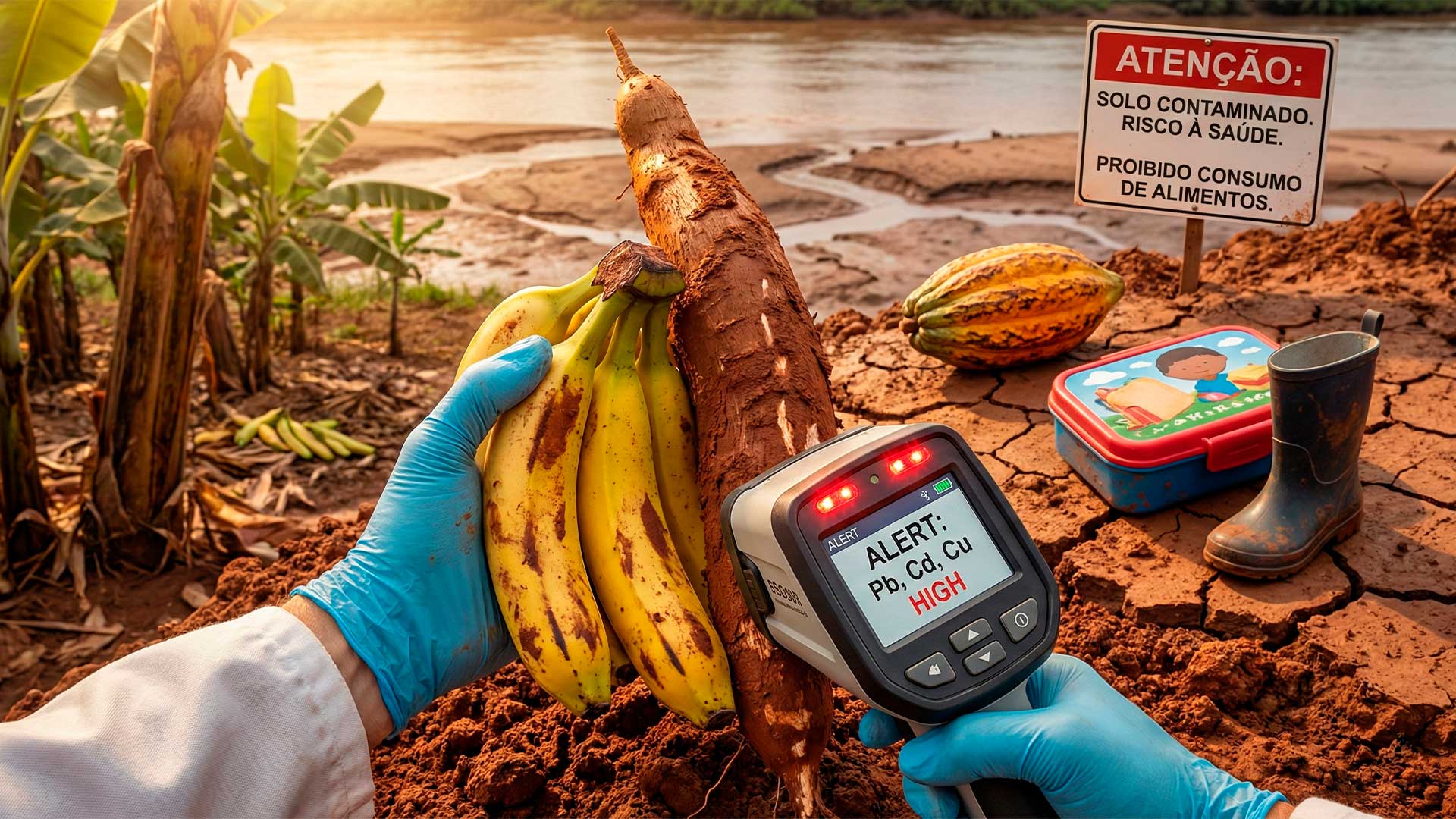


Research in Linhares (ES) Detected Potentially Toxic Metals in Banana, Cassava, and Cocoa Grown in Soil Affected by the 2015 Sludge. For Adults, the Levels Remained Below the Risk Threshold, but for Children, Banana Consumption May Exceed the Considered Worrying Level.
Ten years after the rupture of the Fundão dam in Mariana (MG), a new study reignites the debate about food security in the estuary of the Doce River in Linhares (ES). The study identified elevated concentrations of metals associated with the waste and found possible non-carcinogenic risks for children consuming bananas grown in impacted areas.
The work was published in October 2025 in the journal Environmental Geochemistry and Health and evaluated bananas, cassava, and cocoa produced in soils that have received iron-rich waste since 2015. Samples were collected in August 2021, according to the article indexed in PubMed.
The central conclusion is straightforward: cadmium, chromium, copper, nickel, and lead were found in levels above the reference values mentioned by the authors in the edible parts of the analyzed crops.
-
The water that almost everyone throws away after cooking potatoes carries nutrients released during the preparation and can be reused to help in the development of plants when used correctly at the base of gardens and pots, at no additional cost and without changing the routine.

-
The sea water temperature rose from 28 to 34 degrees in Santa Catarina and killed up to 90% of the oysters: producers who planted over 1 million seeds lost practically everything and say that if it happens again, production is doomed to end.

-
An Indian tree that grows in the Brazilian Northeast produces an oil capable of acting against more than 200 species of pests and interrupting the insect cycle, gaining ground as a natural alternative in soybean, cotton, and vegetable crops.
-
The rise in oil prices in the Middle East is already affecting Brazilian sugar: mills in the Central-South are seeing their margins shrink just as ethanol gains strength.

However, the alert is not uniform for all audiences. The risk calculations indicated that, for adults, there would be no probable risk according to the indicators used, but for children, banana consumption may exceed the threshold set in the study.
What the Study Found in Bananas, Cassava, and Cocoa Grown in Linhares
The research analyzed agricultural soils in the estuary of the Doce River and measured the presence of metals linked to the waste, often associated with iron oxides. These oxides are an important component of the sludge and can influence how contaminants remain available in the environment.
In the results released, bananas and cassava concentrated most of these elements in the underground parts, such as roots and tubers. Nevertheless, the study also identified metals in the edible portions.
In the case of cocoa, the scenario was different. There was significant accumulation in the above-ground parts, and in the pulp, the levels of copper and lead exceeded the limit values cited by the FAO in the report summarizing the work.
Why Lead Becomes the Focus When It Comes to Children
Among the contaminants evaluated, lead appears as the main “driver” of the risk calculated for children concerning banana consumption. The report from Agência FAPESP points out that the result for children exceeded the threshold of 1 in the total index used by the authors, primarily driven by lead, with cadmium also above the recommended level in the mentioned segment.
The concern is not abstract. The World Health Organization states that lead can permanently affect the development of the child’s brain, with impacts such as reduced IQ and behavioral changes, including decreased attention.
The CDC in the U.S. also lists learning and behavioral problems, as well as reduced attention span, as consequences associated with exposure. The message is that prevention matters because some damage may be lasting.
That’s why the study closely examines the most sensitive group. Young children tend to be more vulnerable due to biological factors and also because the dose “per kilo of body weight” can be higher when consuming the same food.
How Researchers Measured the Metals and Transformed This into “Risk”
To arrive at the numbers, the team collected soil and plants and separated parts such as roots, stems, leaves, and fruits. They then washed, dried, ground, and conducted chemical analyses to estimate concentrations in dry mass.
The next step was to connect “how much is in the food” with “how much a person can ingest,” using standardized metrics for health risk assessment. The article describes the use of Hazard Quotient, Hazard Index, and Total Hazard Index, and the synthesis is that children consuming bananas may exceed the threshold considered worrying in the model.
In the disclosure, the authors also considered local consumption habits and exposure parameters. Agência FAPESP cites the use of IBGE data to estimate how much of the diet came from outside and how much was produced and consumed within the region itself.
There is a technical point that stands out in the PubMed summary. The study states that the association of metals with iron oxides, which theoretically could reduce availability, was not an efficient mechanism in the evaluated scenario, which raises concerns about food production in these environments.
What This Says About the Legacy of the Fundão Dam Rupture
The rupture occurred on November 5, 2015, releasing tens of millions of cubic meters of waste that traveled through the Doce River basin to the ocean. An analysis published in Perspectives in Ecology and Conservation describes the scale of the disaster and the extent of contamination along the water system.
The current study reinforces the idea that the impact is not only on water and fishing. It reaches the soil and can enter the food chain through crops, especially in estuarine areas where the chemical conditions favor the mobility of contaminants.
In its institutional communication, the Federal University of Espírito Santo also treated the results as a warning signal for food security, pointing out that chronic contamination and the higher risk for children deserve attention and expanded sampling.
The topic gains additional weight because the research is part of a continuous line of investigation and received academic recognition. The thesis related to the work was awarded at USP in 2025, and Esalq also received awards at the 2025 Capes Thesis Award.
Do you think there should be an immediate restriction on the planting and sale of food in areas of the Doce River estuary until independent monitoring “stamps” safety, or would that punish those who are not at fault and rely on local agriculture? Leave your comment.







Esse plantio deve ser realocado para áreas nao contaminadas e as pessoas indenizadas. Nao tem cabimento vender produtos envenenados!
Entre não ter o que comer e passar fome ao ter que comer produtos agrícolas contaminados com metais pesados, com certeza, o povo vai comer os alimentos contaminados.