





 Portuguese
  English
  Spanish
 3 min of reading


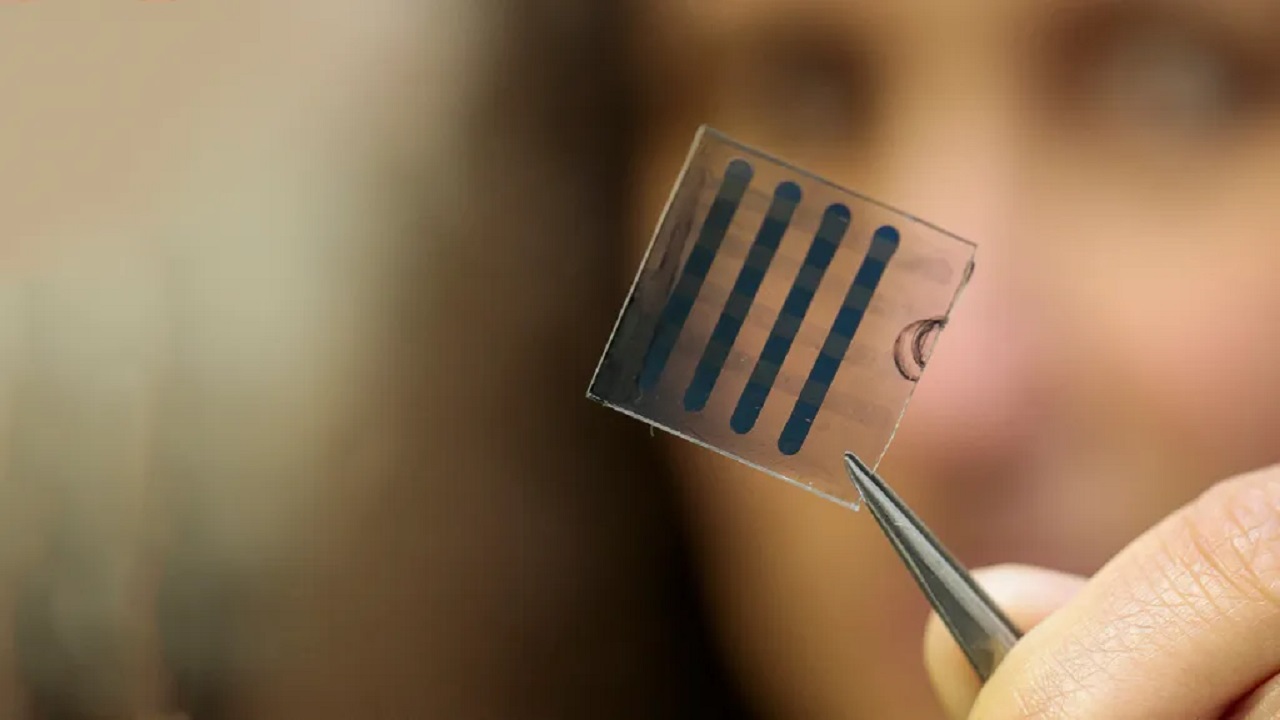
The Researcher Marina Sparvoli Developed a Computer Memory That Could Revolutionize the Technology Market. The New Discovery Uses Graphene and Offers Several Benefits.
A researcher from the University of São Paulo (USP) developed an innovative technique for producing memristors, essential electronic components for neuromorphic computing, which mimics the brain, and for computers that do not lose data during power outages. Marina Sparvoli and her colleagues at USP developed a computer memory mechanism based on memristors using materials never before combined for this purpose, creating a Resistive Memory (ReRAM) using graphene.
Researcher Uses Graphene in Computer Memory
The new memristor architecture consists of a layer of graphene deposited between indium tin oxynitride (ITON) contacts, wrapped in an aluminum casing.
The energy passes through the component generating an electromagnetic field, depending on the voltage, a filament forms or does not form that acts on the resistive switching phenomenon, that is, the component changes between a low resistance behavior to electric current and a high resistance one.
-
Scientists use artificial intelligence to create nearly indestructible steel that does not rust and could change the way industrial energy and oil parts are produced.
-
Instead of buying new electric trucks, India is removing the diesel engines from old vehicles and installing electric propulsion for 40% of the price, and this simple idea could be the solution that polluted megacities around the world have been waiting for.

-
Circles in the Sahara plantations: ISS reveals Sharq El Owainat, in Egypt, irrigated by a center pivot with water from the Nubian Sandstone Aquifer, growing between 1998 and 2019, 290 km from the nearest city.

-
40% still call it a fraud: Soviets monitored Apollo, mirrors on the Moon still return lasers today and rocks confirm it; in 2026, 4 astronauts will return to lunar orbit and the race restarts against China.

Another advantage of the computer memory with graphene is that the entire sandwich of semiconductors is transparent, making it possible to use in electronic architectures close to the surfaces of device screens, further mitigating the space occupied, making miniaturization simpler.
The material, known as (ITON), is a semiconductor still little known among researchers, being a variation of indium and tin oxide, responsible for the operation of touch-sensitive screens. The researcher from USP emphasizes that the innovation lies in using it with nitrogen.
Advantage of Resistive Memory with Graphene
Although its theory first emerged in the 1970s by Filipino Leon Ong Chua, resistive memories only began to be tested in 2008, with the practical confirmation of the operation of this fourth essential electronic component, the memristor.
The great benefit of this new technology from the USP researcher is that, unlike current electronic memories, the information contained in resistive memories does not disappear when the device is turned off. However, despite intense research efforts in the field, there are still no computers with this type of technology.
When you turn on a regular computer, the operating system, which can be Windows, Linux, or MAC OS, is copied from the permanent storage device, which is slower, to the RAM, which is much faster.
This process is time-consuming; however, with the use of ReRAM memories, it could be bypassed. Additionally, memristors are tiny, with only a few hundred atoms thick, and can act like biological neural connections. They are a type of artificial neuron, capable of mimicking synapses.
Understand How the New Graphene Computer Memory Works
This type of memory developed by the USP researcher operates with high and low resistance states that correspond to the binary code of machine language, 0 and 1. In regular computers, this writing is represented not by resistance but by low, high (V) and off (0) or on (1) voltages.
The filaments of the memristors whose resistance changes are in the nanometer scale, promising an infinite amount of information stored in a tiny storage space.
According to a head of the USP laboratory, Professor José Chubaci, this is a project at the frontier of global knowledge, which could be used in the international market in 10, 15, or 20 years. Marina managed to generate resistive memories using graphene with ITON, indium-tin oxide doped with nitrogen, expanding the research space in the field.
Source: Jornal da USP









Seja o primeiro a reagir!