





 English
  Francês
  Alemão
  Italiano
  Japonês
  Norueguês
  Portuguese
  Spanish
  3 min of reading


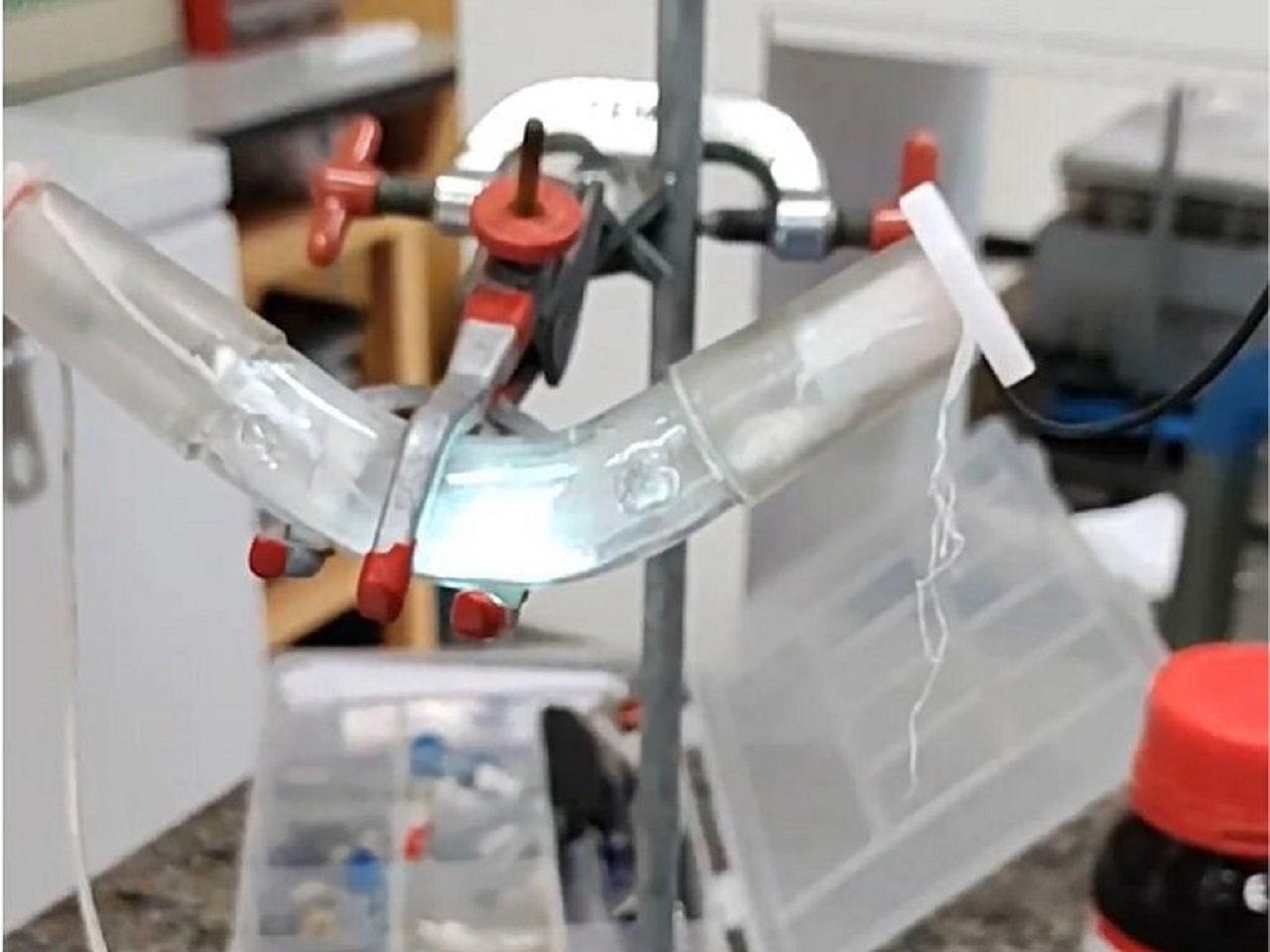
Researchers From CINE and IPEN Developed Nano Sheets of Boron Nitride, Better Known as White Graphene, Using Only a Modified Tesla Coil in the Operation
Brazilian researchers created a simple technique using a modified Tesla coil to produce sheets of one of the most promising two-dimensional (2D) materials for optics and electronics, white graphene. Two-dimensional materials, such as molybdenite and graphene, are becoming increasingly important; however, producing them on an industrial scale while maintaining their properties is still one of the major challenges.
Read Other Related News
Brazilian Researchers Create Fast Method to Obtain White Graphene
Rodrigo de Souza and his colleagues from the Center for Innovation in New Energies (CINE) and the Institute of Energetic and Nuclear Research (IPEN) worked with another 2D material, boron nitride, which is being used to develop artificial synapses for neuromorphic computers and even qubits for quantum computers.
-
Historic bankruptcy of Centauro shocks the market, and the century-old company puts more than 500,000 products, machines, and complete infrastructure up for online auction.

-
Abandoned house for 15 years disappears in the woods, shocks owner with unrecognizable scenery and is reborn in an intense transformation after almost 90 hours of work in just 10 days.

-
In just three hours, a natural stone floor transforms the entrance of the house with an organic effect, immediate drainage, and a sophisticated non-slip finish that doesn’t puddle water, dries quickly, and impresses with the final result.
-
‘Interlocking brick’ made of earth arrives in the construction industry with cost reductions of up to 40% on the project.

Rodrigo and his colleagues developed a fast, scalable, clean, and simple method to obtain hexagonal boron nitride nanosheets, a material composed of flat layers of boron and nitrogen atoms arranged in the shape of hexagons.

To take advantage of all the properties of the material in its two-dimensional version, it is necessary to exfoliate it, that is, to extract sheets of a few atomic layers of thickness from a macroscopic crystal. Known as white graphene, hexagonal boron nitride is similar to carbon material in various aspects, but it is much more difficult to exfoliate.
Tesla Coil Is Successfully Used by Researchers
The team was able to extract the white graphene nanosheets using the plasma created by a modified Tesla coil acting on the material that is held in a tube. The Tesla coil is a simple device that can even be constructed artisanal, capable of producing high voltage discharges, creating electrical arcs.
These electrical discharges ionize the environment, generating the well-known cold plasma, where electrons are at a higher energy state than the rest of the particles. The exfoliation of white graphene occurs when electrons are fired against a macroscopic sample of boron nitride. Part of the energy from the electrons is transferred to the crystal structure, thereby increasing the bond distance between the atomic layers until a point where the bond breaks, and the sheet naturally detaches, depositing itself in the container.
White graphene is also used in research for clean energy generation and storage, in photocatalysis and catalysis processes, and in devices such as fuel cells and supercapacitors.
White Graphene May Be Useful for Sustainability
Despite not containing a single carbon atom, the material has the ability to absorb, in an instant, chemicals from contaminated water. White graphene can absorb all types of organic pollutants such as industrial chemicals and even motor oil.
Furthermore, the material can be cleaned and reused more easily than other nanomaterials previously suggested for similar uses. The secret to this advantage of white graphene lies in its structure full of pores, which allows it to easily absorb contaminants.







Seja o primeiro a reagir!