





 Portuguese
  English
  Spanish
  6 min of reading
  0 comments


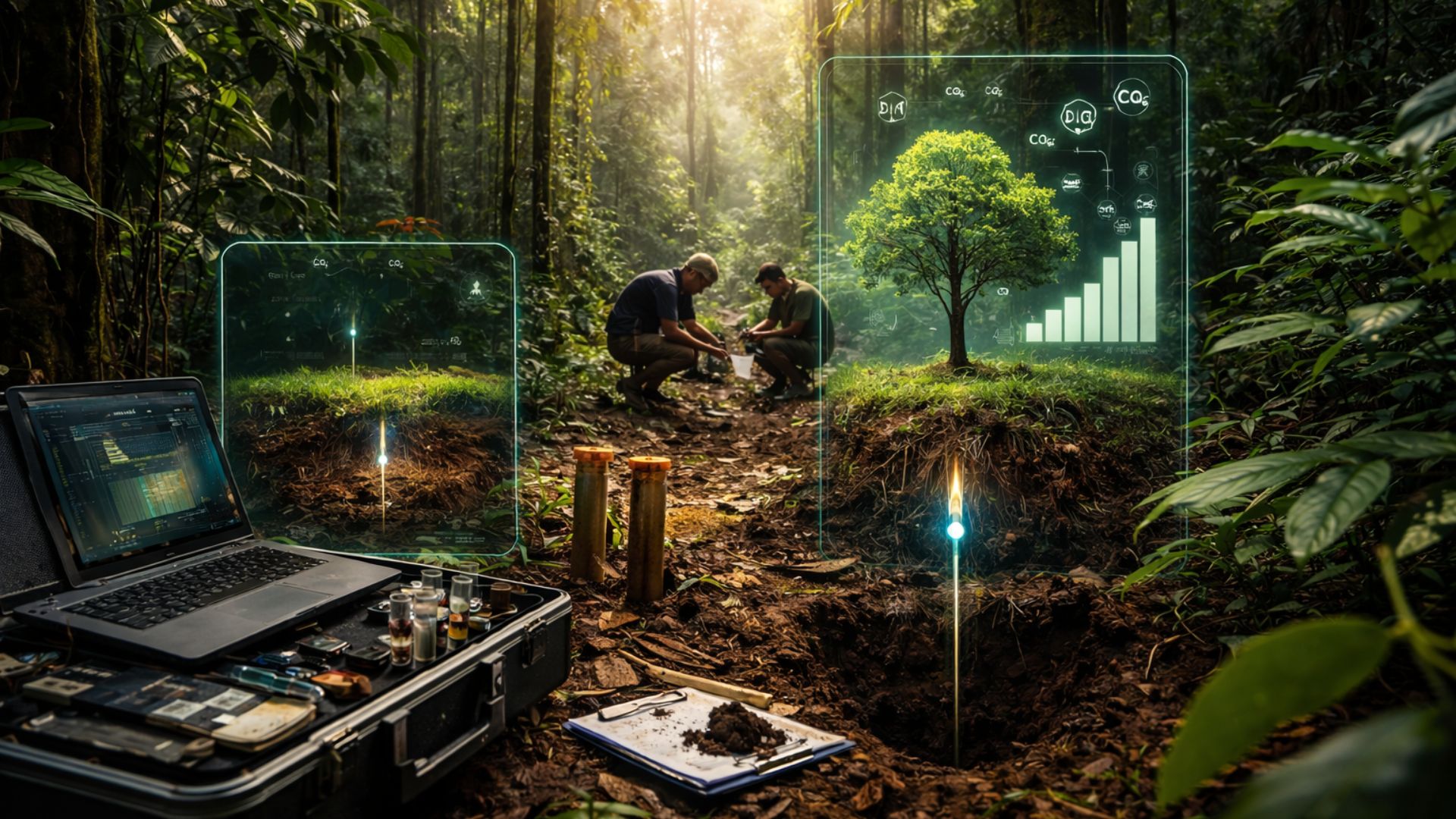
Scientific Study Funded by Petrobras and Shell Will Map Carbon Stock in Brazilian Soils and Forests, Creating a Unique Database for Carbon Credits and Climate Policies by 2030
Petrobras and Shell announced, in January 2026, the funding of an unprecedented scientific study in Brazil to measure the carbon stock present in Brazilian soils and forests, covering all states and biomes of the country. Named Carbon Countdown, the project foresees total investments of R$ 108 million, equally divided between the two companies, with an estimated completion by 2030. The information was disclosed by Folha de S.Paulo.
What Is Carbon Countdown and Its Importance for Carbon Stock in Brazil
The study creates an enormous national baseline in scale and detail on carbon stored in Brazilian territory, considered strategic for climate policies, the carbon credit market, agribusiness, and decarbonization commitments made by the country in international agreements.
The Carbon Countdown is a long-term research project that aims to scientifically and standardized quantify how much carbon is stored in Brazilian soils and forests. The proposal is to fill a historical gap: the absence of national data on carbon stock, often calculated with the support of international parameters.
-
6 sources of free fertilizer that you are throwing away every day and can transform your garden without spending anything.
-
With a water crisis on the radar, Sabesp invests in reclaimed water for data centers and transforms sewage treatment into a solution that saves millions of liters and protects public supply.

-
Foresea achieves 100% offshore waste reuse in 2025, eliminates landfill disposal, and consolidates sustainable strategy with 1,500 tons recycled.
-
With earth, bamboo, straw, and lime mortar, a specialist builds a house for just over $460 and draws attention for its cost being much lower than traditional construction.


Without a national baseline, Brazil loses precision, competitiveness, and bargaining power in the carbon market. The study aims to provide robust and verifiable data capable of supporting public policies, business strategies, and environmental reports.
The initiative will be conducted by the Center for Carbon Studies in Tropical Agriculture (CCarbon), linked to the rectory of the University of São Paulo (USP), with direct participation from researchers at Esalq-USP, an international reference in soil science.
Investments from Petrobras and Shell in Climate Research
Petrobras and Shell will invest R$ 54 million each, totaling R$ 108 million throughout the project. According to the companies, the funds qualify as investments in research, development, and innovation, as per clauses of the exploitation contracts signed with the ANP (National Agency of Petroleum, Natural Gas, and Biofuels).
The companies state that they will not interfere with the scientific results, which are to be published in peer-reviewed academic journals. The transparency of the data is highlighted as a central element to ensure credibility for Carbon Countdown.
Scientific Coordination of Carbon Countdown and Role of USP
The scientific coordinator of Carbon Countdown is Professor Maurício Cherubin, from the Department of Soil Science at Esalq-USP. According to him, the final format of the project is the result of a long negotiation process with the funding companies.
The initial idea, presented by Shell about three and a half years ago, needed to be reformulated to become technically feasible. Scientific autonomy was a key point of the agreement, ensuring that the university had methodological freedom and control over the execution of the study.
Why Measure Carbon Stock in Brazilian Soils and Forests
The carbon stock in Brazilian soils and forests plays a fundamental role in combating climate change. Carbon dioxide (CO₂) is the main gas associated with global warming, and its removal from the atmosphere occurs mainly through photosynthesis, carried out by forests, crops, and pastures.
Rural producers argue that a significant portion of agricultural emissions is offset by carbon capture in the vegetated areas of their properties. However, without standardized national data, this compensation is difficult to prove in official inventories. The Carbon Countdown aims to establish a reliable national average, allowing for more precise assessments of the country’s emission balance.
Scientific Methodology and Scope in Brazilian Soils and Forests
The project will have one of the largest environmental data collection structures ever undertaken in Brazil. It is expected to have 6,500 sampling areas, distributed among agriculture, livestock, eucalyptus plantations, native forests, and degraded areas.
At each point, nine samples will be taken, with analyses reaching up to one meter deep, totaling more than 250,000 soil samples. Additionally, the study will analyze 1,000 forest plots, each consisting of 900 square meters.
The estimate of carbon stored in vegetation will be based on the number of plants and the average diameter of trees. Some trees will be felled for biomass weighing, a procedure that, according to the coordination, will have prior authorization from Ibama.
Relationship of Carbon Countdown with Agribusiness and the Carbon Market
The Brazilian agribusiness sector is one of the most interested parties in the results of Carbon Countdown. Currently, producers and entities question the use of international metrics to calculate the climate impact of national production.
According to Cherubin, the lack of this baseline is increasingly felt, highlighting that the study directly responds to the demands of the productive sector. With its own data on carbon stock, Brazil can strengthen the carbon credit market, reduce methodological disputes, and increase the competitiveness of sustainable production chains.
Criticism of Petrobras and Shell’s Involvement in Climate Studies
Despite its scientific relevance, the involvement of Petrobras and Shell has generated criticism. Experts from the International Institute Arayara warned of possible conflicts of interest.
In a joint statement, Hirdan Costa, John Würdig, and Juliano Bueno stated that fossil fuel companies may use climate studies to shape the carbon market to suit their own interests.
According to them, there is a risk that scientific data will be used to legitimize the continuation of oil and gas exploration under the argument of environmental compensation, a practice often associated with greenwashing.
Defense of the Companies and Transparency of Carbon Countdown Data
The coordination of Carbon Countdown rebutted the criticisms, highlighting that the results will be public and published in scientific journals. Cherubin stated that scrutiny from the academic community will be essential to ensure the integrity of the study.
At Petrobras, monitoring will be direct. The environmental manager of the company’s research center, André Bueno, stated that the company will monitor all phases of the work.
The technical team will oversee all methodologies, results, and analyses, he declared. According to him, the project will be supervised by a technical and management committee responsible for physical and financial progress.
Initiative of Shell and Petrobras: Future Use of Data and Impacts on the Carbon Market
Petrobras does not rule out using the data from Carbon Countdown to generate carbon credits in the future. According to André Bueno, conserved areas and biofuels may benefit from the study’s conclusions.
At Shell, the project is seen as a way to strengthen the so-called carbon asset. According to Alexandre Breda, manager of low-carbon technologies at the company in Brazil, the energy transition needs to occur gradually.
Alexandre states that the world needs energy security, defossilization, and decarbonization. According to him, the study could position Brazil as a global leader in carbon measurement.
What Carbon Countdown Represents for Brazil’s Environmental Future
The Carbon Countdown, funded by Petrobras and Shell, represents a significant advancement for national climate science. By accurately measuring the carbon stock in Brazilian soils and forests, the project creates a unique basis for public policies, business strategies, and international negotiations.
Despite the criticisms and warnings about conflicts of interest, scientific transparency will be the deciding factor for the credibility of the results. If well executed, the study can redefine how Brazil measures, values, and negotiates its carbon by 2030, reinforcing its strategic role in the global sustainability agenda.








Seja o primeiro a reagir!