





 Portuguese
  English
  Spanish
  5 min of reading
  0 comments


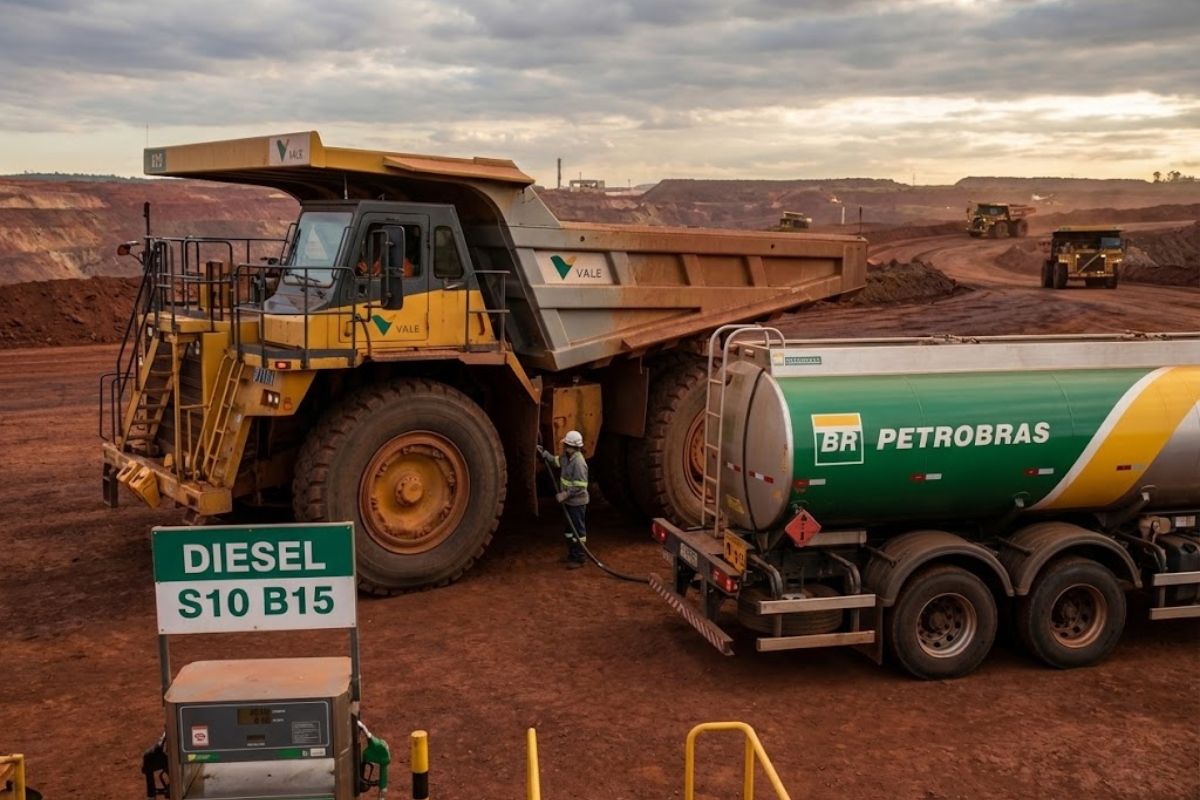
Petrobras and Vale Formalize Agreement for S10 Diesel Already with 15% Biodiesel in the Miner’s Operations in Minas Gerais. The Partnership, Effective Following Carbon Collaboration Since 2023, Outlines Opportunities Such as Purchase and Sale of Diesel R and Possible HVO Negotiations in Regional Direct Supply.
Petrobras and Vale announced an agreement for the supply of S10 diesel already with the addition of 15% biodiesel to the miner’s operations in Minas Gerais, according to a statement released on a Monday.
The agreement expands cooperation in low-carbon solutions initiated in 2023 and paves the way for new business negotiations involving Diesel R, with renewable content, and possible negotiations for the supply of HVO, in addition to reinforcing Petrobras’ strategy to seek direct sales to large consumers.
What Was Signed and Which Fuel Enters First
The agreement formalizes the supply of S10 diesel with 15% biodiesel for Vale’s operations in Minas Gerais.
-
Offshore industrial demand in Macaé skyrockets with the recovery of oil and gas and could grow by up to 396% by 2026 in the Campos Basin.
-
Offshore industrial demand in Macaé surges with the recovery of oil and gas and could grow by up to 396% by 2026 in the Campos Basin.
-
Brazilian giant expands borders in the Southeast: Petrobras confirms new oil discovery in ultra-deep waters in the pre-salt of the Campos Basin.

-
Alert in the global energy market: Severe tropical cyclone hits the coast and disrupts gas production at major plants in Australia, threatening global supply.


In practice, Petrobras and Vale present a product that already comes with a defined mix, avoiding the logic of buying “pure” S10 diesel followed by adjustments later in the final destination.
This framework has operational relevance because it predefines the biodiesel content incorporated into the S10 diesel destined for the miner’s consumption fronts in the state.
The key information from the statement is that the S10 diesel delivered will already contain 15% biodiesel, a parameter that becomes part of the supply contract.
Minas Gerais as the Field of Application and the Logic of Operation
Minas Gerais is presented as the immediate territory for supply because it is where Vale’s operations that will be served by S10 diesel with biodiesel are located.
In the scope of the agreement, the focus is not on retail but rather on supply for corporate consumption, in operational routines that depend on a continuous availability of fuel.
By delimiting Minas Gerais, Petrobras and Vale structure an arrangement that tends to be measured by delivery regularity, product standardization, and predictability for the miner’s internal chain.
It is at this point that the S10 diesel, with 15% biodiesel, becomes a variable of logistical efficiency within a large-scale contract.
What Changes When S10 Diesel Arrives with 15% Biodiesel
The most striking element of the announcement is the content of 15% biodiesel already incorporated into the S10 diesel.
This detail is treated as part of the business repositioning in low carbon between Petrobras and Vale, because the mixture with biodiesel introduces renewable content within the fuel used in the operation.
In addition to the composition, the announcement avoids a reading that the fuel boils down to a one-time purchase.
By highlighting biodiesel and the structured supply, Petrobras and Vale indicate a supply line with clear specifications, directly impacting internal consumption control and traceability of the delivered product.
Diesel R and HVO Enter as Next Steps in Negotiation
The statement about Petrobras and Vale is not limited to S10 diesel with biodiesel.
It mentions opportunities for developing low-carbon businesses, including the possibility of buying and selling Diesel R, described as fuel with renewable content.
Subsequently, the text points to possible negotiations for the supply of HVO, presented by the acronym Hydrotreated Vegetable Oil.
By mentioning Diesel R and HVO in the same context, Petrobras and Vale signal that the S10 diesel agreement could be the first step towards a broader portfolio, with negotiations that still depend on discussions and commercial structuring.
For the market, the presence of Diesel R and HVO in the announcement functions as an indicator of the agenda.
This is not yet a confirmed supply concerning these items, but rather a formal opening for negotiations, focusing on low-carbon solutions linked to corporate supply.
Carbon Partnership Since 2023 and the Continuity Line
Petrobras reported that the two companies have been collaborating since 2023 on business partnerships aimed at developing low-carbon solutions.
This history is important because it positions the S10 diesel agreement with biodiesel as a continuation of a previously built relationship, not as an isolated move in 2026.
At the 2023 milestone, the cooperation is described as the development of low-carbon solutions.
In 2026, the announcement materializes a specific product, S10 diesel with 15% biodiesel, and expands the discussion to Diesel R and HVO, reinforcing the idea that the carbon axis is the common thread in the conversations between Petrobras and Vale.
Direct Sale and the Commercial Strategy Mentioned by Petrobras
The announcement also connects to a commercial guideline mentioned by Petrobras: last year, the company stated that it was seeking opportunities for direct sales of fuels to large consumers in the agribusiness sector and to companies like Vale and J&F.
In this context, the S10 diesel contract with biodiesel for Minas Gerais fits as an example of direct sales to a large industrial consumer.
The logic is to reduce intermediaries and structure contracts that meet significant volumes, with product specifications and the possibility of expanding to items like Diesel R and HVO.
Why the Agreement May Redesign Supply Starting from 2026
The reading of a “strategic turnaround” appears because Petrobras and Vale combine, in the same announcement, an immediate supply of S10 diesel with biodiesel and the opening of a future agenda for Diesel R and HVO.
If this agenda advances, the natural consequence is a redesign of corporate supply, with more options for fuels with renewable content in the negotiated portfolio.
However, what is confirmed is the supply of S10 diesel with 15% biodiesel for operations in Minas Gerais.
The remainder, Diesel R and HVO, is in the realm of opportunities and negotiations, and will depend on the evolution of talks between Petrobras and Vale.
The agreement announced on 01/05/2026 places Petrobras and Vale on the same supply route with S10 diesel already with 15% biodiesel for operations in Minas Gerais and simultaneously opens commercial discussions for Diesel R and HVO within a carbon partnership that has been developing since 2023.
To keep up with the next chapters, the practical step is to monitor whether the negotiations for Diesel R and HVO progress to contracts and how Petrobras’ direct sales strategy unfolds into new agreements with large consumers, including Vale.
Do you think Petrobras and Vale will turn Diesel R and HVO into contracts by 2026, or will S10 diesel with biodiesel remain the only concrete delivery for now?







Seja o primeiro a reagir!