





 Portuguese
  English
  Spanish
  6 min of reading
  0 comments


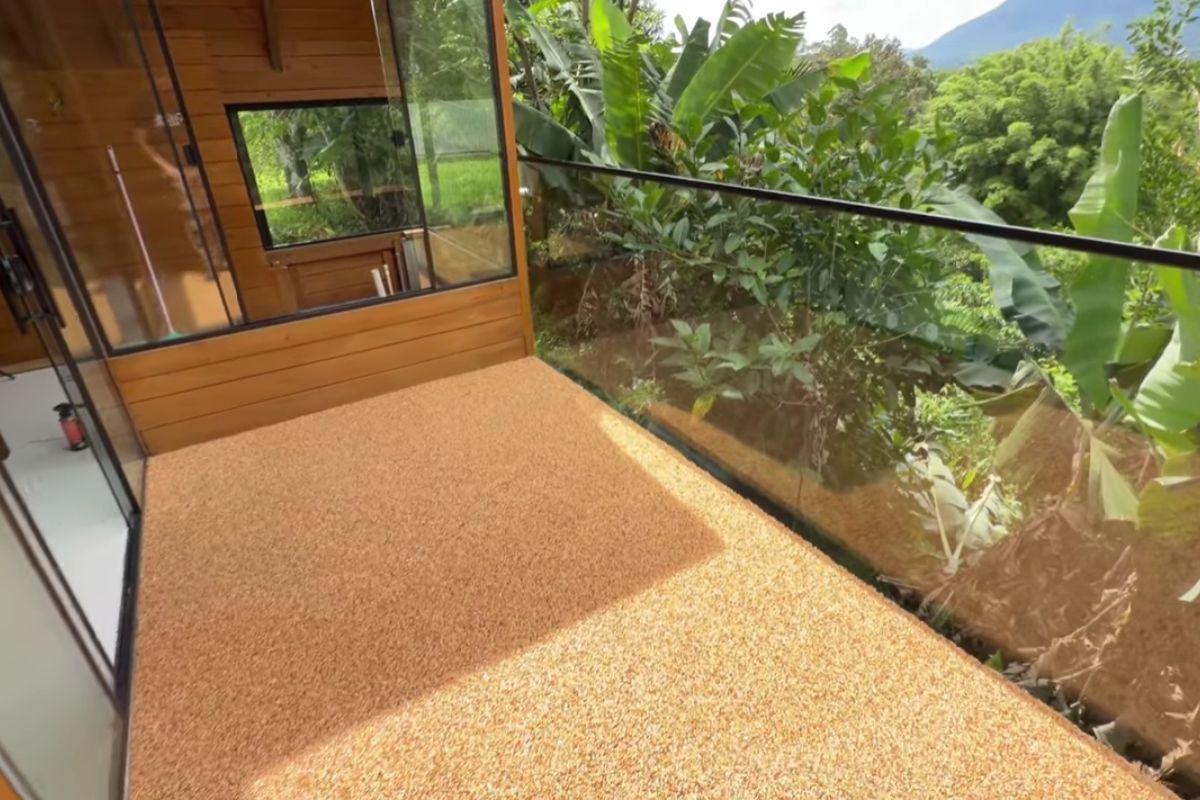
The Stone Flooring Applied Over Uneven Slab Drew Attention Because It Combined Drainage, Monolithic Finish, Simple Cleaning, and Natural Appearance, Seamless for Dirt, With a Layer of About 1 cm for People Circulation and Practical Tests Showing Quick Water Drainage Right After Application in the Outdoor Area.
The stone flooring shown for the outdoor area stood out less for its visual appeal and more for the technical aspects of the application. The base was a concrete slab, with unevenness and points of dirt accumulation, that received a drainage system, without grout, designed to drain water and keep the surface cleaner.
The execution sequence was straightforward and revealed why this finish has been drawing attention. There was heavy cleaning of the old floor, mixing of natural stone with resin, spreading in stages, constant compaction, and corner correction with a spatula. The final result combined strong aesthetics, quick drainage, and sufficient resistance for people walking on it.
The Cleaning of the Slab Determines Whether the Stone Flooring Will Adhere or Come Loose
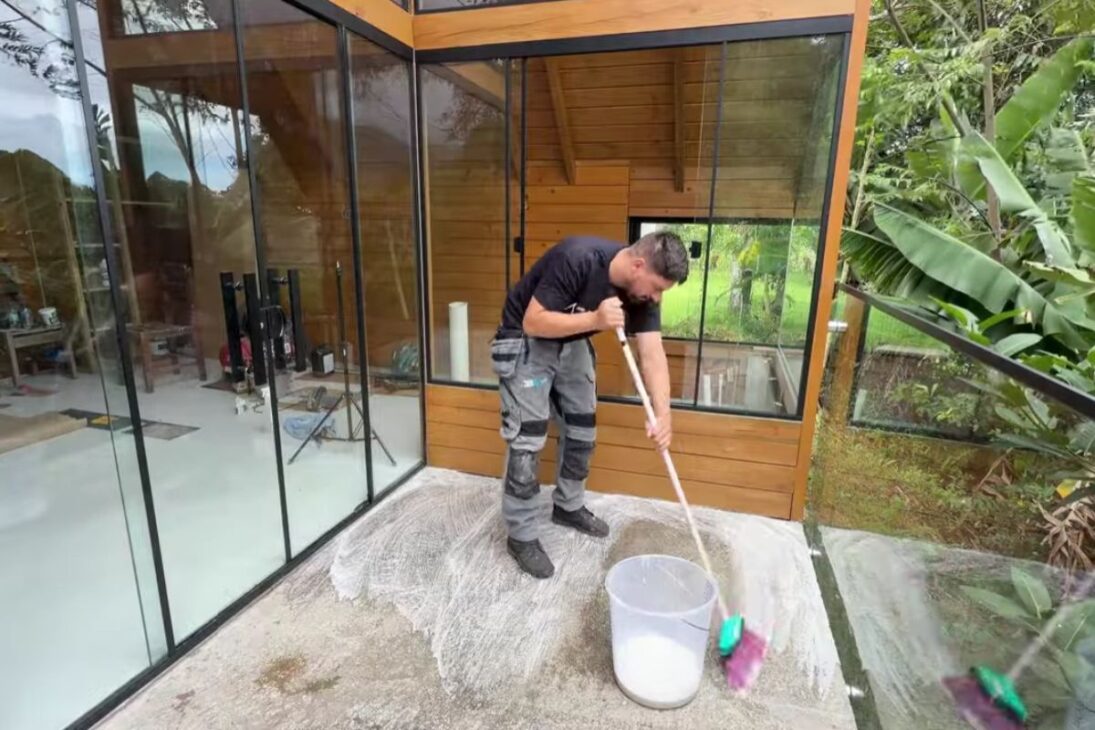
Before any application, the slab needed to be thoroughly cleaned. There was an accumulation of moss, standing water, and stubborn dirt, which made it unfeasible to place the stone flooring on top without prior preparation. The logic is simple: product applied over dirt does not adhere properly and tends to lose grip over time, especially in the outdoor area.
-
Giant Roman treasure found at the bottom of Lake Neuchâtel in Switzerland reveals an advanced trade system, circulation of goods, and armed escort in the Roman Empire about two thousand years ago.

-
He buried 1,200 old tires in the walls to build his own self-sufficient house in the mountains with glass bottles, rainwater, and an integrated greenhouse.
-
The aircraft carrier HMS Prince of Wales is heading to the Arctic with F-35 fighters, helicopters, and warships in an operation that repositions the United Kingdom at the forefront of NATO in 2026.

-
He found the largest gold shipwreck in the United States with tons of the precious metal at a depth of 2,400 meters in the Atlantic and recovered a treasure that no one thought possible to reach, but 500 gold coins disappeared without explanation.


For heavy cleaning, a dilution of one part cleaner to one part water was used. For maintenance, the suggested reference was much lighter, up to ten parts water for one part product. After sweeping, the floor was scrubbed and rinsed. The visual difference appeared quickly, and this step became central, because a clean slab completely changes the adherence of the system.
This preparation also helps explain why the final finish was uniform. Instead of trying to hide a contaminated floor, the application started with the base already ready to receive the resin and the stone. In stone flooring, the beautiful appearance depends more on adherence than on the shine of the material.
Since the proposal was a finish without grout, any adherence failure would be more exposed in the overall assembly. Therefore, cleaning was not just a detail of neatness. It served as the step that separates a firm finish from one that may start off beautiful but lose performance later.
The Mixture, Thickness, and Compaction Are What Really Shape the Finish
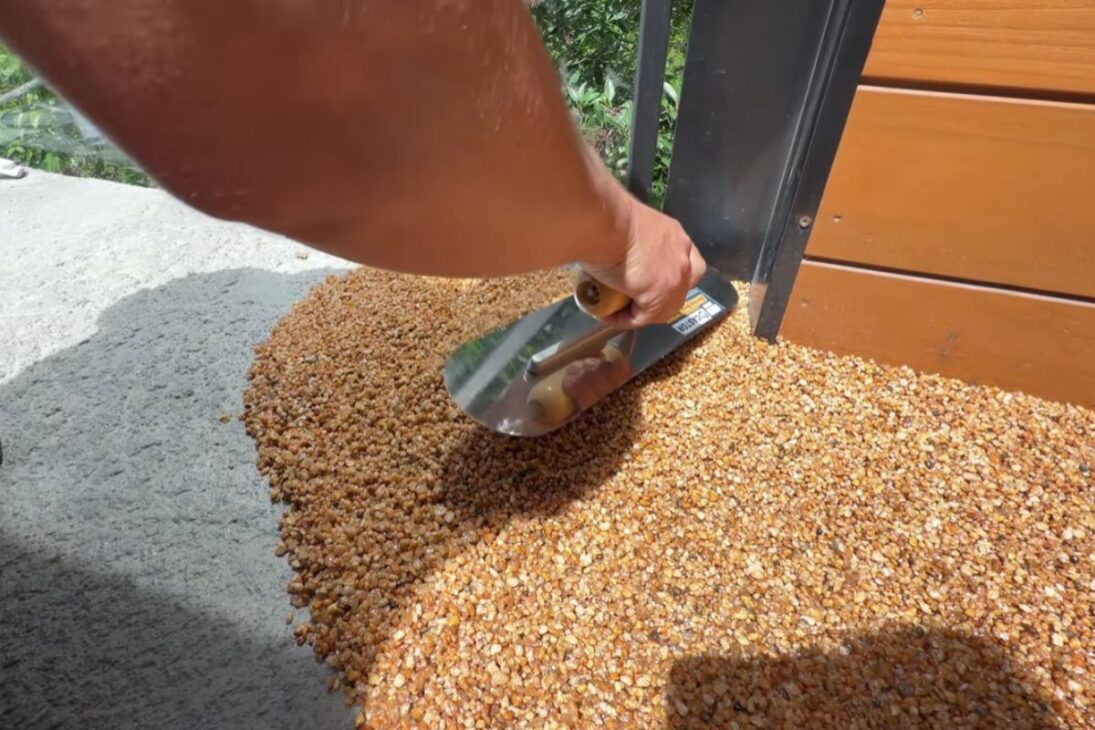
The mixture was made with natural stone and a fixing resin, using a concrete mixer, although using a bucket with a paint mixer or a rubber bucket was also suggested. The mentioned stone bag weighed 15 kg, and the proportion used for the fixer was 3% of that weight. After that, the mixture spun for about one to two minutes, until the resin fully enveloped the stones. This point is crucial because it defines uniformity and grip.
When applying, the guideline was to start at the corners and spread the material until completely covering the base. If the slab was visible, it was a clear sign of lack of product in that area. The reference thickness was approximately 1 cm for people circulation, always with the care of not leaving the layer too thin or too thick unnecessarily. In stone flooring, irregular thickness becomes a visual defect and can also lead to fragility.
Compaction was a mandatory step, not optional. First, the material was pushed into the right place. Then, compaction was done to align the surface and join one strip to another. In the final finish, the spatula needed to be laid down flat, pressing the layer to keep everything even. That’s why the importance of using a trowel with rounded edges was emphasized, avoiding marks on the stone.
This compaction also explains the perceived resistance afterward. The better the surface locking, the fewer small stones remain loose at the top. A good finish does not arise solely from the right mixture, but from the correct repetition of spreading, compacting, correcting, and leveling. This is what transformed an irregular slab into a visually cleaner plane.
The Drainage Behavior Without Grout Is What Differentiates This Stone Flooring
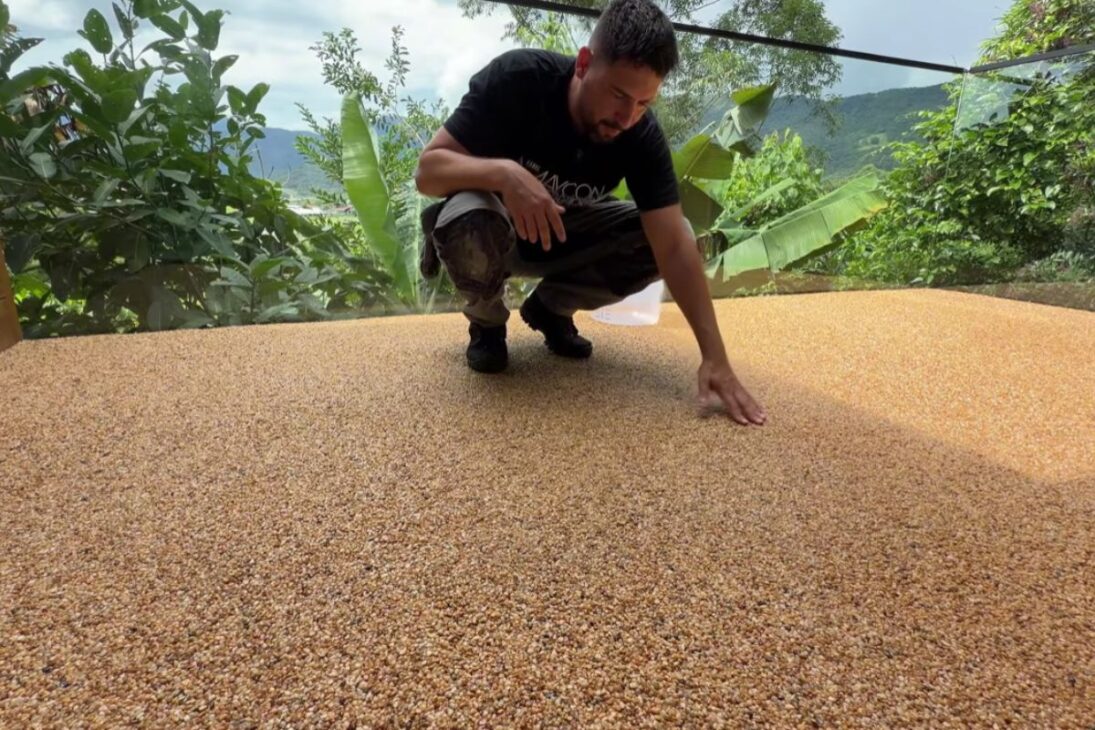
One of the system’s strongest points was the drenage behavior. The stone flooring was designed not to retain water on the surface, and this was evident in practice. The solution adopted on-site included drainage holes below the layer, protected with fiberglass mesh so that small stones would not fall into those voids. This is where the finish changes category, because it is not only about beauty, but about functional response to water.
The absence of grout also played an important role. Since the surface is monolithic, without joints to accumulate dirt, the assembly presents a more continuous and cleaner visual. At the same time, this absence of grout requires greater care in spreading and compacting since the finish depends on the regularity of the stone body with resin, not on corrections between separate panels or pieces.
In tests, the water disappeared rapidly. First, small amounts were poured, and the disappearance was almost immediate. Then, the test increased to approximately 10 liters, which vanished in less than 20 seconds. This does not mean that the water evaporates. It means that the drenage system finds an exit path through the base. For outdoor use, this is the kind of response that weighs much more than a simple visual effect.
It also became clear that the system depends on how the drainage was resolved underneath. Where there are holes, the water finds a direct exit. In other situations, such as sidewalks without perforation, the practical recommendation was to create slope or drainage cuts so that water does not accumulate. In other words, the finish is drenage, but the construction needs to provide it with a real exit route.
Where This Stone Flooring Works Best and Where It Needs Technical Limits
The example was executed in an outdoor area of a chalet, over a concrete slab, and the result was designed for people circulation. In this condition, the layer of about 1 cm was treated as sufficient, as long as the compaction was well done. For car traffic, requirements change: a thickness of 2 cm of stone was mentioned, structured with a mat. This shows that stone flooring is not the same for all uses.
This distinction is important because many people see a beautiful finish and already try to apply the same logic anywhere. In the presented case, the work was small, the sun did not hit directly during execution, giving more working time. In a larger outdoor area, with more heat or different load demands, the material’s behavior may require a different pace, more people to help, and greater control over thickness.
In the first few days, some higher stones may still come loose. This was shown directly. It’s not a general loss of the finish, but a point detachment from what was left up and was not compacted as it should have been. The correction was also presented as simple, with localized reinforcement of stone and resin. The system was not treated as perfect, and this helps the technical reading of it.
In maintenance, the finish showed another advantage. Cleaning can be done with a broom, water, and even a pressure washer, since the surface does not hold water and does not rely on grout to maintain its appearance. For those seeking outdoor area with frequent use, this point is significant because it reduces dirt accumulation and simplifies the routine care of the stone flooring.
The stone flooring tested over the slab delivered a challenging combination to ignore in an outdoor area: strong visual, grout-free finish, quick drenage response, and sufficient resistance for people circulation. What most draws attention is not just the appearance but the combination of correct preparation, well-executed compaction, and functional drainage underneath.
In your opinion, is this stone flooring really the best option for outdoor areas or does it still fall short compared to more traditional options when heavy use is required?







Seja o primeiro a reagir!