





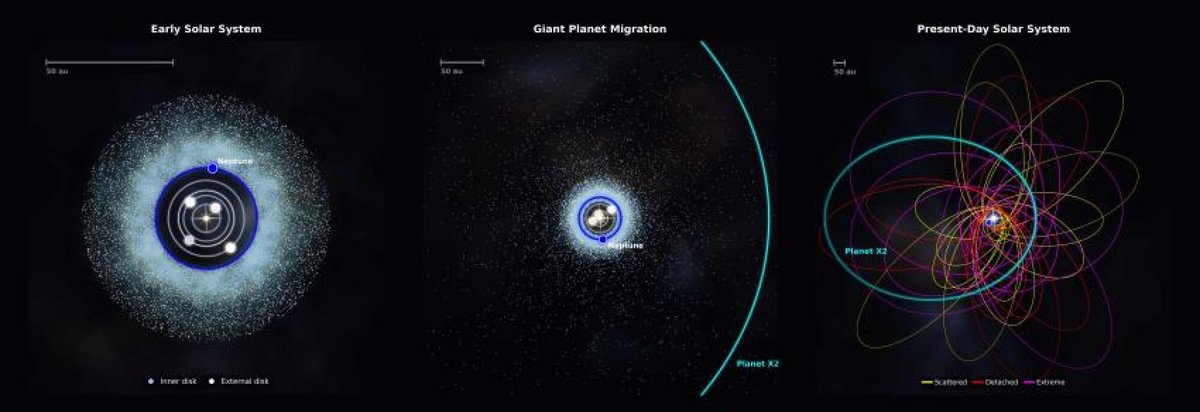
Astronomer Patryk Sofia Lykawka and two colleagues say a hidden world of about 1.5 to 2 Earth masses, which they call Planet X2, could explain the strange orbits of icy objects far beyond Neptune, in a study published on November 23.
The planet has not been seen. It exists, for now, only inside computer simulations that ran through 4.5 billion years of the Solar System’s history, and the researchers say so openly.
What the simulations show is that a body of that size, on a wide and stretched orbit, would push and tilt distant icy objects in ways that the eight known planets struggle to explain.
A planet nicknamed PX2, published on November 23
The work appeared in the Monthly Notices of the Royal Astronomical Society under the title “Signatures of an Earth-class Planet in the Distant Solar System”, according to the University of Southern Queensland (UniSQ), which announced it the same day.
-
Borr Drilling Faces Total Loss and Multi-Million Dollar Setback After Prospector 5 Sinks Off Gabon, Investigation Continues

-
Passing Paraná’s Road Test: 1,776 New Drivers Stuck Without Temporary License Due to Missing Toxicology Test Requirement
-
Brazilian Navy Launches $197,000 International Tender for Riachuelo-class Submarine Equipment
-
Brazil’s Federal Revenue Service rejects 280,800 applications to join Simples Nacional for 2027, approves 376,500 others and explains what small businesses can do after denial

Lykawka is an adjunct associate professor at UniSQ and is based at Kindai University in Japan. He is also linked to the National Astronomical Observatory of Japan.
His co-authors are Pedro Bernardinelli, an assistant professor at the University of Washington and the University of São Paulo, and Jonti Horner, a professor at UniSQ.
“Imagine discovering, after decades of mapping our Solar System, that another planet has been hiding from us all this time,” Lykawka said in the university’s statement.
Up to twice the mass of Earth, at least 200 times farther out
The proposed planet would have about 1.5 to 2 times the mass of Earth, which puts it in the same weight class as our own world rather than among the giants.
Its orbit would be elliptical, with a semi-major axis, a measure of the size of the orbit, of around 350 to 500 astronomical units. One astronomical unit is the average distance between Earth and the Sun.
Even at its closest approach, the model keeps PX2 at least 200 astronomical units from the Sun.
Icy objects that do not follow Neptune’s rules
Beyond Neptune lies a crowded region of icy bodies called trans-Neptunian objects. Most of them belong to the Edgeworth-Kuiper Belt and move in a broad disk between 38 and 50 times the Earth-Sun distance.
Over the past two decades, astronomers have found a growing group of more distant objects on unusually tilted or elongated orbits. Their paths are hard to explain with the pull of the known planets alone.
One of the most intriguing is Sedna, whose highly elongated orbit carries it far beyond the region where the known planets move, the university noted.
4.5 billion years of gravity run on a computer
To test the idea, the team simulated the whole 4.5 billion years of the Solar System’s evolution and asked whether one extra distant planet could shape the outer region the way we see it today.
In the simulations, the gravity of PX2 separated some icy objects from Neptune’s influence and tilted others to unexpectedly high angles, the two effects that have puzzled observers.
“Our model reproduces several of the unusual orbital patterns observed among distant icy objects, although there are still differences between the model and observations that we need to investigate further,” Lykawka said.
Not the same as Planet Nine
The proposal is different from the better-known Planet Nine hypothesis. That idea points to a substantially more massive world as the cause of some of the odd orbits beyond Neptune.
PX2 is smaller, Earth-class, and the authors present it as a broader explanation for the dynamics of the whole trans-Neptunian region, not only for a handful of extreme objects.
The search began with Percival Lowell and ended with Pluto in 1930
The hunt for an unseen planet out there is old. Percival Lowell’s search for a theoretical Planet X helped lead to the discovery of Pluto in 1930.
Later evidence showed that Pluto was far too small to cause the movements that had started the search. The Planet X idea came back in recent years to explain features of the Kuiper Belt, and PX2 builds on that core idea.
Rubin Observatory could put the idea to the test
The researchers point to the Vera C. Rubin Observatory and its Legacy Survey of Space and Time as the tool that can check their predictions as it scans the sky.
“The exciting thing is that we now have an opportunity to put this idea to the test,” Horner said. “As the Rubin Observatory surveys the sky, we will find new clues that help us understand the distant reaches of the Solar System.”
Rubin is already turning up distant bodies. Its data recently revealed a possible dwarf planet up to 1,500 km wide beyond Pluto that had hidden among millions of stars for more than 10 years.
What the study does not say
The paper does not give a position in the sky where PX2 should be, and nobody has photographed it. The orbit size of 350 to 500 units is a modelled value, not a measured distance to a real object.
That is why the team calls the planet hypothetical. If it exists, Lykawka said, “it could change how we understand the history of our Solar System and how its most distant objects came to follow such unusual orbits.”
The full statement is on the University of Southern Queensland news site.
If Rubin finds an Earth-sized planet hiding 200 times farther out than us, should the Solar System officially count nine planets again?


