





 Portuguese
  English
  Spanish
  7 min of reading
  5 comments


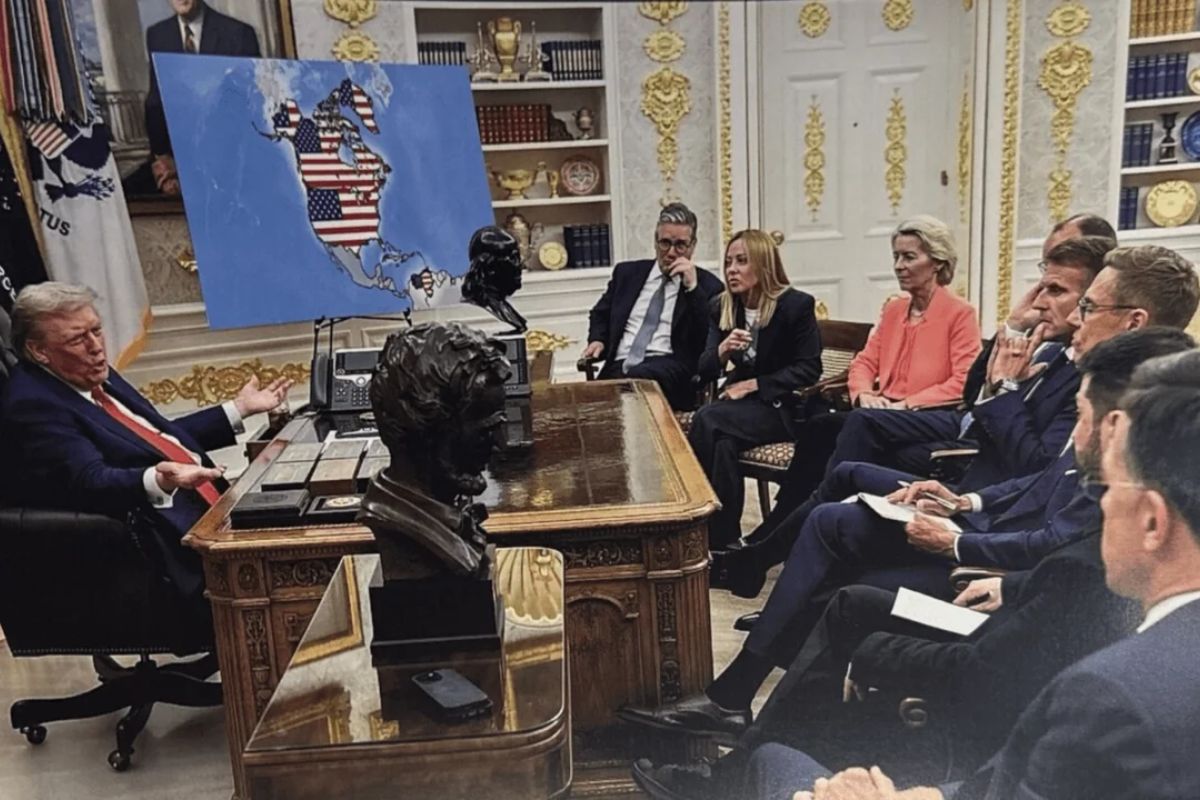


In The Midst Of An International Perception Of Weakening, The 2027 Plan Consolidates A Strategic Turn For The US That Abandons The Classic Logic Of Territorial Occupation And Invests In The Silent Capture Of The Gears That Sustain Economies, Governments And Critical Infrastructure Worldwide
In early 2026, the US operates simultaneously on two levels. On the symbolic level, it faces headlines about political polarization, record public debt, and dollar erosion. On the operational level, it executes structural adjustments that have been underway for at least a year and that converge towards a new model of global power. The 2027 Plan emerges as a synthesis of this transition, described not as a collapse, but as a phase shift.
The central reading is that the American empire is not being dismantled, but reconfigured. Instead of troops, contracts. Instead of borders, standards. Instead of flags, systemic dependence. The fourth empire does not seek to annex territories, but to become indispensable to the functioning of the next century.
The Genealogy Of American Power And The Logic Of Phase Change
The history of the US is presented as a sequence of imperial reincarnations. The first empire, from the 19th century until around 1890, was territorial and continental. Uncontrolled urban expansion, the logic of manifest destiny, the purchase of Louisiana, and the displacement of Indigenous nations composed a model in which land equated to power. With the closing of the Pacific frontier, this equation ran its course.
-
“No one will make us change the Pix,” says Lula after the US report.

-
Lula responds directly to Trump and says that Pix is from Brazil and will not change under pressure from anyone, after a report from the United States pointed out the Brazilian payment system as an American trade barrier.

-
Amazon has just announced a new fee on all deliveries, and your online purchases will become more expensive starting April 17, including for those buying from the United States here in Brazil.

-
He sold his share for R$ 4 thousand, saw the company become a giant worth R$ 19 trillion, and missed the opportunity of a lifetime.


The second empire, from 1898 to 1945, was born after the Spanish-American War. The strategy shifted from prioritizing annexations to seeking ports, maritime routes, and commercial access. Power was projected through a deep-water navy and control of shipping lines. The equation changed: access became more valuable than territory.
The third empire, from 1945 to the recent present, was structured around standards. The Bretton Woods system, NATO, and, above all, the dollar created a liberal international order in which American rules became the operational standard of the planet. Standards equated to power. Now, this arrangement shows signs of fatigue.
The 2027 Plan emerges as a response to this fatigue. The logic is not to deny the erosion of the previous model, but to replace it with something more efficient. The analogy used is biological: when a rigid structure can no longer accommodate the organism, it is discarded to make way for a larger and more adapted form.
Diminishing Returns, Debt And The Cost Of Being Hegemon
The economic mechanism underlying the 2027 Plan starts from a classic diagnosis: diminishing returns. For approximately 80 years, the US has benefited from the “global buffet” of the post-war period. By the early 2020s, the cost of maintaining this position began to outweigh the benefits.
In 2026, the US national debt is estimated at US$ 38.45 trillion. Interest payments consume about 19% of federal spending, becoming the fastest-growing expense. The country spends more to finance the past than to build the future.
On the domestic front, political polarization adds risk. In 2026, 43% of American CEOs cite internal uncertainty as their main economic concern, surpassing external factors. A fractured state projects less power, especially when it cannot resolve budgets, borders, or basic consensuses.
This set of challenges forces a strategic choice. Instead of trying to indefinitely sustain a fraying globalized model, the 2027 Plan opts for a selective withdrawal and a redesign of the foundations of power.
The Dollar In Retreat And The Global Chain Reaction
For decades, the dollar has served as the universal language of trade and finance. In 2000, it accounted for around 71% of global foreign exchange reserves. By early 2025, this number had fallen to 58.4%. In 2026, drops below 47% are observed in some categories of official reserves.
The explanation offered is not just economic, but geopolitical. The use of the dollar-based financial system as a sanctioning instrument, especially in 2022, raised the risk of counterparty. Countries began to question whether they truly control their own resources when the financial infrastructure is operated by third parties.
In this environment, BRICS is advancing. With the entry of economies like Saudi Arabia and the United Arab Emirates, the bloc moves beyond rhetoric and begins constructing the BRICS Bridge, a blockchain payment system in pilot testing, with the ambition of facilitating up to 85% of cross-border trade in local currencies.
The growth numbers reinforce the trend. In 2026, average growth of 1.1% is projected for the G7, compared to 3.7% for BRICS and associated economies. In purchasing power parity, BRICS reaches 41% of global economic activity, while G7 falls to 28.4%.
Universal Tariffs And The Construction Of The Economic Fortress

The response of the 2027 Plan to the dollar’s weakening is not to try to restore the past but to build an economic fortress. Between 2025 and early 2026, the US implements a universal base tariff of 10% to 20% on nearly all imports.
The logic is twofold. First, to force industrial relocation. A recurring example compares a factory in the US, costing US$ 100, to a foreign factory costing US$ 85. With a 20% tariff, the imported product begins to cost US$ 102, reversing the economic decision. Second, to raise revenue.
By the end of 2025, the projection is around US$ 264 billion per year in tariff revenue. This amount is equivalent to the GDP of several medium-sized countries and fuels the war chest of the American fortress.
Critical Minerals As A Geoeconomic Weapon
No technological fortress operates without inputs. The 2027 Plan treats cobalt, lithium, and neodymium as “vitamins of the modern world.” On January 15, 2026, an executive order adjusts the imports of processed critical minerals and imposes a 180-day deadline, until July 2026, for aligning partners.
The strategy is akin to a NATO for minerals. Reliable allies receive privileged access to the American market. Others are excluded. Greenland stands out not only as a strategic position but also for housing the Tanbreez mine, touted as one of the largest rare earth deposits on the planet.
Venezuela appears on the same board. The fall of the regime in January 2026 is associated with the intent to stabilize the country and unlock the largest oil reserves in the world, along with coltan and gold. Iran, mired in internal instability, emerges as another potential point of forced resource flow reorientation.
Secondary Sanctions And The Technology Toll
If the dollar ceases to be universal, the 2027 Plan bets on making the American technology stack universal. Chips, AI models, cloud, applications, and infrastructure become tolls. Those who want access to the most advanced technologies must accept the rules.
Intel emerges as a symbol of this change, with 9.9% of its foundry in the hands of the US government. The goal is not to nationalize the company but to ensure that the world’s most critical hardware operates according to national security priorities.
This logic extends to the cloud. Data centers are treated as national security projects, with expedited licensing and construction on federal land. When tax records, power grids, and hospitals depend on externally controlled infrastructure, sovereignty becomes a technical variable.
AI, Energy Crisis And The Return To Nuclear
The expansion of AI exposes an energy bottleneck. A single query in advanced systems consumes about ten times more electricity than a traditional search. In January 2026, the American power grid faces clear limits.
The response of the 2027 Plan is nuclear. The Department of Energy grants US$ 800 million in subsidies for small modular reactors, SMRs, described as nuclear batteries manufactured in factories. Companies like Alphabet and Meta sign agreements to purchase this energy directly, powering data centers with dedicated power plants isolated from the grid.
Space, The Moon, And The Militarization Of Volume
Space dominance completes the design. The strategy is not punctual, but volumetric. In 2019, there were 26 launches. In 2024, 134. In 2025, about 165, one every two days. This represents approximately 85% of American launches and more than the rest of the world combined.
The Space Force structures civil reserves that can be converted into military assets. In 2025, the Golden Dome is launched, a space defense layer with hundreds of satellites and interceptors, capable of neutralizing missiles still in the boost phase.
On the Moon, the Artemis 2 mission, scheduled for February 2026, marks human return after more than half a century. The objective goes beyond scientific exploration: to establish norms, zones of operation, and access to polar ice. The lunar market is estimated at US$ 19 billion by 2030, with direct impacts on mining and space logistics.
State Capitalism And Resilience As Value
The 2027 Plan openly assumes a hybrid model. The free market gives way to industrial policy. The State accepts to pay more for products manufactured within the fortress in exchange for resilience. Efficiency is no longer the sole criterion; security carries a premium.
This logic brings the government and Silicon Valley closer, blurring institutional boundaries. Companies receive billions in resources but accept strategic countermeasures, including priority state access in emergencies.
Decline, Reboot Or Strategic Invisibility
The final question is not whether the US will survive, but whether the third empire needs to disappear for the fourth to consolidate. The history of Rome suggests that empires rarely fall all at once. They transform, change shape, and symbolic capital.
The 2027 Plan bets that the perception of decline is, in fact, the noise of a machine shifting gears. Irrelevance would be the true collapse. The American strategy attempts to prevent this by becoming the invisible infrastructure of the future.
In your view, does the US 2027 Plan represent a smart strategic withdrawal or merely postpone an inevitable decline?









Com certeza os EUA agora estão no caminho certo e com o presidente certo. O Brasil não tem escolha e vai continuar a ser quintal. O lado bom é que será quintal da maior e mais pujante democracia no mundo! Infinitamente melhor que ser escravo de uma **** comunista onde seríamos apenas números. Sei que muitos não concordam pois sofreram décadas de lavagem cerebral patrocinadas pela esquerda mas, se conhecessem a China pessoalmente e pensassem com a própria cabeça entenderiam. Liberdade e respeito às pessoas igual nos EUA não existe em nenhum lugar do mundo.
Fundamentada. Mas destinada ao fracasso, tão só esperando. China se ergueu fazendo isso. Em todas essas áreas o potencial Chinês é maior. Tchau império
E interessante se armar im jogo como se o adversário jfosse estático. A questão se resume no seguinte: A diferença de custo da produção onde a virtude do pobre sobre o rico é saber viver de escassez. A diferença de custo da produção cria a mais valia e no caso da China essa diferença vai para o Estado que aplica em ciências e tecnologias. O império romano caiu pois a tecnologia romana produzia comida e os bárbaros invadiram para comer. A invasão ao império dos EUA se dá ao inverso com a absorção da tecnologia em prazo curto.
Seria mais inteligente se não tivesse no comando o Trump (c/seu ego e psicoses), com sua “visão de cone”, e considerasse a universalidade e o bem comum planetário.