





 Portuguese
  English
  Spanish
  6 min of reading
  2 comments


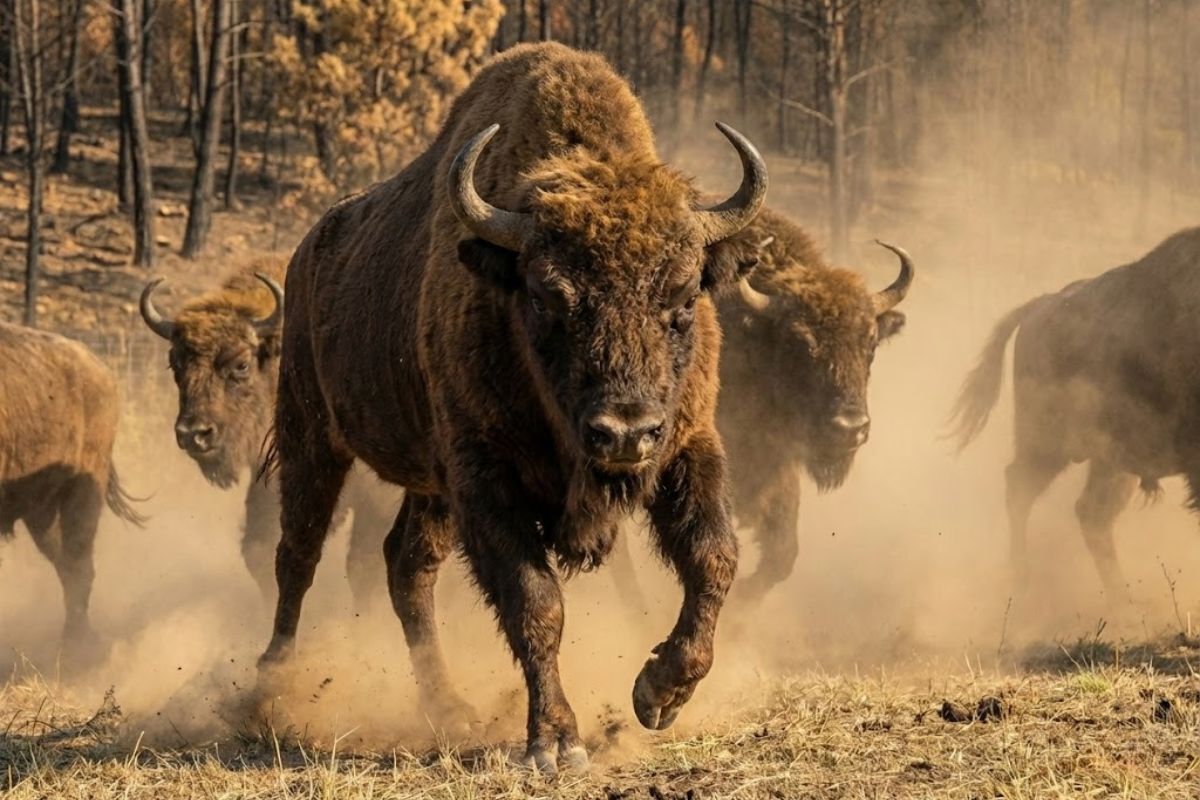


In Southern Spain, European Bison Brought From Poland Have Been Released Into A Private Sanctuary Of 2,500 Acres, After A Journey Of 1,870 Miles, In An Unprecedented Reintroduction That Tests Adaptation To Heat, Diet, And Interaction With Other Species, While The Country Seeks To Reduce Fires, Desertification, And Biodiversity Loss Right Now
European bison, the heaviest land animal still roaming Europe, have become the center of a risky plan in Spain: using a large herbivore as an ecological tool in a territory that faces fires, droughts, and soil degradation. Adult males can reach about 5.9 feet at the hump and weigh over 1,760 pounds, a size that changes the landscape when these animals pass through.
The Spanish bet is not improvised. Eighteen European bison were transported by truck for about 1,870 miles and released on private land in Andalusia, in an area of approximately 2,500 acres that already hosts other rare species. The goal is to observe, with metrics and tracking, whether they can adapt to the local climate and if the ecological effect outweighs the risks.
Why Spain Decided to Bring European Bison Now

The experiment arises from a combination of environmental pressure and human gaps.
-
The first nuclear submarine in Latin America is being built in Brazil, but the Navy warns that without an additional one billion reais, the project may halt, and the delivery forecast, which was 2029, has already been pushed to 2037 due to a lack of funds.

-
The most expensive appliance in your home is not in the kitchen or the bathroom, it runs 24 hours a day to cool a few items and can cost more per month than the value of everything it stores, while a single replacement eliminates the consumption equivalent to a shower running for 30 minutes daily.

-
Beneath 25 km of ice, a moon of Jupiter hides an ocean with more water than all the seas on Earth and may have the necessary conditions to support life, according to studies supported by NASA.

-
The appliance that should cool your home may be driving up your electricity bill when installed with the wrong power, forcing the device to work harder and consume much more than necessary.


Spain deals with wildfires, droughts, water depletion, resource degradation, and desertification, and the rural landscape has changed: fewer and fewer people are interested in agriculture, which means fewer sheep and fewer animals to consume brush and highly flammable vegetation.
Within this scenario, the idea is simple and brutally pragmatic: if human maintenance fails, a large herbivore can do the work continuously.
European bison trample, open trails, eat shoots and leaves, and reduce plant mass in areas where the accumulation of plant fuel favors fires.
What Makes the “Risky” Project Truly Risky

Introducing European bison into a new territory is not something immediate.
First comes preparation, followed by a long observation phase to answer basic questions: can the animals withstand the heat, can they feed well, do they form groups, avoid conflicts, and fit into the local dynamics without causing unwanted impacts.
There is also an institutional risk: despite the enthusiasm, Spain does not fund this type of initiative, and the reintroduction itself carries a legal obstacle.
It is illegal to release European bison into the wild in the country, so centers and sanctuaries depend on donations, volunteers, and private or enclosed areas, with a legal custodian for the animals.
How European Bison Are Being Monitored In Andalusia

The control routine has been set up to reduce speculation.
GPS location devices have been installed on some females, and camera traps have been distributed at strategic points to map movement, habits, and interactions.
Monitoring also includes drones to observe the effect on the landscape and an essential biological component: fecal samples collected monthly.
This data allows for comparing the diet of European bison with that of red deer and other local residents, checking how much woody vegetation, shoots, and leaves are being consumed over time.
What Has Emerged In The First Results Of The Experiment
Monitoring indicated consistent signs of adaptation: European bison handled the heat well, fed well, and, after some time, formed groups.
The symbolic milestone came with the birth of the first member of the new generation, an important point because descendants raised there are likely to be better adjusted to local conditions.
The case in Andalusia is just one piece of a larger puzzle.
There are 18 breeding centers for European bison, and the last decade has seen a significant increase in the number of animals in these facilities, from 22 to 150, with a trend of growth.
The Ecological Role Of European Bison As A Keystone Species
The bet is not just aesthetic or nostalgic.
European bison are regarded as a keystone species because they alter the functioning of the environment as they live.
They help establish and preserve open spaces such as meadows and pastures, creating mosaics of open areas and wooded patches that favor diverse habitats.
This transformation occurs in various ways. European bison consume grass and shrubs, bark trees, traverse dense vegetation, and create patches of exposed soil.
With more light entering, more grass grows, and the overall landscape becomes less uniform, opening space for other organisms to establish themselves.
“Natural Firefighters” And What They Really Eat
The fire argument goes through the menu.
Experts point out that European bison can consume approximately 66 pounds of vegetation per day, with about 30% of woody fiber and 70% of shoots and leaves.
This pattern matters because part of what they prefer to consume is precisely what tends to become fuel in dry seasons.
The practical example mentioned in another European context highlights the economic dimension of the effect: when seven bison were released in an area of 49 acres of oak forest in 2010, the removal of understory vegetation was estimated to have saved around US$ 72,000, an amount that would have been spent paying people to do the same task.
When The Bison Disturbs The Ground, Water And Life Follow
The impacts are not limited to vegetation. European bison enjoy rolling in sandy areas and exposed soil.
Due to their weight, the activity keeps patches open for longer and contributes to visible, albeit gradual, changes.
They also create depressions in the ground.
Over time, these holes can fill with rainwater, becoming places for frogs to lay eggs and water sources for other species during tougher times.
In cold environments, open trails can even help smaller animals find food by clearing snow.
The Invisible Effect Of Manure And Why This Counts
A less glamorous part of the project is the more biological aspect.
A few days after the group’s arrival in Spain, dung beetles were attracted to the manure.
There is an ecological reason for this: coprophagous beetles help decompose waste and recycle nutrients, sustaining the balance of the ecosystem.
The data cited by the researchers is straightforward: 20% of Mediterranean coprophagous beetle species are endangered, partly because livestock feces may be contaminated with medications.
In contrast, the manure from European bison has been described as free of these harmful substances, containing nutrients that feed the decomposition chain.
And there is a cascading effect: more larvae attract more birds that use these spots as food sources.
The Return Of The European Bison And The Memory Of Its Near Extinction
The Spanish experiment also carries the memory of a recent collapse on a historical scale.
The last wild European bison was hunted in Poland in 1919 and in Russia in 1927.
The species only survived because 54 individuals remained in captivity, a number that proved sufficient for a slow recovery.
Since the 1950s, reintroduction efforts have gained momentum, and today the numbers exceed 10,000 worldwide.
Nevertheless, the discussion around Spain is sensitive: there are scientists who claim that European bison never existed in the country, although archaeological finds and cave paintings are cited as evidence.
The explanation given is that these remains could belong to the steppe bison, a species that disappeared from the peninsula about 12,000 years ago, leaving a gap too long to be ignored.
The Bet Against Fires And Desertification In A Warmer And Drier Country
The plan for the European bison fits into a harsh diagnosis. Since 2011, the number of wildfires in Spain has reportedly increased by 20%.
Warming and reduced rainfall serve as a backdrop, and there is a projection that droughts could become 10 times worse than they are today, amplifying shortages, including of drinking water, and raising social and environmental costs.
In this scenario, the promise of the project is to reduce plant fuel, open clearings, diversify habitat, and push nutrients through the soil with efficiency that does not rely on permanent human teams.
At the same time, the risk is real: it is a reintroduction under challenging climatic conditions, relying on private areas, with legal barriers and dependence on continuous monitoring.
Would you bet on European bison as part of the fire and desertification plan, or do you see more risk than solution in this type of experiment? Share your thoughts on the case and what would make a difference in trusting this model.







Saludos, que traigan bisontes y tengan que hacer seguimiento para ver si se hadactan habiendo otros animales aquí como **** que se podían dejar en libertad, no sería mejor
Se o projeto Bisão não der certo, é só abater os indivíduos e apostar num novo projeto, se existe o monitoramento tem tudo para dar certo, parabéns pela Idéia e viva a Espanha por tentar melhorar o seu Meio Ambiente 🤠🌿🇧🇷💖🙏👏