





 English
  Francês
  Alemão
  Italiano
  Japonês
  Norueguês
  Portuguese
  Spanish
  5 min of reading
  0 comments


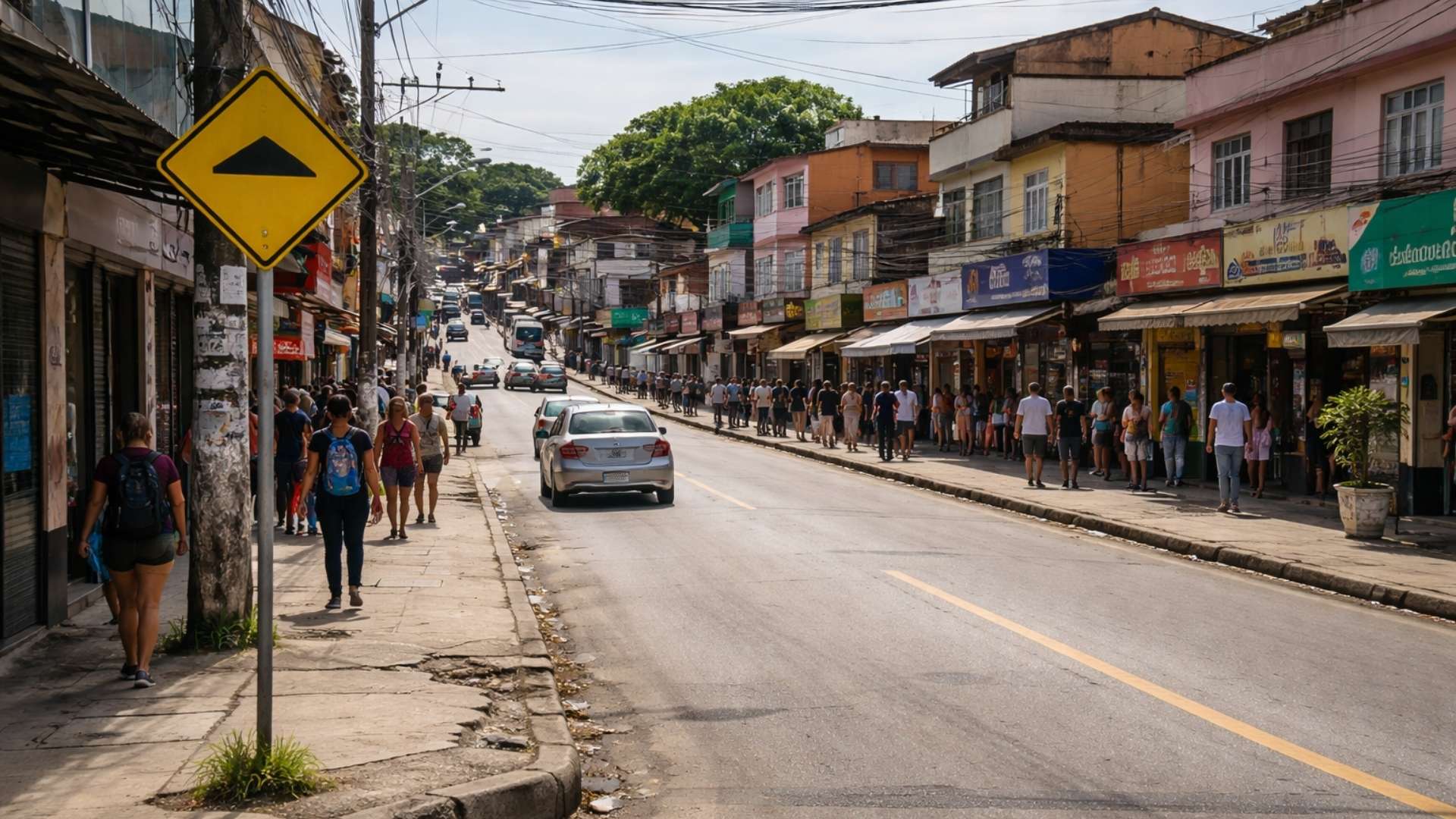
Municipality of Baixada Fluminense appears isolated in the most critical range of the national index and concentrates more than half a million residents in a scenario of low performance in health, education, and income, according to a recent survey that compares official data across the country.
Belford Roxo ranked last in the state of Rio de Janeiro in the Firjan Municipal Development Index and also ranked among the 500 worst results in the country.
With 0.3868 points, the municipality was the only one in the state classified in the critical development range, a condition reserved for indicators below 0.4.
IFDM Ranking exposes critical position in Rio
The result draws attention not only for its position in the ranking but also for the size of the city.
-
Couple buys house in the South Zone of São Paulo, opens a hidden door in the garage, and finds a secret wine cellar with dozens of old wines forgotten since the 1970s.

-
With 19,000 tons, 199 meters in length, and the capacity to carry 720 marines, the ROKS Marado has become a floating amphibious base that extends South Korea’s naval reach in one of the most tense regions on the planet.

-
The United States has unveiled the MQ-25 Stingray, the world’s first carrier-based tanker drone designed to operate on aircraft carriers and extend the range of naval fighters.

-
A cheap Brazilian invention promises to change the fate of patients in ICUs by accelerating muscle recovery even in critical condition.

Belford Roxo had 483,087 residents in the 2022 Census, a population density of 6,116.19 inhabitants per square kilometer, and an estimated 518,384 inhabitants in 2025, according to IBGE.
In Firjan’s special analysis for Rio, the municipality is identified as the sixth largest in the state, which increases the social weight of the performance recorded in the survey.
The most recent edition of the IFDM examined 5,550 Brazilian municipalities based on official public statistics and maintained three central axes in the composition of the score: Employment & Income, Health, and Education.
According to the methodology, scores between 0 and 0.4 indicate critical development; from 0.4 to 0.6, low development; from 0.6 to 0.8, moderate; and above that, high.
In this framework, Belford Roxo fell below the minimum threshold for transition to the next range.
Decline in performance over the decade


More than just remaining at the bottom of the state table, the city has also worsened compared to the beginning of the series compared in the state study.
The overall score dropped from 0.3940 in 2013 to 0.3868 in 2023, a negative variation of 1.8%.
In the same interval, the other two municipalities in Rio that were in critical condition in 2013 moved out of that range and advanced to low development level.
Belford Roxo was the only one that remained stagnant at the most severe level.
Health pulls the worst result of the municipality
The breakdown by area helps to locate the size of the problem.
In Employment & Income, the municipality fell from 0.4865 to 0.4539, remaining in low development and accumulating a drop of 6.7% compared to 2013.
In Education, there was an improvement from 0.3374 to 0.4326, enough to move the indicator out of the critical range, but not enough to take it beyond the low level.
It was in Health that the result weighed the most: the score fell from 0.3580 to 0.2740, a retraction of 23.5%, keeping the municipality in the critical range also in this axis.
This performance in health helps explain why the city ended up isolated in the last position in the state.
The Firjan report highlights that Belford Roxo was, alongside Duas Barras, one of the cases where there was simultaneous worsening in Employment & Income and Health throughout the observed series.
Even though education has improved, the gain did not compensate for the losses in the other two fronts, especially in the area that measures conditions more directly associated with basic care and health outcomes.
Baixada Fluminense has the worst average in the state
In the regional analysis, the picture is also unfavorable.
The Baixada Fluminense recorded an average IFDM of 0.5316, a performance 14.6% lower than the average of municipalities in the state of Rio.
According to Firjan, all regional aspects fell below the state standard: Education scored 0.4854, Health was 0.5189, and Employment & Income was 0.5904.
The study points out that this was the worst average result among the fluminense regions.
Within Baixada, the contrast is evident.
Itaguaí had the best regional result, with 0.6705, the only municipality in the region classified with moderate development and placed in the 25th state position and 1,851st national position.
At the other end, Belford Roxo appears as the regional and state lantern, failing to achieve moderate development in any of the three evaluated areas.
The distance between the two cases summarizes the internal heterogeneity of the same metropolitan region.
Isolation in the state scenario of Rio
The snapshot of the state reinforces the isolation of the case of Belford Roxo.
In Rio de Janeiro, 63% of municipalities were in the moderate development range, 35.9% in low development, and only 1.1% in critical condition.
This only critical case was precisely Belford Roxo.
Firjan also observed that Rio was, in that context, the only state in the Southeast without any city in high development, but still, most fluminense municipalities managed to remain above the critical zone.
Direct impact on more than 500 thousand residents
From a population perspective, the situation gains another scale.
Firjan estimates that more than 518 thousand inhabitants live in critical development conditions in the municipality.
It is therefore not a statistical distortion in a small city, but a negative signal concentrated in one of the largest urban contingents in the state, situated in a densely populated area and strongly connected to metropolitan flows of work, transport, and services.
The ranking also undermines the reading that proximity to the capital, urban density, or territorial integration would be sufficient, by themselves, to push social indicators.
Belford Roxo continues to lack moderate performance in Education, Health, or Employment & Income, even being in one of the most populous areas of the metropolitan surroundings of Rio.
The most striking data is not only the position at the bottom of the list but the persistence of the city as a negative exception on the fluminense map.
By standardizing the reading of health, education, and labor market based on official data, the IFDM does not exhaust the complexity of a municipality but offers a comparable portrait of what has advanced and what has regressed over time.
In the case of Belford Roxo, the historical series shows that there was improvement in education, but insufficient to compensate for the deterioration in health and the loss in employment and income.
The final result reflects a development crisis that has ceased to be merely regional and has objectively occupied the center of the state debate.





Seja o primeiro a reagir!