





 Portuguese
  English
  Spanish
  7 min of reading
  1 comment


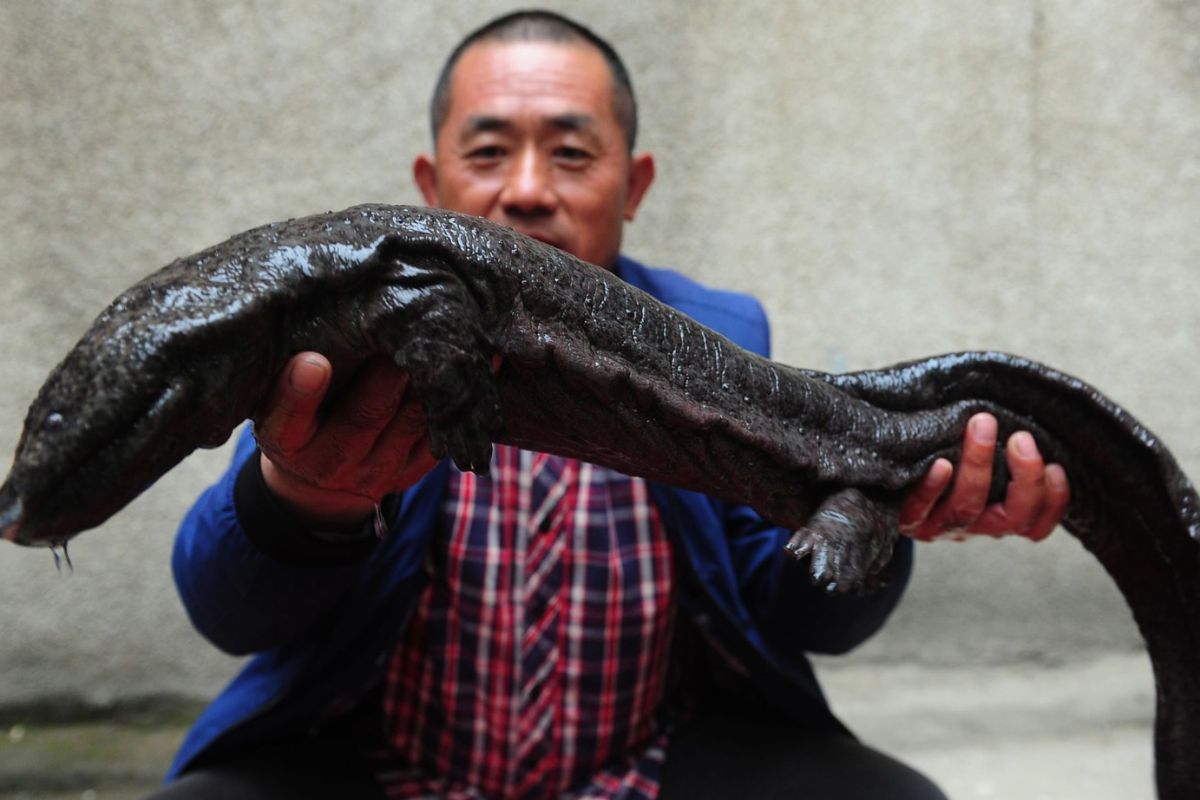

Mass Production Of Giant Salamanders In China Supplies Consumption And Traditional Medicine, But Mixes Similar Species, Generates Hybrids And Encourages Random Releases. Tank-Farmed Animals May Carry Infections, Do Not Survive Well In The Wild And, Upon Escaping, Cause Genetic Damage And Silent Extinctions In Whole Rivers For Years Running
Giant salamanders farmed in Chinese farms have become the center of an environmental alarm because hybrids released into the wild may threaten pure species, spread diseases, and accelerate silent extinctions in whole rivers. The problem grows when farming, intended to supply consumption and use as an ingredient in traditional medicine, begins to feed uncontrolled releases and escapes.
In a farm in northern Shaanxi, near the Qinling mountain range, the average annual production is 10,300 salamanders, but the strategy for reintroducing artificially raised individuals does not deliver the expected results. The diagnosis pointed out is straightforward: part of these animals does not survive well in the wild and, when they do survive, may carry a high ecological cost.
From Evolutionary Ancientness To Recent Collapse In Freshwaters

The salamanders are described as an ancient group, with origins attributed to the Jurassic period, between 150 and 170 million years.
-
New Zealand builds a shimmering building that vibrates, featuring a 62-seat cinema, moving sculptures, and an environment where sound, light, and energy are felt in the body.

-
Two colored cubes of 2.5 m transform a public bathroom into a selfie spot in Western Australia, costing up to 75% less than traditional construction and helping to reduce vandalism in public spaces.

-
Santa Catarina produces up to 7 times more than it consumes in some sectors, and its century-old industries founded by grandparents and great-grandparents now compete on equal footing with Germany and the United States in the international market.

-
U.S. war giant weighing 9,600 tons and equipped with long-range missiles is sent to the Atlantic to protect global internet and hunt submarines.


The cited trajectory points out that, about 55 to 70 million years ago, a genus separation occurred associated with a period of cataclysms and ecosystem transformations, while these salamanders remained resilient.
Later, the genus is said to have divided into two species referred to as Andrias davidianus and Andrias japonicus, with the mentioned interval between 11 million and 3 million years.
This history helps explain why giant salamanders are seen as resilient, with skin respiration and the ability to regenerate large tissue fragments when injured.
The Size, The Behavior And The Lifestyle Dependent On The River

Chinese giant salamanders are described as larger than other amphibians and regarded as the largest in the world, despite their slimy appearance and robust body.
They spend most of their time submerged, coming to the surface mainly to reproduce, and act as top predators with a hunting style considered lazy, staying hidden and attacking what appears.
The cited diet includes insects, millipedes, nematodes, other amphibians, freshwater crabs, shrimp, fish, and even giant Asian water shrews.
This broad diet, combined with their nocturnal habits and use of caves and crevices, makes their survival dependent on rivers with shelter, flow, and quality.
The Invisible Error: Similar Species, Crossbreeding And Mass Hybrids
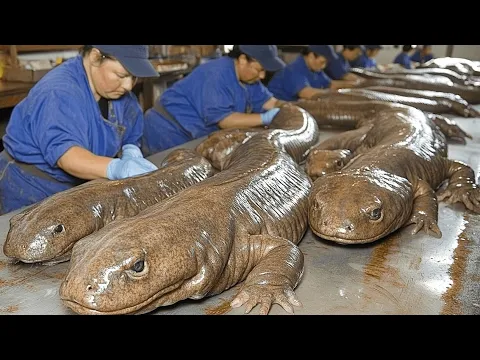

For a long time, Chinese giant salamanders were treated as a single species, but it later became clear that there were five to eight distinct types in their natural habitat.
The critical point is that they look very similar, and even experts have difficulty distinguishing them, which increases the risk in farms.
Farmers may have crossed different species without realizing it, generating active hybrids and mixed breeds, slowly losing the distinctions that allowed local survival.
The presented consequence is harsh: genetic analyses on over a thousand captive amphibians would have indicated that they are all hybrids, implying loss of genetic diversity and individual uniqueness.
Hunting, High Prices And Direct Pressure On The Last Wild Populations
The narrative describes a drastic decline in the natural environment, with nighttime expeditions failing to find salamanders where previously two or three could appear in a single night.
The cited reason is hunting that is faster than reproduction, whether for sale as meat or to supply farms.
Financial incentives appear in several sections: the penalty mentioned for illegal hunting would be 50 yuan, while restaurants would be willing to pay US$ 250 to US$ 400 for 2 pounds of meat.
In 2013, one kilogram could be sold for more than 2,000 yuan, around US$ 280, with prices “through the roof” and continuous encouragement for the capture cycle.
Crimes, Thefts And The Market That Turns Farming Into Targets
The value attributed to giant salamanders also appears in police cases.
In April 2022, Chinese police reportedly solved the theft of salamanders valued at more than 300,000 yuan, approximately US$ 41,000, involving a batch that included more than 30 animals.
In 2010, in another Chinese city, a reported case involves a 20-year-old farmer who allegedly killed a caretaker with a hoe, stole a key, and took 139 small salamanders valued at around US$ 20,000, later being sentenced to death.
For farms, the message is technical and practical: physical control and tracking become part of the operational risk.
Why They Escape And Why It Makes Everything Worse In Rivers
The giant salamanders are described as surprisingly fast on land and in water, able to climb high and even lift heavy objects according to the reported account.
During heavy rains, water influx and egress, walkways and structures become vulnerable points, requiring devices to prevent escape.
In addition to escape, there is a sanitary risk.
Captive salamanders may become ill and recover through acquired immunity but may also carry infections without symptoms.
Releasing them “to increase wild populations” is cited as a trigger for a series of problems, mixing genetics and diseases in already fragile river systems.
Industrial Scale And The Paradox: Too Much Farming, Little Real Conservation
By 2012, farms in Shaanxi Province reportedly accounted for about 70% of salamander breeding in China, with production also in other provinces, described as popular and profitable.
The recent scenario includes more than 10,000 farmers, with seven or eight families raising more than a million salamanders per year.
There are even larger numbers for hatchlings: Shaanxi would produce around 16 million baby salamanders, while Hansong would produce around 14 million.
One cited farm would have 27 acres and a total investment of more than 3 million yuan, about US$ 400,000, reinforcing the economic weight behind the subject.
Breeding Requirements And The Point That Decides Life Or Death Outside The Tank
The farms are described as needing to be focused on the salamanders, with clean running water, a tranquil environment, and shelters to escape the light.
There are recommendations for density and separation: hatchlings in plastic buckets, a maximum of five per 15 square feet, and adults separated because cannibalism is cited as possible even with available food.
Temperature is noted as a critical factor: they may stop eating when the water exceeds 68°F, with a “perfect” range between 60 and 71°F.
Temperatures above 95°F (35°C) are described as deadly.
In the natural environment, it is noted that they live at altitudes between 980 and 2600 feet, and that pools need to be more than 90 cm deep to contain escape attempts.
Controlled Breeding On The Farm And The Risk Of Releasing Without Defined Genetics
The breeding season cited runs from mid-August to mid-October, with around 20 breeding sites and more than 10 caves built for the occasion in a lake.
The hatchlings would hatch 40 to 60 days after the female releases the eggs, and growth is slow: in the wild, it would take 5 to 6 years to reach maturity and over one pound, while under man-made conditions it would take at least 3 years to reach market standards.
The central point of the warning is that releasing animals anywhere, without defining the genetic composition, turns reintroduction into a threat.
The mix is compared to a “cauldron,” and the end effect would be extinction of unique species and loss of genetic diversity.
Random Releases, Ignored Warnings, And The Count That Changed The Scenario
The material describes that experts say there is no effort to prevent farmers from releasing hybrids wherever they want.
It is noted that in 2009 scientists were already discussing the problem, but the warnings had been ignored.
Since then, more than 70,000 salamanders have reportedly been released into the wild, in random places belonging to different species.
In 2013, a massive study project was launched, with four years of work.
Researchers reportedly explored riverbeds in 16 regions, distributed across 97 sites, and found giant salamanders in only four locations.
It is also cited that half of 3,000 interviewed residents said they had seen salamanders in the past, but the last confirmed sightings reportedly occurred about 18 years ago.
The Proposed Solution: Separate Pure Breed, Selectively Breed And Release In The Right Place
Despite the described dire situation, a positive note arises: a natural population of pure breed was recently found in a national reserve in Jilin Province, presented as the first population with distinct and consistent genetic identity reproducing in the wild.
The proposed solution is technical and laborious: analyze the genetics of the salamanders on the farms, separate purebred animals by species, focus on selective breeding, and only then release the resulting individuals, strictly in locations designated by nature.
The final assessment is that the challenge is enormous and may be nearly impossible, but that there would be no better alternative.
Laws, Reserves And The Gap Between Formal Protection And Real Effect
The material points out that legal measures have existed since 1988, with 22 natural reserves in Central and Southern China to conserve habitat.
It is also mentioned that only the second generation of artificially raised animals can be consumed and sold, and that a license is required for artificial breeding.
Even so, the combination of low fines, high prices, and demand creates an environment where control fails.
For farmers, the message remains clear: preventing escape and preventing release is part of what separates production from an irreversible environmental risk.
In your opinion, what should be prioritized to prevent giant salamanders from becoming a permanent problem in rivers: physical control on farms, mandatory genetic testing, or total prohibition of random releases?







Is there any living creature that they don’t eat in China?