





 Portuguese
  English
  Spanish
  6 min of reading
  19 comments


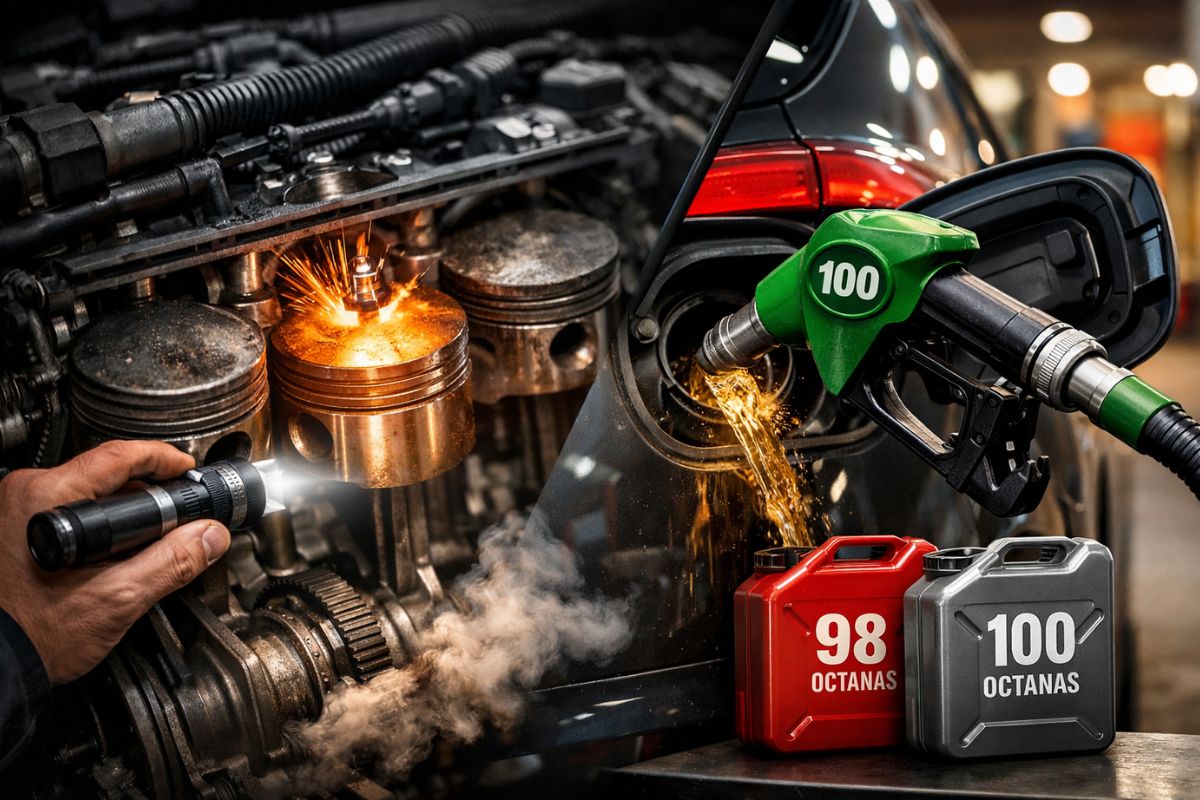


For Those Who Drive in the City, Face Heavy Traffic, and Notice a Gradual Loss of Power, Alternating Regular and Premium Gasoline Judiciously Can Reduce Detonation Under Load, Limit Invisible Wear, and Maintain the Efficiency of the Engine, Provided the Choice Respects the Engine Design, Compression, and Manufacturer’s Guidance.
Premium gasoline with 98 or 100 octanes is often treated as “sports fuel,” but the topic is broader and more technical than it seems in everyday use. In specific scenarios, it can act as an extra margin against detonation, helping the engine run more stably when there is high load, heat, and continuous demand.
This does not mean automatic power gains in any car, nor instant savings. The central point is to understand when the additional octane provides protection, when it merely increases costs, and why the correct decision depends less on “feeling” and more on mechanical compatibility, driving style, and manufacturer recommendations.
When Octane Really Comes into Play
Octane is, in practice, the gasoline’s ability to resist premature detonation within the cylinder. In more demanding engines, with higher compression ratios or performance tuning, this resistance is crucial to avoid what is called engine knock, which can occur when the mixture ignites before the ideal time. The higher the resistance to detonation, the more controlled combustion tends to be in critical situations.
-
The 2026 electric Vitara arrives in Brazil and proves that Suzuki is not leaving: 4×4 traction, 184 hp, 61 kWh LFP battery, 293 km range, R$ 259,000, and a trunk capacity of 224 L.

-
Hyundai has unveiled the Boulder, a square SUV with a body-on-frame design, 37-inch mud tires, and carriage-style doors that seems to be made to take on the Ford Bronco and the Scout Traveller in the United States.

-
The Toyota Hilux is R$ 75.5 thousand cheaper and bets on the 2.8 turbodiesel engine with up to 204 hp and 50.9 kgfm to catch up with the VW Saveiro, which leads with 4,472 sales.

-
The new Renault Koleos has a screen exclusively for the passenger that is invisible to the driver, heated rear seats, and 29 assistance systems, but its Chinese competitors cost R$ 40,000 less and deliver more power.


In everyday use, this primarily manifests under load: long ascents, strong acceleration with a full car, towing, intense heat, or prolonged use at high RPMs. Under these conditions, higher octane gasoline can serve as additional protection against events that, when repeated over time, contribute to invisible wear of internal components.
What Changes Between 95, 98, and 100 Octane Gasoline in Real Use
For most common cars designed to work with 95 octane, premium gasoline does not become a “shortcut” to constant extra performance. The engine has already been designed to operate well with the specified gasoline, so continuously switching to 98 or 100 may not yield noticeable improvements in power, response, or fuel consumption. The engine’s engineering comes before the selection at the pump.
On the other hand, in vehicles more sensitive to detonation or in severe use, 98 or 100 octane gasoline can reduce combustion noise under stress, provide a feeling of smoother operation, and maintain thermal stability in demanding scenarios. It is a contextual benefit, not magic: the difference is usually situation-dependent, not universal.
It is also essential to separate expectation from reality: premium gasoline does not turn a regular car into a sports car, does not fix mechanical failures, and does not replace preventive maintenance. It can serve as a technical tool for protection and operational consistency, provided it is used judiciously and with a clear objective.
Who Is Likely to Notice Some Benefit and What to Expect
Those most likely to perceive a concrete gain are drivers whose vehicles already require higher octane as per the manual, or those who frequently drive in demanding conditions: daily heavy traffic, routes with inclines, long trips with loads, and frequent accelerations for overtaking. In these cases, the benefit appears more as operational regularity than as a performance boost.
For those who use their cars only for light, short trips with gentle driving, the effect tends to be subtle. The “how much” to expect needs to be realistic: generally, it is about smoothness, a lower tendency to detonate, and maintaining the engine’s response over time, rather than achieving dramatic power gains or immediate savings.
There is also the profile of occasional use: some drivers alternate between regular and premium gasoline at strategic times, especially when they notice a gradual loss of response or before periods of greater demand. In this logic, higher octane gasoline acts as a temporary protective adjustment, not as a permanent refueling rule.
Where the Occasional Use of Premium Gasoline Makes More Sense
In urban environments, with constant stop-and-go, the engine operates in cycles that do not always favor optimal thermal efficiency. In vehicles that spend long periods in this pattern, the occasional use of premium gasoline can help stabilize combustion during higher load phases, especially when the driver notices rougher operation in accelerations.
On highways, the context changes: stable speeds tend to reduce sharp oscillations, but long trips with loads, mountainous terrain, or heat can increase mechanical demand. In these scenarios, 98 or 100 octane gasoline can be useful as a safety margin to preserve smoothness under continuous effort, especially in more sensitive engines.
Where it does not make sense to insist is in automatic use, without technical criteria and without relation to the vehicle’s design. Refueling “just in case,” always, without mechanical necessity, can raise costs without proportional returns. An intelligent choice arises from the combination of the manual, usage conditions, and the car’s actual behavior.
Why Premium Gasoline Should Not Be Treated as a “Miracle Cleaner”
There is a common belief that premium gasoline “cleans the engine” thoroughly and resolves performance losses on its own. This interpretation is exaggerated. In modern engines, injection systems and electronic management have already been designed to minimize deposit formation under normal use and maintenance parameters.
The additives present in premium fuels can help maintain the system in good condition, but by themselves, they do not possess the power to “heal” already established deposits or installed mechanical issues. Additive helps maintain; it does not replace technical diagnosis when there is a persistent failure, abnormal consumption, or continuous loss of performance.
If the car shows frequent symptoms like stalling, recurring detonation noise, ignition failures, or excessive vibration, the safest path continues to be mechanical inspection. Correct fuel is part of the strategy, not an isolated solution for every type of problem.
And What About Diesel Engines
In diesel engines, the choice reasoning follows a different fuel and operation logic, although the principle of “using the right product for the right project” remains the same. In many cases, shops and specialists recommend premium diesel because of cleaning and protection additives, which can favor smooth operation.
Still, the same rule of caution applies: premium diesel does not eliminate the need for maintenance, nor does it compensate for worn components. Gains tend to emerge when there is technical compatibility, appropriate usage routine, and quality fueling. Correct fuel maximizes a healthy system; it does not reverse structural wear on its own.
Therefore, directly comparing premium gasoline to premium diesel without considering the engine type leads to incorrect conclusions. Each system has its own requirements, and the right decision always starts in the manual and the real usage history of the vehicle.
The Final Decision: Manufacturer’s Manual and Emergency Driving
If the manufacturer specifies 98 octane gasoline for a given engine, that specification must be followed strictly. Ignoring this requirement and repeatedly refueling with lower octane can increase the risk of unwanted detonations and progressive damage in the long term, especially in severe use.
In an emergency situation, when only lower octane gasoline is available, moderate driving is the safest way to reduce immediate risk: gradual acceleration, avoiding overload, controlling RPMs, and not demanding abrupt accelerations. Driving smoothly, in this scenario, is a mechanical protection measure.
In the end, the best answer to “which gasoline to use” is not found in a ready promise, but in technical context: engine design, usage conditions, temperature, load, and system sensitivity. This perspective eliminates myths, reduces unnecessary costs, and preserves what really matters: long-term reliability.
98 or 100 octane gasoline can indeed have a useful role—but at the right moment, for the right engine, and with the correct expectation. It mainly acts as protection against detonation and as support for stability under greater demand, not as a universal formula for power or economy.
In your case, in what situation did you notice a real difference when switching the type of gasoline: uphill with a full car, heavy traffic, long trip, or no change? Share your car model and daily usage type—this practical account helps other drivers decide with greater precision.









E POR FALAR EM GASOLINA, QUANDO VÃO DIMINUIR OU MESMO ACABAR COM ESSA GASOLINA COM TRINTA POR CENTO DE ETANOL? EU QUERIA COMPRAR SOMENTE GASOLINA E NÃO ESSA **** QUE VENDEM POR AÍ. MEU CARRO NÃO É FLEX, E SE FOSSE EU NUNCA ABASTECERIA COM ETANOL. MAS ENQUANTO EU NÃO POSSO TROCAR O MEU CARRO, VAMOS LEVANDO. ESSAS GASOLINAS MENCIONADAS AÍ, COM TRINTA POR CENTO DE ETANOL, SÃO A MESMA ****.
Perfeito ………obrigado e parabéns pela materia
Carros novos de 2020 em diante o modulo do carro vai identificar o combustível e funcionar perfeitamente e caso seja esportivo vai ser perceptível a diferença em 98 a 100 por cento.
Alguns carros pela propriedade do solvente do combustivel podem dar problema na bomba de alta pressão ou no filtro dentro dela no caso dos injetados. A Honda e Toyota tiveram problemas com a gasolina aditivada aqui no Brasil, coisa que a Toyota no caso omitiu essa informação jogando a responsabilidade em cima do cliente por uso de combustível adulterado onde muitos não tiveram direito a garantia. Ja no caso da Honda foi competente e fez o seu papel como empresa seria que é. E carros mais antigos podem ter problemas de pré ignição podendo causar danos no pistão ou cabeçote pois o sistema não vai fazer corretamente a mistura ar combustível.
Uma reportagem porca sem conhecimento técnico algum. Provavelmente foi uma criança de 10 anos que escreveu a matéria. Deveriam rever seu pessoal e orientar melhor seus leitores.