





 Portuguese
  English
  Spanish
  5 min of reading
  0 comments


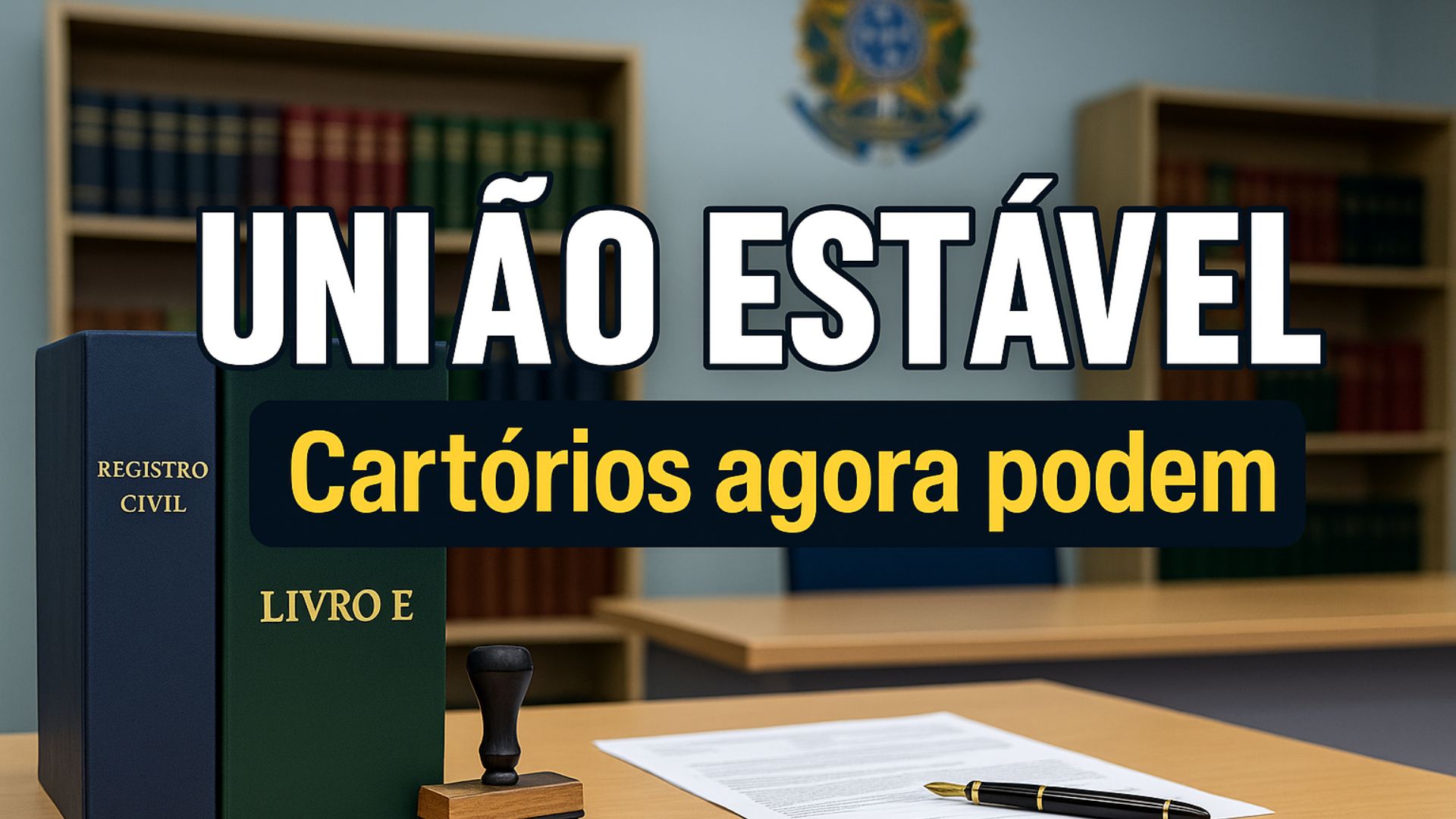
Change in CNJ Regulations Expanded Notaries’ Duties in the Registration of Stable Unions, Allowing for Changes in Property Regimes Without Court Proceedings in Specific Situations, with Effects Against Third Parties and Standardized Administrative Procedures.
The regulation of stable union registration has undergone recent changes with the issuance of a rule by the National Justice Corregedoria (CNJ) that expanded the duties of Civil Registry notaries.
Provision 141 updated provisions of Provision 37 and now allows, in specific situations, that changes to the property regime be made directly at the notary office, without the need for court proceedings.
The measure standardized administrative procedures and changed how stable unions can be formalized and updated within the registration framework.
-
Sleeping at different times each day can be a bomb for your heart and even double your risk of having a heart attack.

-
Without help and without heavy machinery, a woman builds a house from scratch with stone, wood, and cement, erects a chimney, creates a complete leisure area, and transforms an empty lot into her dream home.

-
Couple transforms abandoned house after years of being closed; residence was overgrown with weeds, had a green pool, and a deteriorated structure in the interior of Rio de Janeiro.

-
Hidden marks on the walls of the site associated with the Last Supper of Jesus for centuries have been deciphered in Jerusalem, revealing medieval inscriptions left by pilgrims, European nobles, and travelers from the Middle East.

Published in 2023, the rule also regulated the use of the declaratory term for recognition and dissolution of the stable union, in addition to consolidating existing rules on the conversion of the union into marriage.
As a result, procedures that previously depended exclusively on a court decision now have an administrative alternative, provided that the stipulated requirements are met.
Registration of the Stable Union in Book E and Effects Against Third Parties
The registration of the stable union in Book E of the Civil Registry remains optional.
However, the updated text of Provision 37 establishes that, when registered, the entry begins to have legal effects against third parties.
In practice, information such as the existence of the union and the adopted property regime cease to be effective only between the partners and become opposable outside the private sphere.
According to experts in registration law, this publicity tends to reduce disputes in relationships involving third parties, such as credit operations, contracts, and future inheritances.
The rule reinforces the role of the public record as a means of providing transparency and predictability to formalized legal situations.
Accepted Documents for Registering a Stable Union
Before the entry is issued, a formal title must exist.
The provision accepts different documents as the basis for registration, including declaratory sentences of recognition or dissolution, public deed of recognition, public deed of dissolution, and a declaratory term drawn up before the Civil Registry itself.
This declaratory term may contain clauses similar to those provided in public deeds, including the definition of the property regime.
Once drawn up, it remains filed in the registry office and allows for the issuance of certificates.
If the couple requests registration at a notary office different from the one competent for the entry, communication between the registry offices occurs through the Civil Registry Information Center (CRC).
Where to Register the Stable Union and How to Keep the Entry Updated
The entry must be made at the notary office of the location where the partners have or had their last residence.
The rule also provides that the registrar shall make or receive communications to annotate relevant subsequent facts, such as death, marriage, new stable union, or interdiction.
This information must be updated through the CRC, ensuring the integrity of the record.
When there is a court decision establishing the period of cohabitation, the dates set must be included in the entry.
Outside these situations, indicating the start and end of the union depends on the mechanisms expressly provided, avoiding records based on unsubstantiated information.
Legal Limits and Safeguards of the Administrative Registry
Despite the expansion of the administrative procedure, the provision establishes clear limits.
Legally married individuals may not register a stable union in Book E, even if they are de facto separated.
The exception occurs in cases of judicial or extrajudicial separation already formalized or when there is a final judgment recognizing the union.
The certificates relating to the registration must contain an express warning that the entry does not automatically produce effects of conversion into marriage.
Situations involving unborn children or incapacitated children remain subject to judicial proceedings, maintaining the requirement for judicial oversight in these cases.
Change of Property Regime Without Court Proceedings
The possibility of changing the property regime directly at the notary office is pointed out by legal professionals as the main practical innovation of Provision 141.
Article 9-A authorizes the request to be submitted through a joint petition from the partners.
This petition can be made in person or through a public power of attorney.
The notation of the change must contain an express cautionary note protecting good faith third parties, including creditors with claims established prior to the change.
As provided in the rule, the new regime produces effects from the notation, without automatically retroacting to assets acquired previously.
In the case of adopting a universal community property regime, the effects encompass the assets existing at the time of the change, preserving the rights of third parties.
When Is Legal Counsel or Judicial Action Required?
Although the procedure is administrative, not all cases dispense with the intervention of a lawyer or public defender.
Legal assistance is required when there is a proposal for sharing in the request or when certain certificates present specific notations.
There are also situations in which the change of regime must obligatorily occur in court.
When the certificate of interdictions is positive, the procedure leaves the administrative sphere and depends on a court decision, due to possible repercussions on civil capacity.
Required Documents and Importance of Notation
The request for extrajudicial alteration of the property regime must be accompanied by certificates from civil distribution and tax execution.
Certificates of protests, labor court, and interdicts from the Civil Registry indicated by the rule are also required.
All documents must cover the last five years of the place of residence.
Depending on the couple’s financial situation, a proposal for sharing may be presented.
In other cases, a declaration of the absence of assets or a declaration that they do not intend to share at that moment is accepted.
For the alteration to have effects against third parties, the notation in the entry of the stable union is indispensable.
Without this record, the adjustments remain limited to the relationship between the partners.
Conversion of Stable Union into Marriage
Provision 141 also consolidated the rules on converting a stable union into marriage.
As a rule, the resulting marriage maintains the property regime in effect during the union.
If the couple chooses a different regime, the change requires a prenuptial agreement.
The exception occurs when the choice is for partial communion, in which case an express declaration is sufficient.
The conversion via the extrajudicial route remains optional and does not exclude access to the Judiciary.
According to experts, the coexistence of the two routes allows accommodating situations where there are divergences, documentary doubts, or the need for a judicial decision.
With the expansion of the notaries’ duties in registering stable unions, procedures have come to follow a more defined administrative process.
The rules address publicity, property effects, and protection of third parties.
In this context, how should couples and legal professionals adapt to avoid future conflicts in formalization and alteration of the property regime?









-

-

-

-

-

14 pessoas reagiram a isso.