





 English
  Francês
  Alemão
  Italiano
  Japonês
  Norueguês
  Portuguese
  Spanish
  3 min of reading



The First Solar Refrigerator In The World Could Change The Appliance Industry, Help Consumers Save Electricity, And Can Also Be Used As An Air Conditioner
The latest innovation is a refrigerator capable of cooling food to extreme temperatures using only solar energy; the cooler does not even need to be plugged in. The idea originated from an upgrade in thermosolar technology, which had previously been used to desalinate seawater with 100% efficiency by Arab scientists.
Read Also
Solar Refrigerator Does Not Require The Use Of Electrical Components
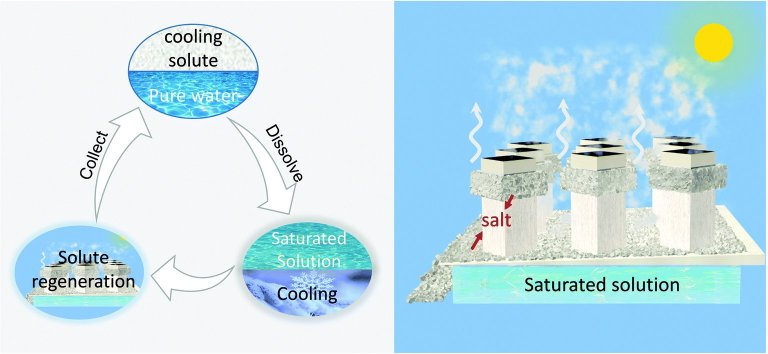
The first prototype of the solar-powered refrigerator has no electrical components. The cooler operates solely through the cooling effect triggered when certain types of salts come into contact with water and dissolve.
Throughout each cycle, the solar-powered refrigerator uses the energy generated from the sun to evaporate water and recover the salt; this process becomes a cycle and reuses all the vapor generated.
-
Renewable energy advances over protected areas in Brazil, and a survey by the Energy Transition Observatory reveals silent impacts that challenge environmental conservation and pressure sensitive traditional territories.

-
Rio Grande do Sul accelerates energy transition: State invests in renewable technologies and consolidates decarbonization strategies and pathways to attract billions in new industrial investments.

-
With 160,000 m² of collectors, an area larger than 20 football fields, Silkeborg, in Denmark, hosts a solar thermal plant that heats 19,500 homes and could become the largest solar heating plant in the world.

-
A study reveals the expansion of renewable energy procurement in Brazil and shows how companies are taking advantage of opportunities to reduce expenses, ensure energy efficiency, and strengthen strategic environmental commitments.


More technically, ammonium nitrate (NH4NO3) proves to be the most efficient of the salts, as it has a cooling power up to four times greater than its direct competitor, ammonium chloride (NH4Cl).
“The solubility of NH4NO3 reached 208 grams per 100 grams of water, while the other salts were generally below 100 grams. The other advantage of this salt is that it is very inexpensive and is already widely used as a fertilizer,” said Wenbin Wang from King Abdullah University of Science and Technology.
Solar-Powered Refrigerator Can Be Used As An Air Conditioner

The concept of the world’s first solar-powered refrigerator has proven to be a project capable of changing the appliance industry, as it does not consume electricity, preserves food like a regular refrigerator, and can also reduce energy bill expenses.
The team used a previously constructed solar regenerator to evaporate the water. As the water evaporated, NH4NO3 crystals grew on the outer wall of the container.
“The crystallized salt can be collected automatically as the salt falls due to gravity,” said Wenbin. Once collected, the salt effectively represents a stored form of solar energy, ready to be reused for cooling again when needed in the solar refrigerator or air conditioner.
Innovations Around The World Are Starting To Use Solar Energy
The solar-powered refrigerator is not the first invention to harness the power of the sun to enhance its use. In 2019, we had the announcement of the Lightyear One, a solar-powered electric car with a range of 700 km on just one charge.
We also have the Solara 50, the first long-duration drone powered by solar energy, capable of carrying just over 30 kg; however, depending on the time of year and flight location, it can carry larger loads.
And last but not least, in August 2019, Eternit presented its photovoltaic solar tile at Intersolar South America. With integrated photovoltaic cells, each tile produces 9.16 watts and measures 36.5 by 47.5 mm.
This ensures an average monthly production capacity of 1.15 kilowatt-hours per month (kwh/month). The tiles are already being produced on demand at the Tégula Solar factory in Atibaia, São Paulo, for pilot projects. One of the tests is even being conducted at the Federal University of Santa Catarina (UFSC).










Seja o primeiro a reagir!