





 Portuguese
  English
  Spanish
  3 min of reading
  0 comments


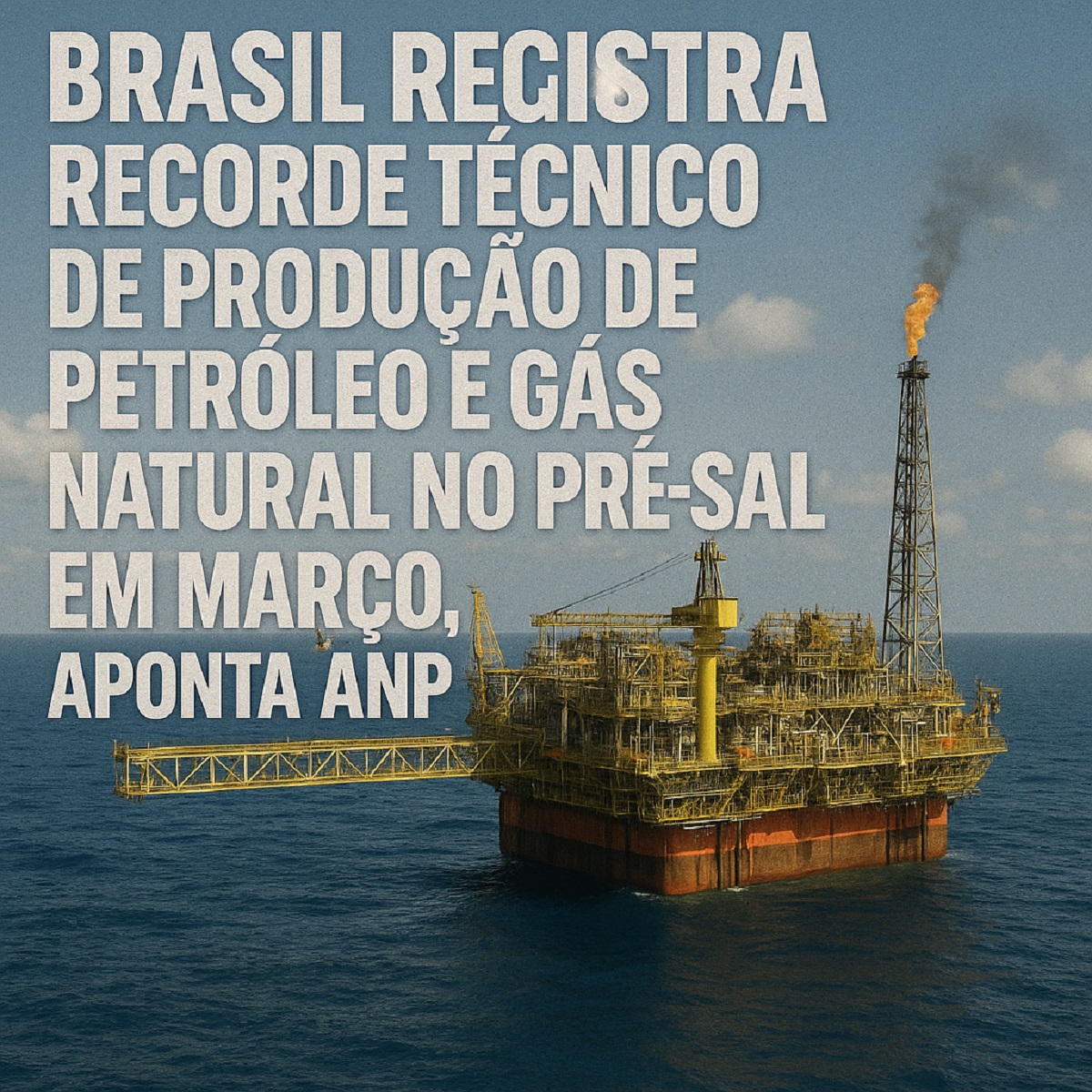
ANP Report Highlights Petrobras’ Performance and Offshore Platforms in National Energy Production, Focusing on Pre-Salt and Natural Gas Utilization
In March 2025, Brazil reached a new level in oil and gas production, as disclosed by ANP in April. Additionally, production totaled 4.662 million barrels of oil equivalent per day, indicating significant progress in the national energy sector. Of this total, 3.716 million barrels (79.8%) came from the pre-salt, reinforcing its strategic importance. Consequently, this result demonstrates the technical success of offshore operations, as well as the ongoing investment in energy infrastructure.
Technical Data on Energy Production in March
Total production was 4.662 million boe/d, comprising 3.621 million barrels of oil per day and 165.53 million cubic meters daily of natural gas. The pre-salt was responsible for 3.716 million boe/d, while offshore production accounted for 97.6% of the oil and 87.9% of the gas extracted. Natural gas utilization was 96.5%, according to technical data verified and published by the National Agency of Petroleum, Natural Gas and Biofuels (ANP).
Role of the Pre-Salt and FPSOs in National Production
The Tupi field, located in the pre-salt of the Santos Basin, was the largest producer of the month, with 780,000 barrels of oil per day and 39 million cubic meters of natural gas. The FPSO Sepetiba and FPSO Guanabara platforms, which operate in the shared Mero field, also stood out among the most productive units in March. The operational performance of these structures shows the impact of technological efficiency applied to production in the Brazilian pre-salt.
-
Petrobras evaluates suspension of sales to distributors and considers canceling the cooking gas auction following guidelines from the Federal Government.

-
Lula reveals a masterstroke by Petrobras to undo a deal made by Bolsonaro, which involves the return of an important refinery that currently produces less than half of what was expected and makes Brazil dependent on international diesel.
-
A study confirms that the natural gas sector will reduce greenhouse gas emissions in Brazil by 0.5% and accelerate the energy transition by 2026.

-
Petrobras implements a severe adjustment and confirms a 55% increase in the price of aviation kerosene with a proposal for installment payments for the companies.


Monthly Production Evolution Confirms Steady Growth
Compared to February 2025, indicators point to continuous growth. Oil production increased by 3.8%, natural gas grew by 4.3%, and the total volume of oil equivalent rose proportionately, from 4.490 to 4.662 million boe/d. The pre-salt saw an increase of 4.3%, reinforcing its relevance to the Brazilian energy matrix.
Natural Gas Utilization Remains High, with Attention to Commissioning
Although the natural gas utilization rate remained at 96.5%, which is considered high, however the flaring increased significantly. In addition, daily flaring reached 5.77 million cubic meters, representing a 17.5% increase compared to the previous month. As reported, this growth is related to the commissioning of the FPSO Almirante Tamandaré, which began on February 15, 2025. Therefore, as the process is still in the adjustment phase, the increase was expected, according to a technical note issued by ANP itself.
Technical Factors That Influenced Sector Performance
The production growth in March was driven by the expansion of FPSO capacities in operation and the logistical integration between production and transport units. There was an expanded use of digital technologies for automation and remote monitoring, combined with the operational stability of pre-salt fields. Analysts from the International Energy Agency (IEA) and consulting firm Wood Mackenzie also point to the positive influence of international demand and the appreciation of oil in the external market.
Petrobras’ Participation Was Determinant in the Total Volume
Petrobras was responsible for 90.19% of the national oil and gas production in March, according to ANP. The state-owned company operates directly or in partnership in the main pre-salt fields, focusing on innovation, efficiency, and technical management. The company maintained its leadership position in the sector as a result of robust investments in exploration and technology over the past few years.
Projections Indicate Gradual Production Expansion Until 2030
A report published in April 2025 by the International Energy Agency (IEA) predicts that Brazil could join the group of the five largest oil exporters by 2030. The continuity of this expansion depends on regulatory stability, investment flow, and the adoption of environmental and operational practices that maintain the country’s competitiveness. The report also highlights the importance of maintaining balance between exports, domestic consumption, and diversification of the energy matrix. The performance of Brazil’s energy production in March 2025 represents a consistent technical advance, driven by efficient management and structured operation in the pre-salt. Petrobras, along with partners in offshore consortiums, demonstrated operational capacity, logistical control, and responsible environmental utilization of natural resources. Based on projections from international agencies, the country remains on a path of gradual and sustainable growth, with strategic potential in the global energy scenario.










-

Uma pessoa reagiu a isso.