





 Portuguese
  English
  Spanish
  3 min of reading
  0 comments


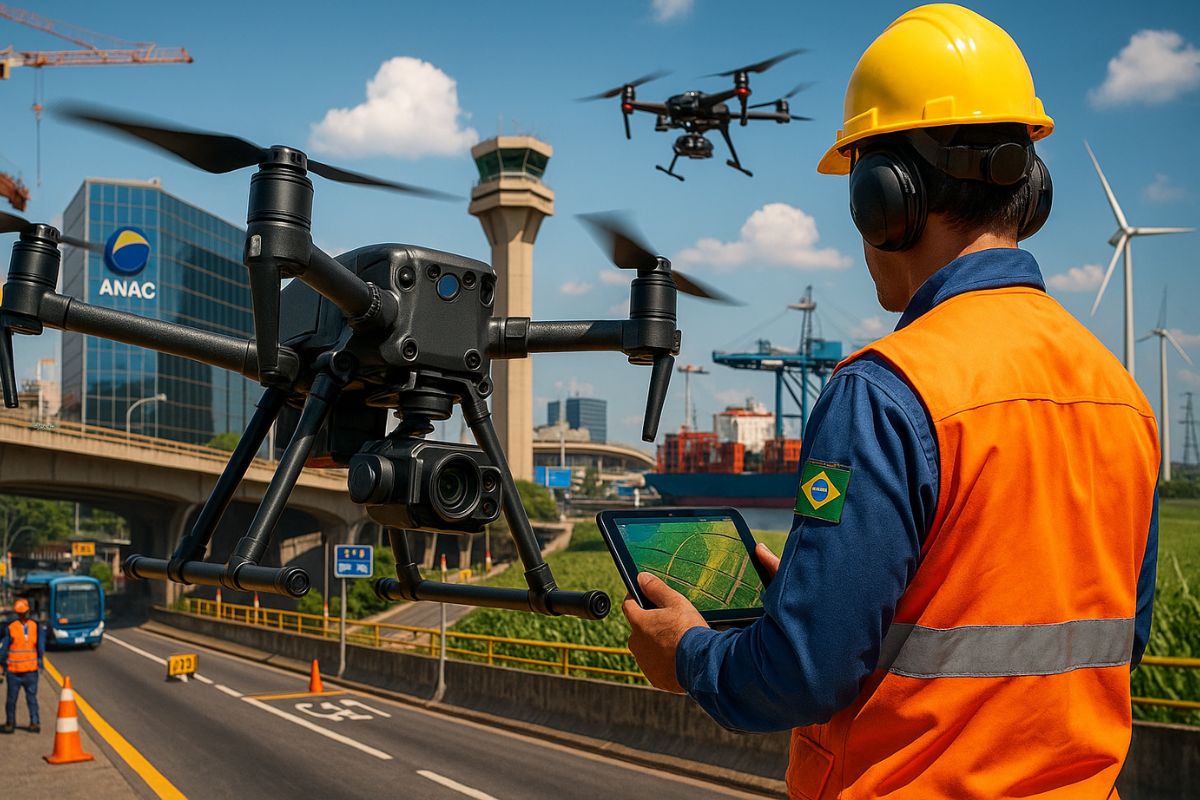
Drone Professions Evolved From Filming to Critical Operations in Agriculture, Engineering, and Logistics, Increasing Remuneration and Requiring ANAC Certifications, Data Dominance, and Safety Protocols
Drone professions have moved from a niche in audiovisual to part of the country’s productive infrastructure. Companies in agriculture, construction, and industry now treat these operations as sources of efficiency, risk reduction, and quality standardization. The result is a market that pays better, demands more qualifications, and opens space for technical careers beyond piloting.
Technological advancements and regulatory maturity bring a practical agenda: mastering ANAC legislation, operating with planning, and risk assessment, capturing high-quality data, and transforming it into decisions. Those who deliver this complete cycle are quickly absorbed by operations that grow month after month.
What Does a Professional Drone Pilot Do
Being a pilot goes far beyond taking off and landing.
-
Future profession with immediate earnings: Specialist reveals how a solar energy technician earns R$ 8,000 per month by taking advantage of the explosion in demand across the entire country.

-
Work from 8:30 AM to 5:30 PM with a 1-hour break at Sicredi as a Customer Service Assistant and receive a salary + benefits such as life insurance, dental plan, partnerships, Gympass, and much more in job openings across various states.

-
Subsea7 has job openings: the company has offshore and onshore positions available in 2026 for operators, pilots, supervisors, engineers, and much more.

-
Unimed is hiring candidates with and without experience! More than 10 job openings for Assistants, Analysts, Kitchen Assistants, and much more!


The job begins with flight planning, including risk analysis, weather checks, area authorizations, and equipment redundancy verification.
During the mission, the focus is on precise control, the safety of people and assets, and consistent data capture.
After the flight, unloading, organizing, and validating images and telemetry take place.
Sectors Hiring the Most Today
The audiovisual sector remains relevant, but the highest demand comes from technical areas.
Precision agriculture uses drones for mapping and targeted applications.
Civil engineering and industrial inspection monitor bridges, towers, transmission lines, and platforms with safety and standardization.
Logistics tests routes and delivery models. Commonly, all require data quality and process traceability.
Careers Emerging From the Complexity of Operations
Sophistication has opened positions beyond piloting. Notable roles include:
Drone Maintenance Technician handles hardware, sensor calibration, motors, and battery management.
Drone Data Analyst transforms thermal, LiDAR, and multispectral images into actionable reports and insights.
Flight Instructor trains new operators and standardizes procedures.
Training and ANAC Legislation as Differentiators
Operating legally depends on mastery of ANAC regulations and documentation routines.
Valued professionals master aircraft registration, risk classification of operations, and compliance evidence.
Operational safety and regulatory compliance are criteria for hiring and retention.
Salaries and Contracting Models
Remuneration varies by specialization, experience, and sector. In CLT, there are consolidated ranges; in project work, pilots define packages according to scope and risks. As a market reference:
Junior to Mid-level Drone Pilot: R$ 2,500 to R$ 5,000
Specialized Pilot in Topography or Agribusiness: R$ 5,000 to R$ 10,000
Mid/Senior Drone Data Analyst: R$ 6,000 to R$ 12,000
Mid Drone Maintenance Technician: R$ 3,500 to R$ 6,000
Complex projects and critical operations significantly raise the ticket, especially when involving analysis and technical delivery.
Technical Stack Driving Employability
Those who combine piloting, sensors, and data processing expand opportunities.
RGB, thermal, and multispectral images, photogrammetry, and the generation of orthomosaics and digital terrain models comprise the basics of technical operations.
Standardizing file naming, metadata, and reports accelerates audits and data reuse.
Operational Routine and Safety
A mature routine has three acts: plan, execute, validate. In planning, measurable objectives, routes, and barriers come into play.
Execution follows checklists, communication, and contingencies.
In validation, data integrity, georeferencing consistency, and minimum decision quality are verified.
Safe and repeatable operations ensure scalability.
Piloting tends to become increasingly automated, with pre-programmed flights and multiple aircraft per operator.
This shifts value to the Drone Fleet Manager, who coordinates aircraft, maintenance windows, and data SLAs.
In analysis, artificial intelligence accelerates anomaly detection and target classification.
There is also growing demand for ethics and privacy specialists, aligning technology and best practices.
How to Start and Evolve
Map your area of interest and build a portfolio that showcases data and decisions, not just pretty images.
Structure checklists, safety protocols, and practical knowledge of ANAC legislation. Learn to write objective reports with indicators and recommendations.
Those who master the entire value flow, from operation to insight, accelerate their career and salary.
For you, which drone professions have the most future in Brazil now: data analysis, maintenance, specialized piloting, or fleet management?









-

-

-

-

-

19 pessoas reagiram a isso.