





 Portuguese
  English
  Spanish
 4 min of reading


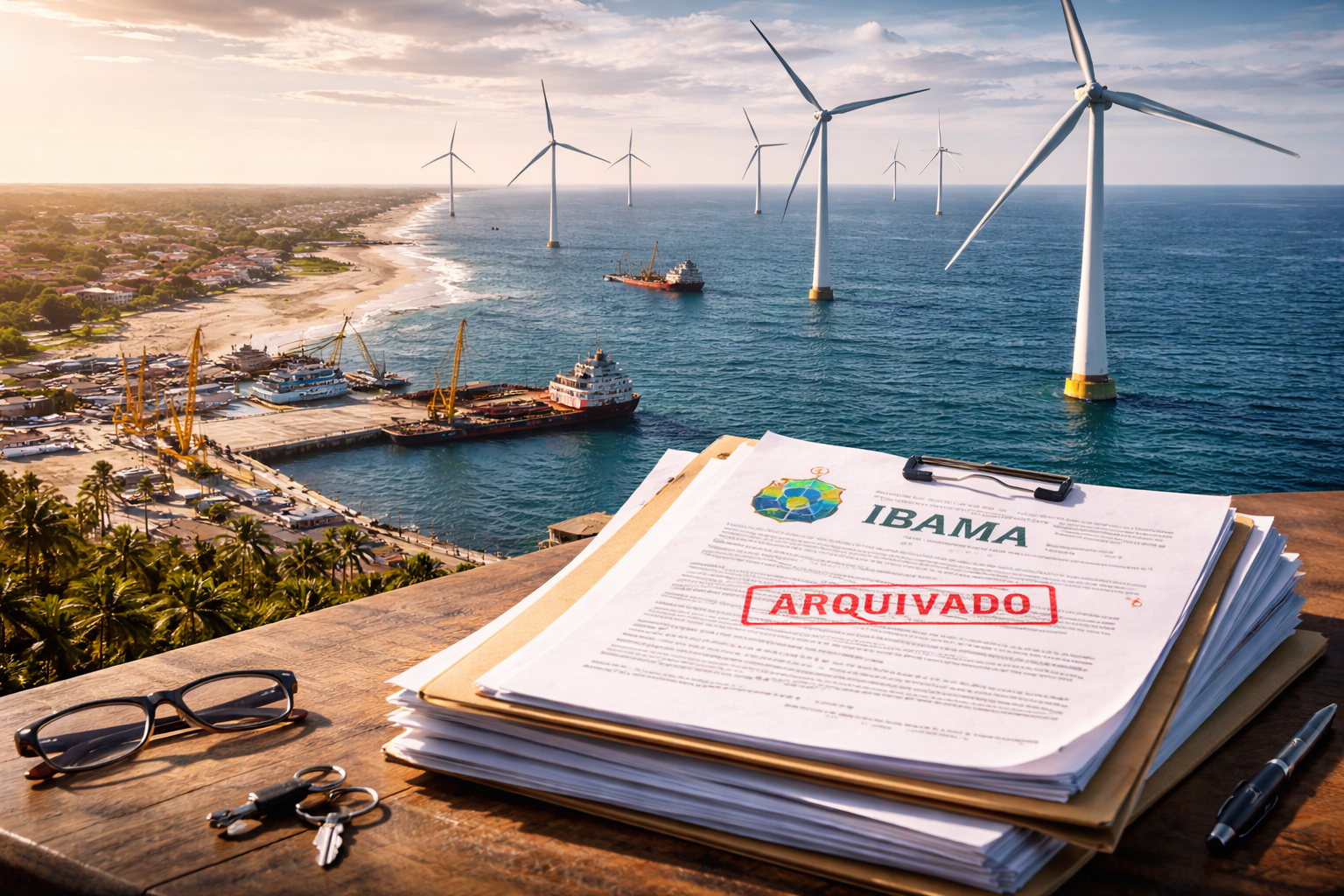
The Advancement of Offshore Wind Energy in Brazil Follows a Slower Path Than Initially Planned. Although the Country Has Extensive Coastline and Favorable Natural Conditions, the Regulatory Framework and the Pace of Development Still Impose Significant Obstacles.
This scenario became evident after the decision of the Brazilian Institute of the Environment and Renewable Natural Resources, Ibama, to archive 11 environmental licensing processes for offshore projects in Ceará.
According to Ibama itself, the archiving occurred due to the absence of procedural movement for a period exceeding two years by the responsible companies. The decision does not represent, therefore, a definitive veto on the projects, but indicates the need for restructuring and resubmission of requests if the companies wish to continue with the ventures.
In addition to these archived processes, another 16 offshore projects are under review by the environmental agency, which demonstrates that the interest in the sector remains, although it progresses cautiously.
-
With Announcement for ROV Course in Partnership with Zen, Rio das Ostras Aims to Transform Technical Qualification into Real Jobs in the Competitive Offshore Market

-
Free Offshore Steward Course in São Gonçalo Emerges as a Strategic Opportunity for Those Seeking Qualified Work at Sea

-
Messer Gases Reopens Branch in Macaé to Serve Offshore Oil and Gas Market in Northern Fluminense with Supply of Oxygen, Argon, and CO₂
-
Offshore Profession Simplified: Comprehensive Guide Reveals How to Trade Common Routine for High Salaries and Long Breaks in Life Aboard in the Oil Sector


Offshore in Brazil and the Historical Context of Licensing
To understand the impact of the decision, it is important to observe the history of offshore energy in the country. Unlike onshore wind energy, which expanded rapidly starting in the 2010s, offshore projects are still in the early stages in Brazil. The absence of a specific regulatory framework for many years contributed to this slowness.
According to the Ministry of Mines and Energy, only in recent years has the country begun to structure clearer guidelines for the exploration of offshore wind energy. Prior to that, companies submitted licensing requests in an environment of high legal and regulatory uncertainty. As a result, many processes remained stalled, awaiting definitions from public authorities.
In this context, the archiving determined by Ibama follows existing administrative rules. According to the agency, processes without progress for long periods can be closed to ensure efficiency and internal organization. The decision, therefore, reflects technical and administrative criteria, rather than a rejection of offshore technology.
Offshore, Business Interest, and Pace of Maturation
Despite the archiving, business interest in offshore energy remains strong in Ceará and other regions of the country. The state stands out for its history in the wind sector, port infrastructure, and proximity to major consumer centers in the Northeast.
According to the Energy Research Company, studies indicate high potential for offshore generation along the Brazilian coastline. However, transforming potential into viable projects requires planning, capital-intensive investment, and regulatory security. Offshore projects demand high investments, long timelines, and coordination with multiple public agencies.
In this scenario, companies tend to adopt a more conservative approach while the regulatory environment is not fully consolidated. The lack of procedural movement pointed out by Ibama reflects, in part, this wait-and-see strategy.

Environmental Licensing and Legal Security
Environmental licensing plays a central role in making offshore projects viable. Since these are ventures in a marine environment, studies require detailed analysis of impacts on ecosystems, fishing, navigation, and coastal communities.
According to Ibama, the archiving of processes does not prevent companies from resubmitting new requests. If there is interest in resuming the projects, companies must initiate the licensing process again, now aligned with the most recent guidelines.
This movement, although it causes delays, can also result in more robust and well-structured projects. As Brazil advances in defining specific rules for the offshore sector, licensing is expected to gain greater predictability.
Offshore and the Future of Energy in Ceará
Looking at the episode more broadly, it is clear that Ibama’s decision signals a transition for the offshore sector in Brazil. The country is moving from a phase of expectation to a stage of institutional organization.
The fact that there are still 16 projects under review indicates that the sector has not lost relevance. On the contrary. It is undergoing a natural selection process, where only initiatives with greater technical, financial, and regulatory maturity are likely to advance.
In Ceará, specifically, offshore energy remains a long-term strategic bet. The experience accumulated with onshore wind energy, combined with existing logistical infrastructure, creates important foundations for future offshore projects.
Thus, the archiving of the processes does not represent a definitive setback. It serves as a course adjustment, reinforcing the need for alignment among companies, environmental agencies, and public policies. In a capital-intensive and planning-intensive sector like offshore, structural decisions tend to shape the growth pace in the coming years.







Seja o primeiro a reagir!