





 Portuguese
  English
  Spanish
 5 min of reading
  19 comments


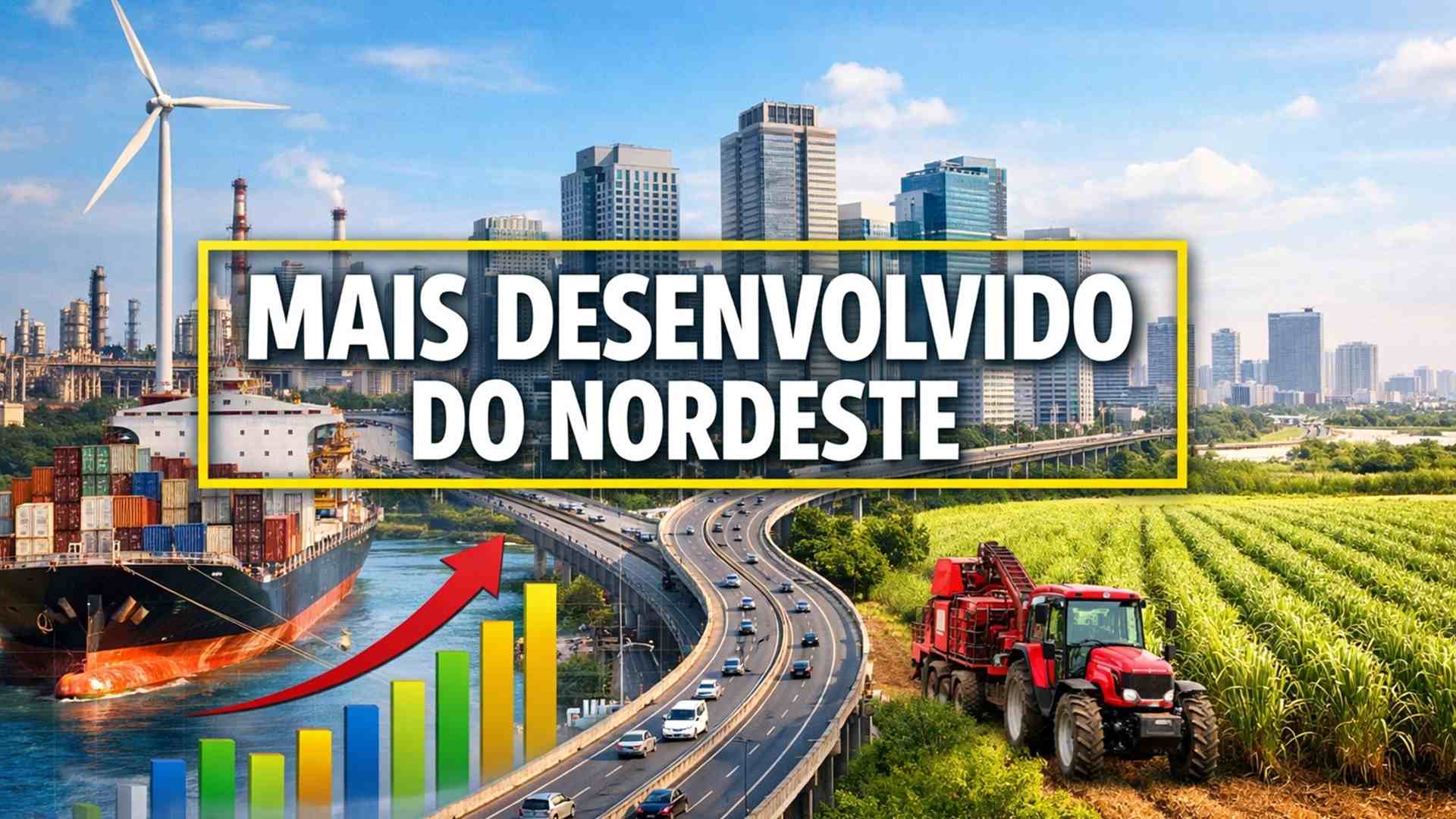


The Comparison Between The Nine States Of The Northeast Considers Consolidated Indicators Of Gross Domestic Product, HDI, Per Capita Income, Logistic Infrastructure, Public Service Offerings, And Productive Complexity, Revealing Profound Structural Differences And A Regional Leadership Defined By The Balance Between Economy And Quality Of Life
The question about which is the most developed state in the Northeast often generates simplified answers, based solely on total GDP or urban perception.
The consolidated data from the Info Nordeste study, prepared from information from IBGE, Continuous PNAD, Regional Accounts, and official sector databases, show that regional development is more complex and involves multiple dimensions: economy, income, productive structure, labor market, urbanization, and national integration.
The Brazilian Northeast has 57.1 million inhabitants, about 26.9% of the national population, distributed across nine states and 1,794 municipalities, of which 78% of the population lives in urban areas.
-
“No one will make us change the Pix,” says Lula after the US report.

-
Lula responds directly to Trump and says that Pix is from Brazil and will not change under pressure from anyone, after a report from the United States pointed out the Brazilian payment system as an American trade barrier.

-
Amazon has just announced a new fee on all deliveries, and your online purchases will become more expensive starting April 17, including for those buying from the United States here in Brazil.

-
He sold his share for R$ 4 thousand, saw the company become a giant worth R$ 19 trillion, and missed the opportunity of a lifetime.


Territorially, the region occupies 1.6 million km², equivalent to 18.3% of the Brazilian territory. The average regional HDI is 0.663, classified as a medium level of development, below the national average, but with strong internal heterogeneity among the states.
Regional Economy Grows, But Concentration Persists
In 2022, the Gross Domestic Product of the Northeast totaled R$ 1.388 trillion, accounting for 13.8% of Brazil’s GDP.
The regional share has fluctuated over the past few decades, falling from 14.1% in 1985 to 12.0% in 1995, and then gradually increasing back to the current level.
The average regional GDP per capita was R$ 25,401.43, still far from the Brazilian average, which reinforces the structural income challenge.
The northeastern economy is heavily based on trade and services, which accounted for 70.4% of the value added in 2022.
Industry accounted for 20.8%, while agriculture accounted for 8.8%. This profile indicates an increasingly urban and tertiary region, although there are significant industrial and agro-exporting hubs in specific states.
Bahia Leads In GDP, But Development Is Not Just About Size
Bahia concentrates 29.0% of the Northeast’s GDP, remaining the largest regional economy.
The state combines a large territory, a population of 14.8 million inhabitants, and a diversified productive structure, with a significant presence of the chemical, petrochemical, oil refining, large-scale agriculture, and services sectors.
However, the study shows that leading in total GDP does not automatically mean being the most developed. Indicators such as per capita income, industrial structure, productive complexity, formal labor market, and urban dynamism significantly change the ranking when analyzed together.
Pernambuco Emerges As An Industrial And Urban Hub
With 17.7% of the northeastern GDP, Pernambuco is the second largest economy in the region.
The state hosts one of the largest urban agglomerations in the North and Northeast, particularly the Greater Metropolitan Area of Recife, which concentrates advanced services, logistics, technology, and public administration.
In industry, Pernambuco stands out for motor vehicle manufacturing, oil refining, production of derivatives, and a more diversified industrial park than the regional average.
These factors increase the degree of economic complexity and amplify the state’s impact on regional and national production chains.
Ceará Combines Growth, Population, And Services
Ceará, responsible for 15.4% of the Northeast’s GDP, has 9.2 million inhabitants and its capital Fortaleza, the largest municipality in the North and Northeast. The state shows strong dynamism in the services sector, trade, tourism, light industry, and logistics, along with consistent growth over the past few years.
Fortaleza plays a central role as a regional hub for services, technology, telecommunications, and trade, increasing Ceará’s economic weight beyond its percentage contribution to GDP.
Smaller States Stand Out In Strategic Niches
Although they account for smaller shares of regional GDP, other states play strategic roles. Maranhão (10.1%), Rio Grande do Norte (6.8%), Paraíba (6.2%), Alagoas (5.5%), Piauí (5.2%), and Sergipe (4.1%) exhibit relevant productive specializations.
In agriculture, the Northeast accounted for R$ 96.6 billion in agricultural production value in 2023. The region is a national leader in various crops, such as banana, mango, melon, watermelon, passion fruit, papaya, and coconut, and is also notable for producing soy, cotton, corn, and sugarcane. Bahia, Maranhão, and Piauí form the main axis of modern regional agribusiness.
Industry Shows Structural Inequality
The northeastern industry exhibits strong spatial concentration. Bahia, Pernambuco, and Ceará concentrate the segments with the highest added value, such as chemicals, petrochemicals, metallurgy, vehicles, and petroleum derivatives.
States like Alagoas and Sergipe have a strong presence of the chemical and food industries, while Paraíba stands out in leather and footwear.
This unequal distribution reinforces the idea that industrial development, one of the pillars of sustainable economic development, is still restricted to a few regional hubs.
Foreign Trade And International Integration
In 2024, the Northeast moved US$ 53.5 billion in foreign trade, with US$ 24.8 billion in exports and US$ 26.8 billion in imports. The region accounted for 7.4% of Brazilian exports and 10.9% of imports.
The main exported products were soy and derivatives, oil and derivatives, chemicals and petrochemicals, and paper and cellulose. China was the main destination, followed by United States, Canada, Singapore, and Argentina. States with greater logistic and industrial infrastructure tend to capture more benefits from this trade, reinforcing internal inequalities.
Labor Market Reveals Quality Differences
The Northeast recorded 10.3 million formal jobs in 2023, with a predominance of the services (3.7 million), public administration (2.7 million), and commerce (1.8 million) sectors. The average monthly income was R$ 2,025, lower than the national average.
States with greater industrial diversification and advanced services have higher average earnings and greater stability in formal employment, which directly affects the evaluation of the level of development.
After All, Which Is The Most Developed State?
The data from Info Nordeste indicates that there is no single state clearly dominant in all dimensions of development. Bahia leads in economic size, Ceará stands out for its urban and demographic strength, and Pernambuco combines industrialization, advanced services, and logistical centrality.
When considering GDP, productive structure, industrialization, labor market, and urban role, Pernambuco appears as the state with the most balanced profile of regional development, while Bahia and Ceará lead in specific dimensions. Thus, northeastern development is polycentric, concentrated in a few hubs and still marked by strong internal inequalities.
This article was prepared based on consolidated data from the Info Nordeste study, which gathers information from IBGE, Continuous PNAD, Regional Accounts, MDIC/Secex, and official sector databases.









Sou carioca de Niterói mas amo o Nordeste o Brasil precisa olhar mas pro Nordeste e iria se surpreender com tantas maravilhas que tem por lá
Você não é Carioca, quem nasce em Niteroi é Fluminense. Carioca só nascidos na cidade do Rio ee Janeiro.
A região nordeste muito oferece em seus caracteres e diversidade, portanto, estaria em um estágio mais evoluído, não fosse anos de descaso por parte da União. Nos últimos vinte, trinta anos isso vem mudando, fazendo com que se vislumbre melhorias significativas.
A maior indústria do nordeste chama-se bolsa família. Pois existe hoje mais gente recebendo bolsa-família que trabalhando de carteira assinada. Aqui onde eu reside por exemplo as famílias além do bolsa-família ainda recebe marmita pra não ter nem o trabalho de fazer almoço, entre outras coisas. Agora arrumar um trabalhador é quase impossível.
Acorda nordeste!
Acorda Brasil!
Não é um trabalhador que cê quer, cê quer um escravo !!!
Um comentário extremamente preconceituoso. Que desconsidera os dados da pesquisa e os dados históricos que legaram pobreza e miséria para a região. Com certeza absoluta, vc deve fazer parte do time que não consegue mais mão de obra semi escrava para trabalhar para si.
Chega de preconceito seus bostoes que aqui chegam e são super bem tratados.