





 Portuguese
  English
  Spanish
  5 min of reading
  1 comment


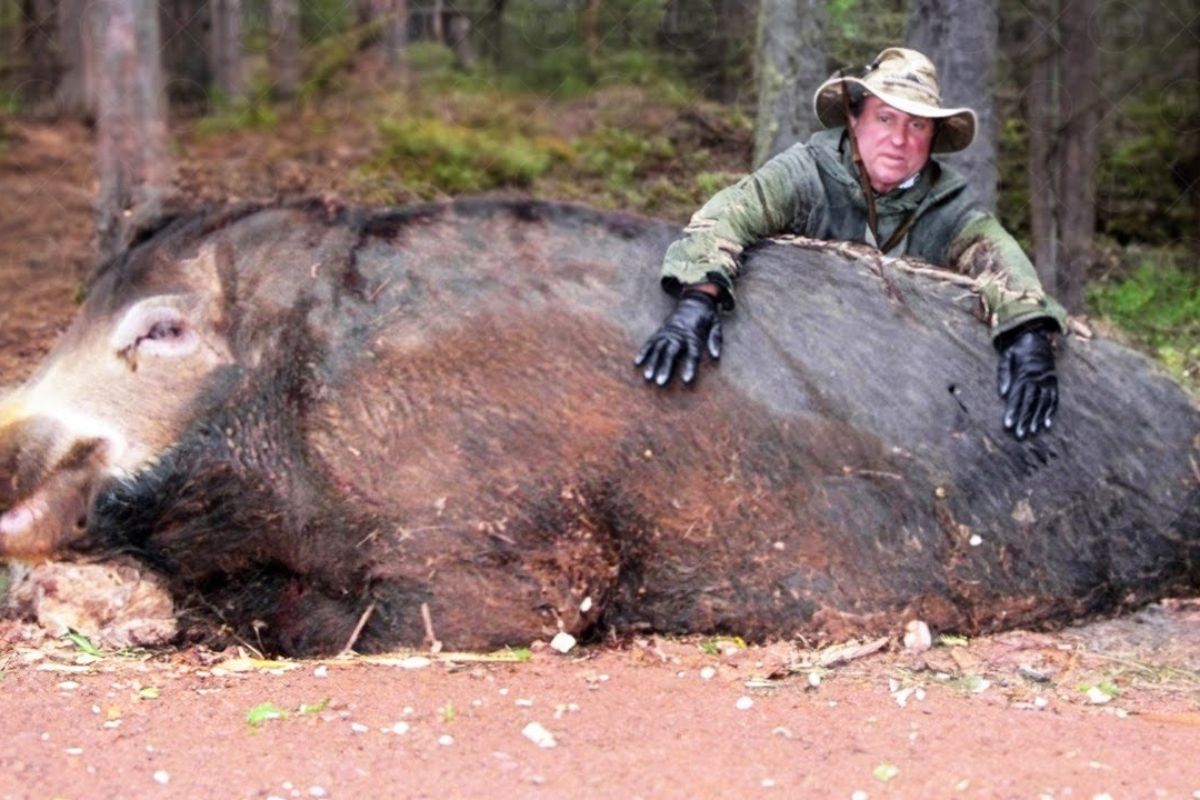


Created in the 1980s by mixing domestic pigs and wild boars, the Invasive Super Pigs escaped from farms and hunting reserves, learned to dig tunnels under 2-meter snow, withstand temperatures as low as -58°F, and are already increasing agricultural damage, health risks, and control conflicts in North America today
The Invasive Super Pigs came onto the radar of farmers after the expansion of wild pigs already established in the U.S., but with a scaled-up jump from Canada. What seemed like an adjustment for cold weather turned into a large, fertile, and hard-to-contain population.
The crisis combines three fronts at once: destroyed crops and pastures, diseases with the potential to affect livestock and other species, and an operational stalemate, because hunting and controlling wild pigs was already expensive and inefficient, and the Invasive Super Pigs added resistance to winter and new routes of advance.
What Are Invasive Super Pigs and Why Did They Appear

The Invasive Super Pigs are the result of decades of breeding initiated in Canada in the 1980s between domestic pigs and wild boars.
-
Scientists have finally discovered where the plastic that disappeared from the oceans went, and the answer is frightening: it fragmented into such tiny particles that they became invisible and now there are 27 million tons of nanoplastic just in the North Atlantic.

-
The Artemis II mission will take the Orion capsule back to the vicinity of the Moon with four astronauts, a private bathroom with a curtain, a system adapted for men and women, and a level of comfort that highlights how the Apollo era operated at the rawest limits of space exploration.

-
Giant structures on the seabed precisely control oil and reveal how high-tech underwater valves work.

-
China has just tested a giant drone the size of a fighter jet with a wingspan of 25 meters that carries 6 tons, flies for 12 hours, and the most frightening part: it can launch entire swarms of smaller drones directly from the air.


The logic was straightforward: to produce animals that withstood cold better and generated more meat, while also being easier to film in hunting reserves, where they were released to be hunted.
The problem began when the market peaked and collapsed in the early 2000s.
With no commercial destination, pigs began to be discarded, and part of that contingent ended up in the wild.
What was expected to result in “freezing to death” did not happen: the Invasive Super Pigs multiplied and consolidated their presence.
Size, Strength, and Adaptation to Extreme Winter

The Invasive Super Pigs stand out for their dimensions above the standard of wild pigs in the U.S.
While typical wild pigs in the U.S. weigh between 75 and 240 pounds, an adult of this lineage can exceed 485 pounds, combining large size, high resistance, and reproductive rate inherited from the domestic component.
The adaptation to cold is not just about fur.
In western Canada, where the wind chill can drop to -58°F, the Invasive Super Pigs use their tusks to dig tunnels under snow that reaches 2 meters, creating shelters lined with bulrush.
The report describes the “igloo” as potentially warm enough for vapor to appear, provided the external temperature is below -22°F.
Why Farmers See the Worst-Case Scenario in Agriculture
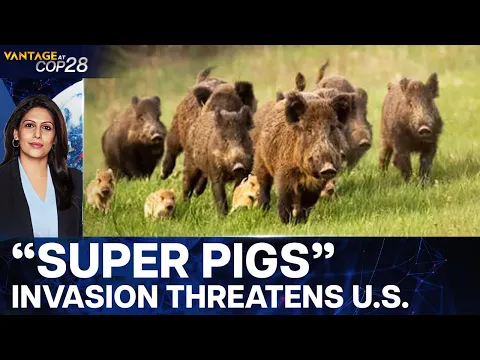

For farmers, the routine already included dealing with wild pigs and other invasive species, but the Invasive Super Pigs added a larger and more adaptable adversary.
They turn over the soil like a cultivator, search for insects and roots, destroy crops and pastures, degrade lawns, and can leave areas looking “as if a bomb had hit.”
The consequences extend to water: the report associates soil destruction and turning over to pollution and degradation of water quality, as well as erosion in riverbeds.
Farmers report fields full of deep holes, hindering replanting and necessitating complex cleanup, with uncertainty about the return of animals.
Diseases and Health Risks That Change the Game
The issue of diseases emerges as one of the greatest concerns for farmers and scientists.
The report mentions flu with the potential for mutation after circulating in pigs and highlights African swine fever, described as a deadly disease for livestock, identified for the first time in 1921 and with a history of devastating consequences where it appears.
The global impact is illustrated by the outbreak in China in 2018, when more than 43 million pigs were slaughtered to contain its spread.
The report also points to confirmed cases in 2021 in the Dominican Republic and Haiti, raising the alarm for regional proximity to the U.S.
Furthermore, pseudorabies emerges, which does not harm humans but can cause abortions in sows and deaths in raccoons, opossums, cats, and dogs. For farmers, the central point is simple: diseases in wild pigs can cross invisible fences.
How We Got Here: From 1539 to Millions Today
The report traces back to 1539, when Hernando de Soto landed in Florida with 13 pigs.
In four years, the population would have reached around 700 and roamed the southeastern U.S.
The most recent jump, however, is attributed to the intentional release for hunting in areas where there were no pigs, leading to rapid multiplication.
The narrative summarizes the modern picture: over 6 million wild pigs in about 34 states.
And, with the Canadian component, the advance reaches another scale.
In the 1990s, pigs were in 27 watersheds; in the last decade, that number increased to 348 and reached 993 affected areas in 2017, with a habitat covering 300,000 square miles.
Control, Hunting, and the Success Rate That Frustrates Governments
Even with incentives, control fails in proportion.
The report describes nighttime hunting, traps, and helicopter shooting as options deemed efficient by hunters for accessing difficult locations and inducing escape, but points out a critical disadvantage: success rates of only 2% to 3%, regardless of effort.
Some states have relaxed rules, like California, allowing hunting year-round.
In Texas, in February 2022, two counties began paying $5 per wild pig upon presentation of its tail as proof, in a state where wild pigs inhabit 253 of 254 counties.
Still, the annual damage attributed to wild pigs in the U.S. is estimated at least $2.5 billion, with public spending cited above $100 million in federal funds to combat the problem.
The report adds the technological component: use of thermal cameras cited at $122,000 each, as well as drones, and military-trained teams.
However, the bill rises since pigs learn to hide in wooded areas and nighttime searches require longer flights, leading to average costs of $11,000 per hunt.
The Myth with Real Measurements: Hogzilla and Extreme Size
The story of hybrids includes a emblematic case: Hogzilla, described as a mix of wild boar and domestic pig, hunted in Georgia in 2004.
A year later, scientists reportedly estimated it at 800 pounds and a length between 7 and 8 feet, although hunters claimed even larger numbers.
The practical point is not the legend, but the signal: if crossing produces giant, fertile, and adaptable individuals, the Invasive Super Pigs can raise losses and increase the risks of diseases and collisions with wildlife, pressing farmers, scientists, and governments in the U.S. and Canada.
The described sequence is a straight line of cause and effect: crossings in Canada, escape and adaptation, territorial expansion, and a package of damage that includes crops, ecosystems, and diseases.
For farmers, the challenge is to deal with an animal that learns, changes habits, and requires multiple strategies, while the Invasive Super Pigs advance into regions where the cold previously served as a natural barrier.
In your opinion, will the Invasive Super Pigs force the U.S. and Canada to abandon hunting-centered solutions and move toward more aggressive and large-scale coordinated actions?










Porqué siempre echar la culpa a los animales, cuando los seres humanos malograron el ecosistema y lo siguen haciéndolo hasta el día de hoy. Deberíamos extinguirnos los humanos somos una plaga que solo hacemos daño.