





 Portuguese
  English
  Spanish
  2 min of reading
  4 comments


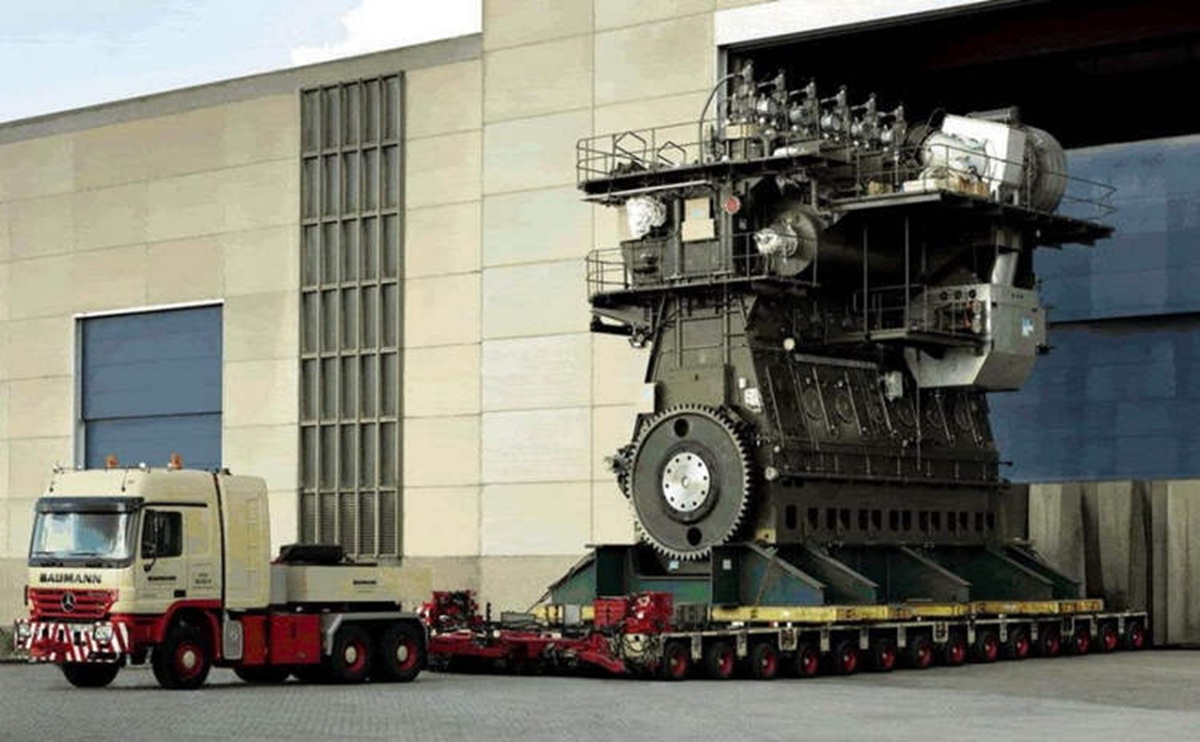


The Largest Combustion Engine in the World, with 14 Cylinders and 2,300 Tons, Drives Giant Container Ships with Power Greater Than 108,000 BHP
The 14-Cylinder Wärtsilä-Sulzer RTA96-C, a two-stroke diesel engine with turbo, holds the title of the largest combustion engine ever built.
Designed to move large container ships, it stands out for its monumental size and ability to generate power at exceptional levels. With a height of thirteen meters, a length of twenty-six meters, and a total weight of 2,300 tons, the structure stands as one of the largest engineering feats ever applied to maritime transport.
Impressive Dimensions and Performance
The assembly brings together components of equally extraordinary scale. The crankshaft weighs 300 tons and each of the 14 pistons weighs 5 tons. Operating at 102 rpm, the engine delivers 108,920 BHP, equivalent to 80,080 kW, consuming around 250 tons of heavy fuel oil per day. Even in its most efficient configuration, the burn rate reaches 1,660 gallons per hour.
-
A Mercado Livre customer opened their package and found 32 resumes of people looking for jobs crumpled as protective paper inside the box, exposing names, addresses, documents, and phone numbers of dozens of candidates.

-
Iceberg A23a, one of the largest in the world, is undergoing accelerated collapse and may disappear: what explains the end of the ice giant?

-
The simplest swap at home can reduce energy consumption by up to 90% without changing habits, using a technology that lasts up to 25 times longer and consumes only a fraction of the electricity.

-
With over 14 million baskets of earth moved, an ancient North American metropolis built a monumental pyramid of 30 meters and established a city with 20,000 inhabitants nearly a thousand years ago.

Expansion of an Established Project
The Finnish manufacturer Wärtsilä decided to develop the new model upon realizing that the 12-Cylinder RTA96C engine would not meet the growing demand for ever-larger ships, such as the Emma Maersk. The solution was to expand the power range of the original design by adding two extra pistons to achieve the necessary 80,080 kW.
Structural Adjustments to Support the New Configuration
The addition of new cylinders required careful revisions. The material of the crankshaft was updated to withstand the increased torque, and engineers meticulously analyzed the stiffness and structural strength of the assembly. The goal was to ensure efficient and safe operation, even with the significant increase in load and internal stresses.
Entry Into Operation and Production Value
First produced in 2006, the 14-Cylinder Wärtsilä-Sulzer RTA96-C entered commercial service that same year, installed on the Emma Maersk, then the largest container ship in the world. The manufacturing process, extremely complex and resource-demanding, results in each unit exceeding a value of 25 million dollars.








Tem pouco anúncio nessa pagina, coloca mais **** da nem para ler a matéria com essse monte de anúncios
Será que as autoridades fiscalizam isso?
Tá aí os maiores poluidores, enquanto o governo se preocupa com carros os navios estão detonado o meio ambiente!!!