





 Portuguese
  English
  Spanish
  4 min of reading
  0 comments


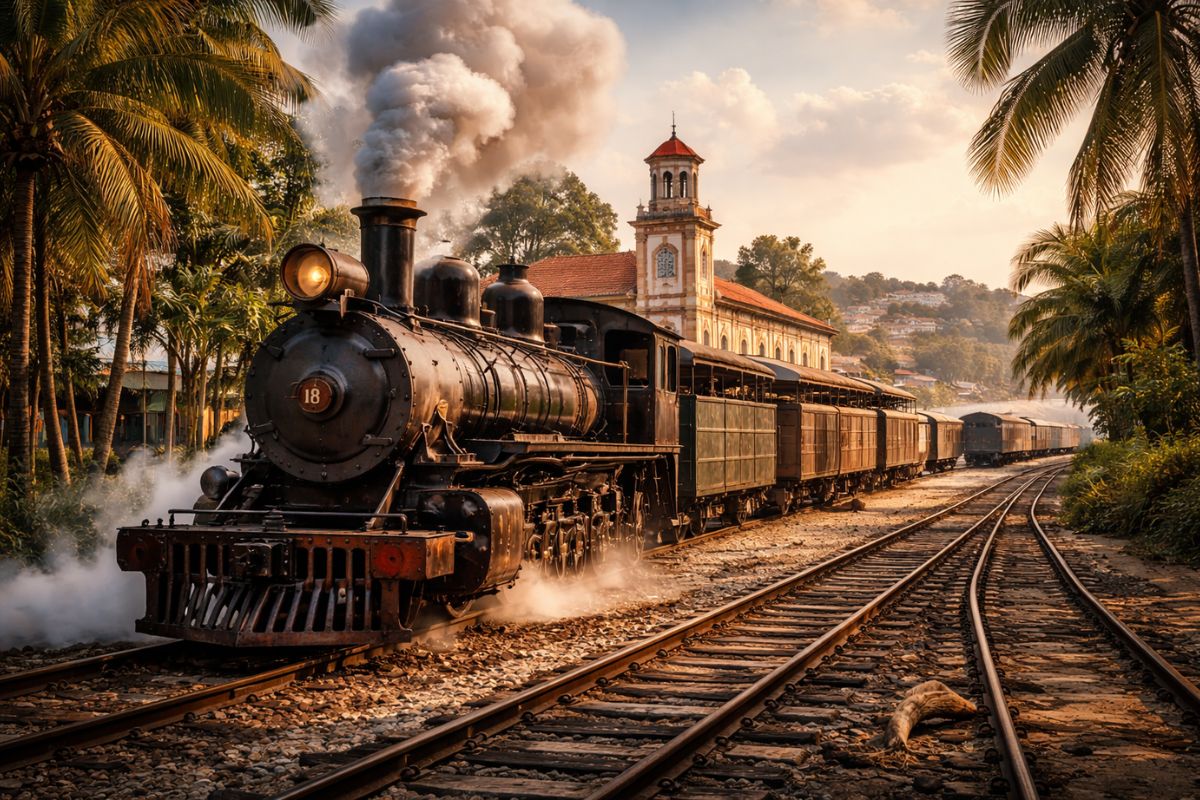
In The Amazon Capital That Grew Between Rivers And Rails, The Tourist Landscape Is Just The Visible Layer: Porto Velho Bears The Marks Of The Madeira-Mamoré Railroad, Known As The Devil’s Railroad, And The Madeira River Remains A Reference For Movement, Memory And Local Economy In A Border Territory, Still Silent.
The Amazon capital of Porto Velho is usually read as a landscape of river and sunset, but the city was born, in practice, from a logistical decision. When the Madeira-Mamoré Railroad began construction in 1907, the construction site became an urban nucleus, and the Madeira River started to organize routes, supply, and work. The legacy is still on the street, not just in the museum.
What today seems like a simple route, with exposed locomotives and old warehouses, is the final layer of a hard process, involving labor immigration, sanitary risk, and a clear economic goal: to overcome the rapids of the Madeira River and connect regional production. The Devil’s Railroad became a nickname precisely because of this sum of ambition and human cost.
Tracks That Became A City

Porto Velho emerged in 1907 as an operational support point for the Madeira Mamoré Railway Company, in the context of the construction of the Madeira-Mamoré Railroad.
-
Home environment can influence the brain, mood, and well-being: studies indicate an increase of up to 15% in productivity, a reduction of 12% in stress with plants, and a direct impact of the circadian rhythm on the 24 hours of the day.

-
A Brazilian millionaire couple restores a farm over 150 years old in the interior of São Paulo and transforms the historic property with Portuguese tiles, antique furniture, and new spaces into a refuge that blends tradition, comfort, and sophistication.
-
Submerged city in a lake in Minas reveals intact streets, preserved vehicles, and houses after more than 60 years, impressing divers.
-
Yellowstone has started to rise again in an area of the caldera, and the movement rekindles fears surrounding the U.S. supervolcano, as scientists monitor the deformation and try to understand what is happening underground.

The logic was industrial: clear a path through the forest, keep supplies coming, and provide technical support to a project that depended on a continuous work rhythm.
In a few years, the railroad structure began to define housing, commerce, and services.
The urban formalization came later, and the Amazon capital that today concentrates administrative functions in Rondônia carries this DNA.
The shape of the city, the circulation axes, and the centrality of the railway complex help explain why “destination” and “infrastructure” blend in the same block in Porto Velho.
What The Madeira-Mamoré Complex Still Proves

In the Complex of the Madeira-Mamoré Railroad, locomotives and warehouses serve as material evidence of an occupation model.
The protection by IPHAN helps preserve the pieces as a historical reference, but the central point is another: the railroad was not an accessory, it was the engine of settlement.
The very expression Devil’s Railroad appears as a public memory of the cost of carrying out heavy engineering in a hostile environment.
The Rondonian Memory Museum enters this circuit as a context archive, gathering objects and records that connect the daily life of Porto Velho to the railway cycle.
Rather than romanticization, the collection is useful to understand who came, why they came, and how the Amazon capital was structured around rails, workshops, warehouses, and ports.
Madeira River As Liquid Road
The Madeira River is not in the narrative merely as scenery.
In a region where river transport has historically been decisive, the river operated as a supply corridor and, at the same time, as a physical and climatic limit.
When the level rises and falls, the routine changes, access changes, commerce changes.
This factor appears even in sunset tours, which are, in practice, a tourist reading of a natural infrastructure.
The relationship with the Madeira River also helps explain why the Madeira-Mamoré Railroad was seen as a solution: the railroad promised to circumvent navigation bottlenecks and accelerate flows.
Even deactivated, the logic remains in the urban identity of Porto Velho, where riverbank, port, and rail are still easily recognizable spatial references.
Between Tourism, Economy And Logistics At The Border
The Amazon capital has consolidated itself as an economic and cultural center of Rondônia, and at the regional base, logistics weighs as much as the river’s imagery.
The city is located on the border with Amazonas and Bolivia, reinforcing its role as a junction.
This is why visitors find, side by side, a museum, a locomotive, and the Madeira River as a lifeline.
There is also a climatic component that influences the city’s use. Porto Velho has a hot, humid equatorial climate, with rainy periods that impact travel planning and outdoor activities, and a record high above 38°C.
Even here, the reading is practical: urban infrastructure needs to respond to heat, humidity, and seasonality, while the memory of the Devil’s Railroad continues to serve as a reference for how the region was “built” through struggle.
Porto Velho is not relevant because it has old locomotives, but rather because they expose the mechanism that founded an Amazon capital around a project: the Madeira-Mamoré Railroad, the Madeira River, and the Devil’s Railroad as marks of decision, risk, and permanence.
Which infrastructure has changed your city the most, a bridge, a road, a port, or a train line, and do you think it improves daily life or merely shifts the local power map?









-

-

2 pessoas reagiram a isso.