





 Portuguese
  English
  Spanish
  4 min of reading
  28 comments


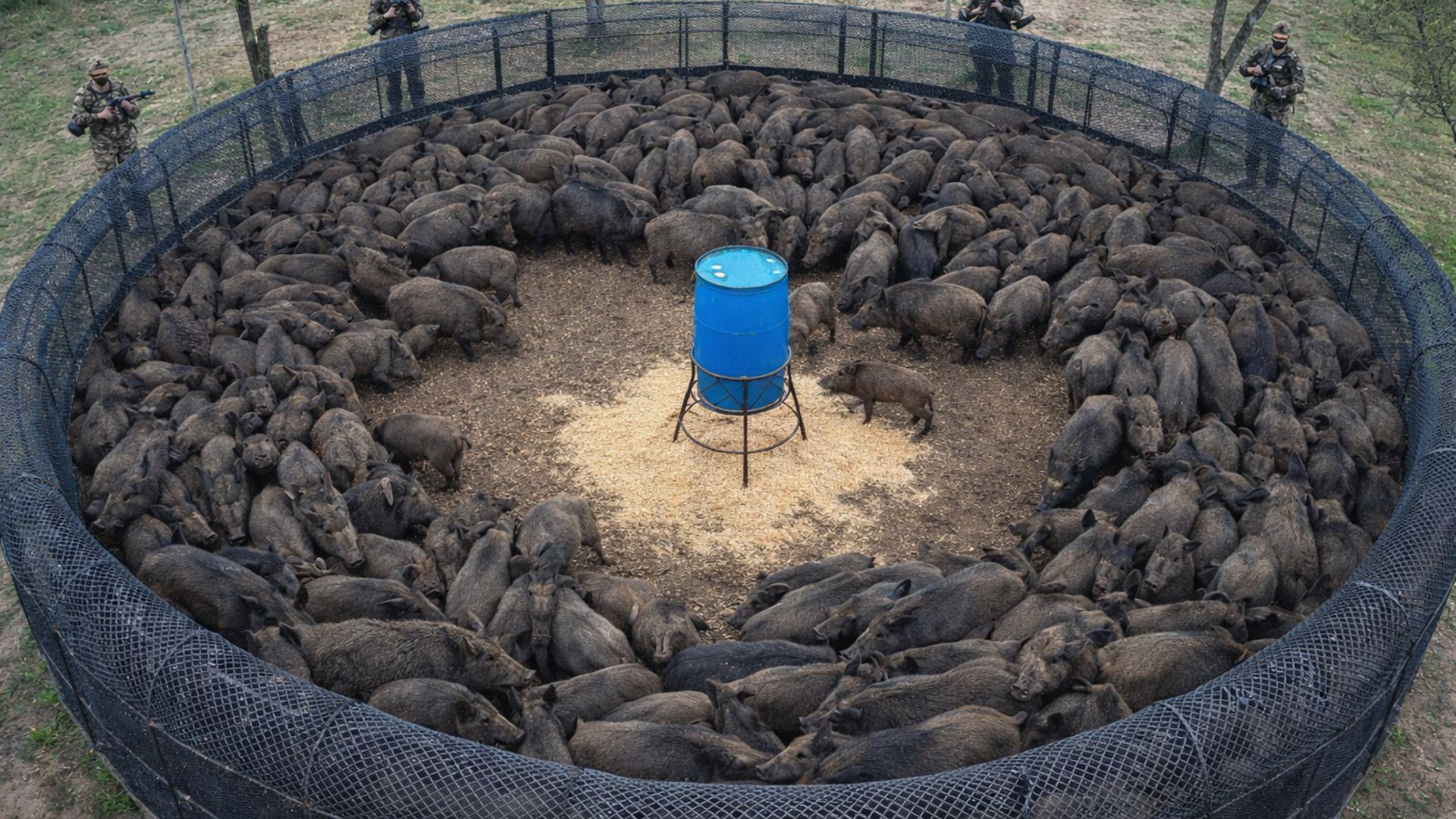


Record Slaughter Coexists with Underreporting, Accelerated Reproduction, and Legal Hurdles That Hinder Wild Boar Control in Brazil, While Producers Report Rising Losses and Experts Warn of the Gap Between Official Numbers and Reality in the Field.
Brazil recorded the slaughter of over 511 thousand wild boars in 2025, according to data from the wildlife management information system operated by Ibama.
Despite the record number, reports gathered by the channel Fatos Rurais indicate that the species’ advance continues practically unchecked, with increasing impacts on agricultural production and the environment.
The discrepancy between official numbers and perception in the field has a recurring explanation among specialists, producers, and hunters.
-
WEG took its technology to Spain to create a solar irrigation system that operates independently without needing an electrical grid, and now farmers control everything remotely via their mobile phones.

-
The US faces a meat crisis with fires, pests, and strikes, consumption rises and supply falls to the lowest level since 1952, creating a billion-dollar opportunity for Brazilian exports to grow in 2026.
-
China rejected an entire shipment of beef from Argentina after detecting an antibiotic so dangerous that it has been banned for human consumption for over 30 years, and now the export sector is facing a crisis of international trust.
-
With nearly 500 thousand tons per year, barley production is growing in Brazil, while a decline in beer consumption among Generation Z raises alarms in the sector.


The registration system is self-declarative, allowing room for underreporting.
According to Professor Paulo Bezerra, cited in articles from Fatos Rurais, the actual total of wild boars slaughtered could be up to five times greater than what is officially reported.
According to reports, many hunters fail to record all the animals killed due to bureaucratic or operational issues.
Official Numbers Do Not Keep Up with the Pest’s Expansion

The over 511 thousand wild boars recorded in 2025 represent the largest annual volume ever reported in the country.
Still, this number would not have been enough to curb the species’ expansion.
Even if the data reflected reality accurately, assessments reproduced by Fatos Rurais indicate that the reproduction rate of wild boars exceeds the current control capacity.
This mismatch helps explain why, despite increasing efforts, producers continue to report losses and an increase in the presence of the animals in agricultural areas.
The absence of a precise estimate of the total population exacerbates the scenario and makes it difficult to define realistic management goals.
Wild Boar in Brazil Advances Without Natural Predators
Originating from Europe and Asia, the wild boar has found a favorable environment in Brazil to expand.
Without natural predators and with a high reproductive capacity, the animal has rapidly spread, especially in the Centre-West, South, and Southeast regions.
In Mato Grosso do Sul, cited in reports from Fatos Rurais, farmers report recurring losses.
Crops of corn, soy, sugarcane, and pasture areas are among the most affected.
Damage occurs both during feeding and while the herds move, disturbing the soil and destroying entire plantations.
In addition to the economic impact, the original text highlights sanitary risks associated with the presence of wild boars.
The possibility of disease transmission is described as a direct threat to productive chains.

Hunting with Dogs and Shotguns Requires Coordination
To try to reduce losses, farmers and hunters resort to different control techniques.
The most common involves hunting with dogs, almost always done in groups.
The method is described as necessary given the size and aggressive behavior of the animal.
The dynamics usually divide the team into two fronts.
One group acts as scouts, moving through the woods with hunting dogs.
Another remains positioned in strategic locations known as “waiting spots”.
The dogs locate the wild boar by scent and keep it under pressure, following its escape at high speed.
This work reduces the chance of direct attack on the hunters.
The shooters, usually armed with shotguns, wait for the moment when the wild boar suddenly appears.
The confrontation usually occurs at short range.
The shot needs to be precise since the wild boar is resilient and may continue advancing even when injured.
Reports gathered by Fatos Rurais indicate that coordination, communication, and experience are essential to avoid accidents.
Collective Traps Gain Ground in Control
In areas with a higher concentration of animals, some producers have started adopting strategies considered more efficient.
Among them are collective traps, capable of capturing entire groups at once.

The older versions were made of iron, in a corral shape, with manual closure.
Although they worked, they were described as expensive, heavy, and difficult to transport.
The new generation uses high-strength nylon nets, as described in content from Fatos Rurais.
Lighter and easier to set up, these traps can be installed far from the property headquarters.
The wild boars enter attracted by food, and the system closes automatically.
The main distinguishing feature is the capture of the entire group, including adults and piglets.
By preventing escapes and reducing the chance of immediate reproduction, the method is presented as more effective.
The text cites the United States as an example of a country where this type of trap has been used for years.
Stalled Licenses and Bureaucratic Hurdles
Even with the adoption of different techniques, pest control faces administrative hurdles.
Hunters report slow processing of licenses and increased supervision.
The text states that over a thousand licenses have been suspended.
There are also reports of weapon authorization processes stalled for months in the Army.
These operational difficulties, according to content reproduced by Fatos Rurais, reduce the capacity for field response.
The Brazilian Association of Hunters is cited as critical of the authorities’ actions.
According to the report, the entity argues that total eradication of wild boars is already considered unfeasible.
Priorities in this context would be damage reduction.
The forecast presented for 2025 indicates the need to slaughter over 1 million wild boars.
If record numbers have not been enough to curb the species’ advance, what adjustments in management, licensing, and monitoring could change this scenario?





Porque as autoridades não administram o controle desta pragas de javalis, para evitar acidentes e crimes ambientais?
Essa praga destrói menos que o governo ****.
Comentário **** ,só pode ser um **** bozolóide.
Todas as pragas crescem com esse desgoverno. E o pior é que travaram os processos legais dos CACs. Enquanto as ONGs querem abate, tipo eutanásia kk, os ruralistas amargam o prejuízo.
Nada a haver com esse governo. É uma praga se repriduz assustadoramente. E outra se nao
For javali originário da Europa e muito pior ou seja se for mestiço com porco é muito mais **** reproduz em larga escala e são transmissores de doenças. Na Europa e Estados unidos eles nao sabem mais o qye fazem. Eles destroem tudo. Devoram as plantações
Mais um comentário **** de um BESTALÓIDE bozopata.
Bestialidade e quem não produz critica controle de praga exótica. Na França comi javali fruto de caça , uma delícia. Aqui temos que liberar caça e consumo da caça para reduzir competição desse **** exótico com espécies nativas.
Chega ser ridículo!!! Com milhões de javalis destruindo o alimento do ser humano, vem uma ONG com essa de eutanásia, é muita ignorância mesmo, o Agro amargando prejuízos e as ongs que nada produzem , com essa historinha de eutanásia.