Portuguese
  Spanish


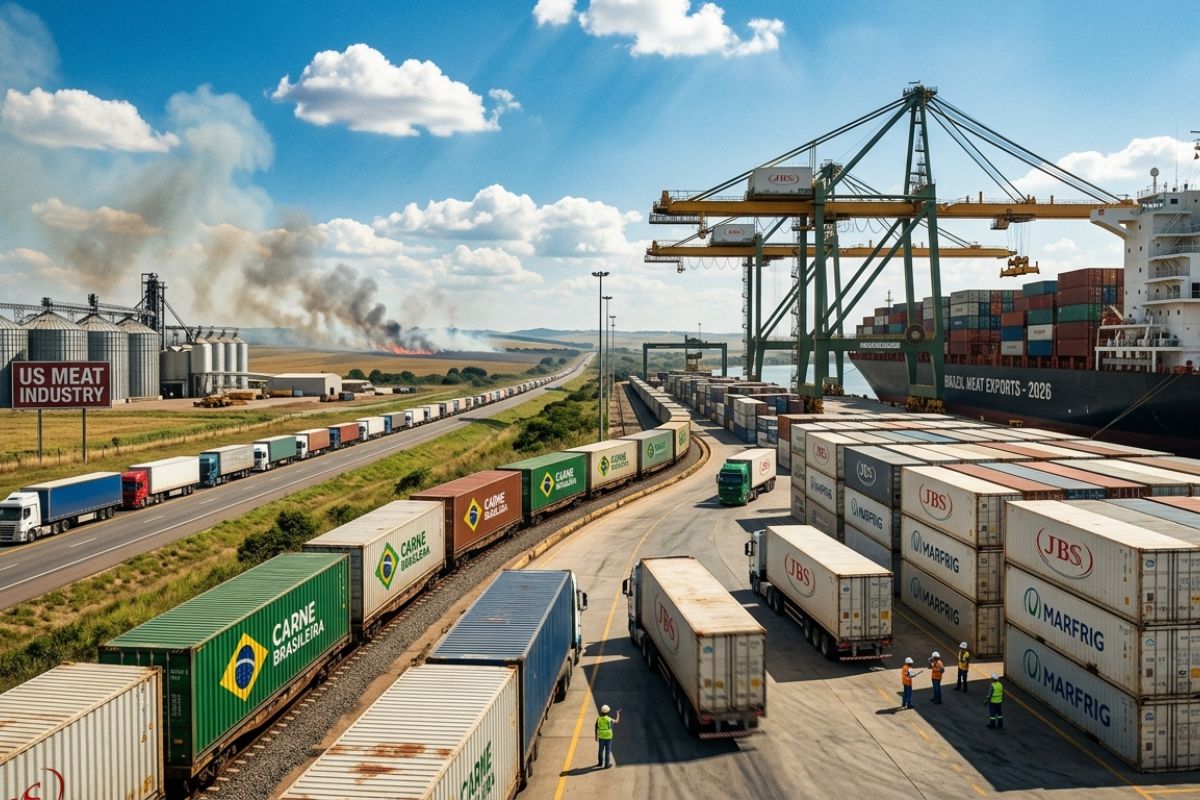

Beef is under pressure in the United States, while Brazil gains strength in exports with a smaller herd and tight supply.
Beef is at a decisive moment in the international market. In the United States, the combination of climate, health, and labor issues is pressuring supply at a time of increasing consumption, creating a strategic window for Brazilian advances in exports in 2026.
At the same time, Brazil is in a privileged position to turn this crisis into an opportunity. With greater production, global leadership, and supply capacity, the country can expand its external presence just when the American market needs to buy more meat from abroad.
Fires, pests, and strikes pressure meat in the United States
The beef crisis in the United States has gained strength from a series of factors that directly affect livestock.
-
Brazilian Farmer Invents Low-Cost Tractor Using Motorcycle Parts, Efficiently Working 2 Acres on 1 Liter of Diesel

-
Regenerative Farmers Use Keyline Plow to Improve Pasture Hydration, Storing 1 Gallon of Water Every 30 Centimeters

-
Bicolor Pumpkin Resembling Hand-Painted Art Discovered by Brazilian Researchers in the Capital Due to “Spontaneous Mutation”

-
In China, a 26-story building produces 1.2 million pigs annually, revolutionizing livestock farming with tube feeding and AI surveillance.


One of the main points is the advance of large wildfires in the state of Nebraska, which have devastated a huge area of pasture, compromising the support base of the herd.
This problem occurs at the same time the sector faces the spread of the so-called New World screwworm, coming from Mexico.
As if that were not enough, strikes at JBS facilities in Colorado also worsen the scenario, reducing the volume of animals sent for slaughter. When fires, pests, and shutdowns combine, the supply of meat becomes even tighter.
Consumption rises even with record prices
The most sensitive point of this crisis is that it occurs at a time when beef consumption continues to advance.
The projection presented in the material indicates that per capita beef consumption in the United States is expected to rise from 26.8 kilograms in 2025 to 27 kilograms in 2026.
This growth occurs even with prices already quite high. In January, beef recorded a 15% annual increase in the American market, a significant advance for a country with historically more controlled inflation.
In other words, consumers continue to buy more even while paying more, which further increases pressure on an already weakened system.
Production grows little and herd falls to lowest level in decades
While consumption advances, beef production has grown only 4%, reaching about 11.8 million tons.
This pace is considered insufficient given the demand and helps explain why the United States has lost global leadership to Brazil.
Moreover, the American herd has seen a 13% decline since 2019, reaching 28 million head. This is the lowest level since 1952.
This data shows that the crisis is not just a point issue, but structural, resulting from years of prolonged drought, reduced pastures, and rising costs in the western part of the country.
The recovery of this situation is not usually quick. The rebuilding of the herd depends on retaining breeding stock, the birth of calves, and a livestock cycle that takes time to respond. Therefore, even if some immediate problems decrease, the supply restriction tends to continue.
Brazil gains a rare chance to sell more meat


Given this combination of limited supply and heated demand, the trend is for an increase in American imports of beef in 2026.
The projected figure is 2.53 million tons, a volume that opens important space for external suppliers.
In this scenario, Brazil emerges as the strongest name. The country already leads global production and has the scale to increase shipments. The opportunity is billion-dollar because it involves a large, pressured market willing to buy more.
If this movement is confirmed, the effect could go beyond the increase in exports. The external appreciation of beef tends to further strengthen Brazil’s position in the global market and may also influence internal prices, as a larger portion of production would be contested abroad.
Brazilian leadership may consolidate even further
The loss of leadership by the United States to Brazil is not just symbolic. It reinforces a shift in the global geography of beef.
With greater production and room to grow in exports, Brazil consolidates itself as the main global supplier at a time of international imbalance.
This position becomes even more relevant because the American market, traditionally very strong, is becoming more dependent on external purchases just when its production faces historical limitations.
For Brazil, it is a chance to increase participation and reinforce its prominence in a strategic sector of agribusiness.
What this crisis could mean for 2026
If the problems in the United States persist in the coming months, 2026 could mark a new leap for Brazilian beef in international trade.
Fires, pests, strikes, a reduced herd, and rising consumption form a combination that is difficult to reverse in the short term.
For Brazil, this represents a concrete opportunity to expand exports, gain market share, and strengthen its global leadership.
The American crisis, which today still seems controlled, could turn into one of the largest recent trade openings for Brazilian livestock.
In your opinion, is Brazil prepared to take advantage of this window and sell even more meat to the external market in 2026?