





 Portuguese
  English
  Spanish
  3 min of reading
  1 comment


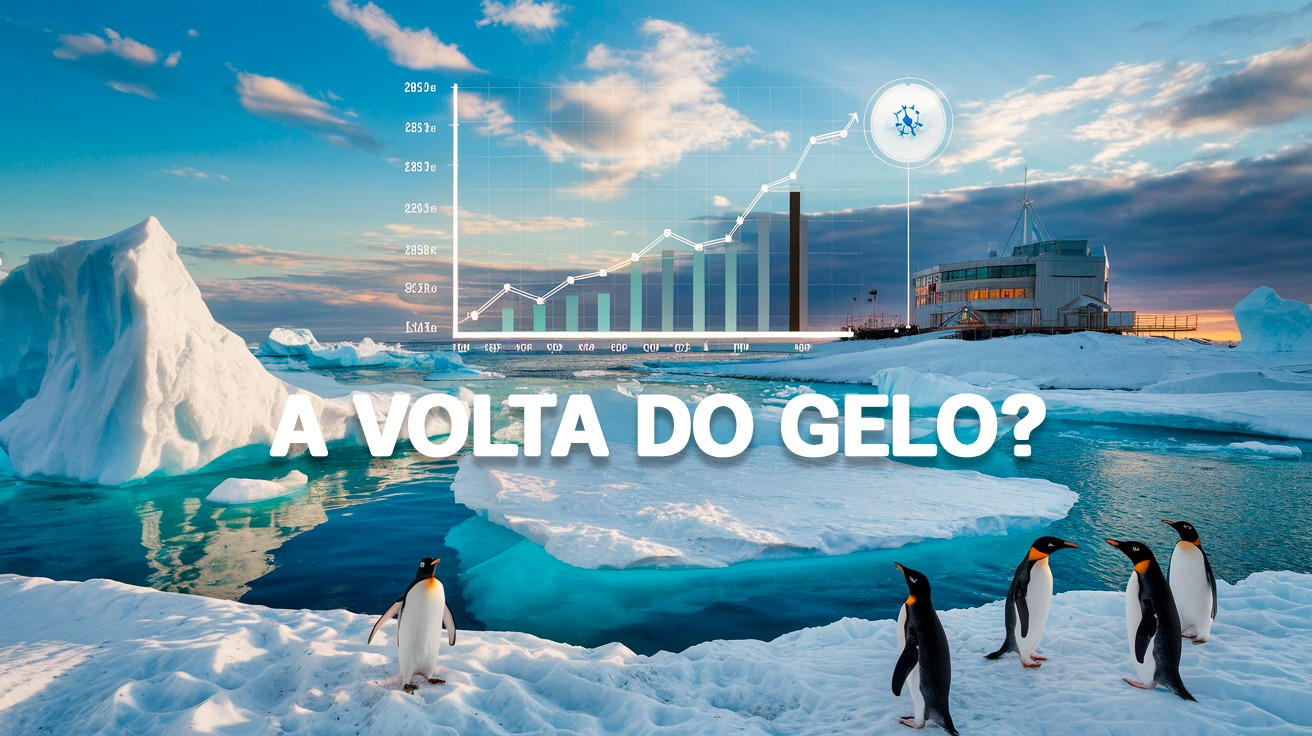


The Antarctic Sea Ice Surprises With An Unexpected Recovery In 2024, After Years Of Record Melting. Data Points To High Variability, But Experts Warn: Global Warming And El Niño Still Threaten The Future Of The Icy Continent.
For years, the Antarctic sea ice has been at the center of global climate concerns. The record losses observed in 2023 and 2024 were an alarming signal of the consequences of global warming.
However, a recent recovery in sea ice extent by the end of 2024 brought temporary relief and raised questions about what is really happening on the coldest continent on Earth.
What The Data Reveals
In December 2024, the extent of Antarctic sea ice reached 7.3 million square kilometers, approaching the average values recorded between 1981 and 2010, as reported by the National Snow and Ice Data Center (NSIDC).
-
Sleeping at different times each day can be a bomb for your heart and even double your risk of having a heart attack.

-
Without help and without heavy machinery, a woman builds a house from scratch with stone, wood, and cement, erects a chimney, creates a complete leisure area, and transforms an empty lot into her dream home.

-
Couple transforms abandoned house after years of being closed; residence was overgrown with weeds, had a green pool, and a deteriorated structure in the interior of Rio de Janeiro.

-
Hidden marks on the walls of the site associated with the Last Supper of Jesus for centuries have been deciphered in Jerusalem, revealing medieval inscriptions left by pilgrims, European nobles, and travelers from the Middle East.


This recovery occurred after a critical period in which the Antarctic faced historical lows in sea ice, due to the high temperatures caused by global warming and the El Niño phenomenon.
According to the NSIDC, the rate of ice loss during November and December 2024 slowed significantly.
This pause was crucial for the sea ice to recover, albeit temporarily. Scientists highlight that the high variability in sea ice extent is one of the most intriguing factors about the Antarctic climate.
“This clearly illustrates the high variability of Antarctic sea ice extent,” stated an NSIDC release. Despite the recovery, there are many reasons to remain alert.
The Influence Of Global Warming And El Niño
The rise in global temperatures has a direct impact on sea ice. In recent years, oceans have recorded historical temperatures, both at the surface and in the depths.
This warming is driven by greenhouse gas emissions and has been exacerbated by the El Niño phenomenon, which has intensified heat on a global scale.
Since 2023, scientists have observed a pattern of accelerated melting in Antarctic sea ice, contributing to rising sea levels and threatening coastal communities around the world.
The recent recovery, although positive, does not contradict the long-term trend of increasingly severe losses.
According to Uol, scientists are closely monitoring these variations to understand whether the recovery is just a transitional phase or part of a broader pattern of climate variability.
The Danger Of Permanent Changes
Since 2016, there has been growing concern that global warming is causing permanent changes in the dynamics of Antarctic sea ice.
The combination of elevated ocean temperatures and extreme weather patterns has led to a series of atypical events, such as the “dramatic” or record highs of 2017, 2023, and 2024.
The “regime shift thinking” theory has gained prominence in recent years. This idea suggests that Antarctica may be undergoing a transition that will lead to permanent losses of sea ice.
The data from 2024, despite being hopeful, is not enough to invalidate this possibility.
Why Is Antarctica So Important?
Antarctica plays a crucial role in global climate balance. Its ice layers reflect sunlight, helping to keep the planet cooler.
Additionally, sea ice acts as a protective barrier, regulating ocean temperatures and protecting vulnerable marine ecosystems.
If the ice layers continue to melt, the impact on sea levels will be devastating. Millions of people living in coastal areas are at risk.
Moreover, the loss of ice can trigger cascading effects, such as changes in ocean currents and global climate patterns.
What Comes Next?
Although the recovery of sea ice in 2024 is a positive sign, scientists warn that there is no reason for complacency.
It is essential to continue closely monitoring conditions in Antarctica and to reduce greenhouse gas emissions to mitigate the impacts of climate change.
As reported by the NSIDC, long-term monitoring is essential to understand natural variability and the impacts of human activities on Antarctic sea ice. Only with coordinated global action will it be possible to preserve this crucial ecosystem.
Is The Recovery Of Sea Ice In Antarctica A Relief Or A Warning? Share Your Opinion In The Comments!








Olá Pessoal ! Tenho esposto através do LinkedIn ( Valderi Ribeiro)meus vários projetos, que sem dúvidas nem uma irão salvar o planeta Terra! De um colapso generalizado. Meu principal projeto e mais urgente sem dúvidas nem uma, que irá impedir o derretimento das geleiras dos polos, recuperando de todos degelo já ocasionado! Impedirá que os SOL aqueça além do normal vários países. Uma vês regulando a temperatura, evita-se várias tragédias tipo, ciclones tornados grandes incêndios, quase na totalidade, chuvas exageradas etc… Evitando a falta de água doce e em consequências a pior causa de todas, que nos levará a extinção muito em breve! A falta de alimentação que já está ocorrendo infelizmente. Peço a todos os cidadãos de bem, que me ajudem nesta causa. Tão necessária e urgente para nossa sobrevivência nesta terra.🌍🌍🌍. Que Deus nos Abençoe! Amém 🙏🙏🙏