





 Portuguese
  English
  Spanish
  6 min of reading
  0 comments


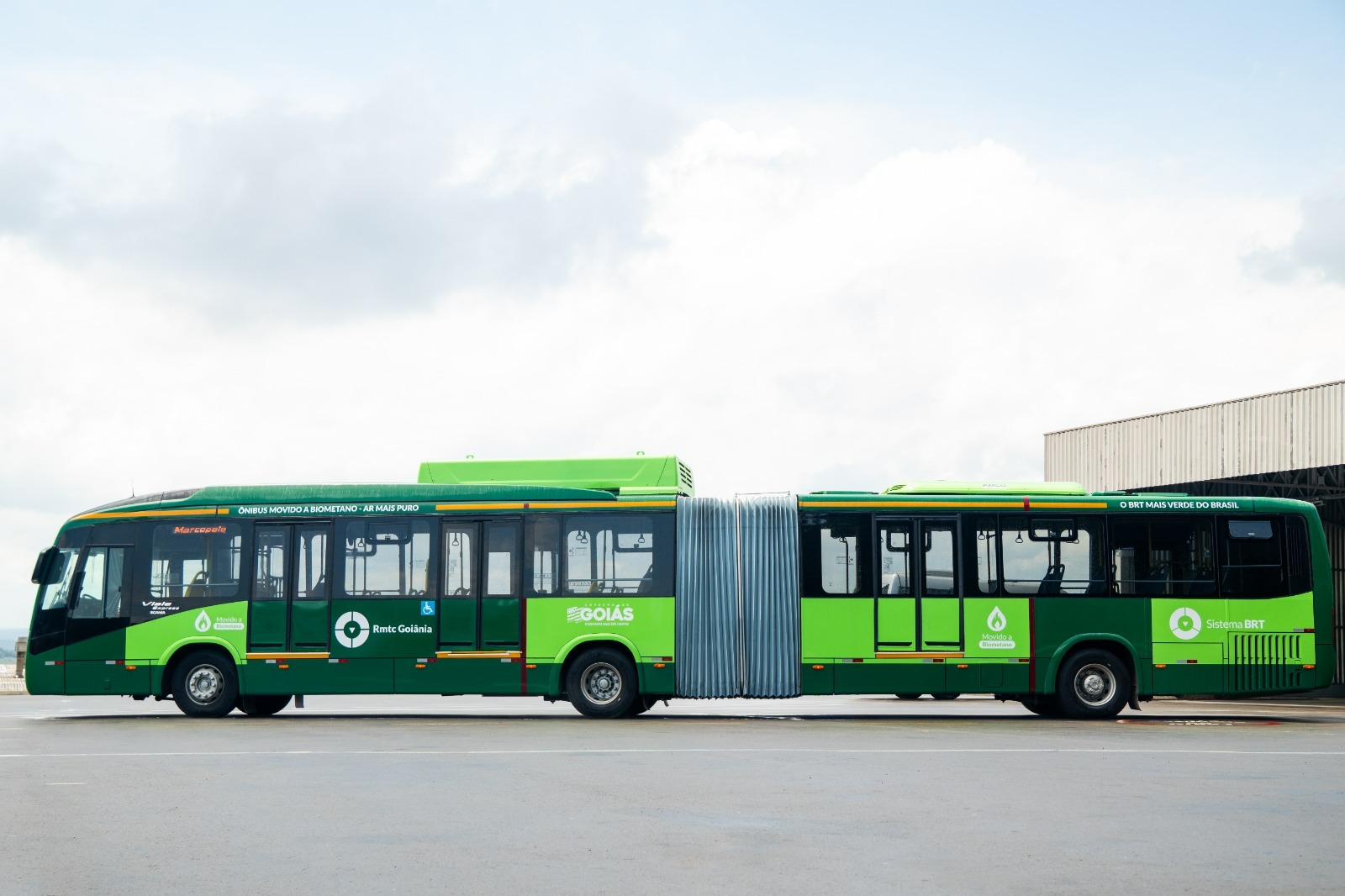
The capital of Goiás begins the renewal of its fleet with the arrival of articulated buses powered by biomethane, a sustainable technology that uses renewable gas to transform urban mobility and reduce dependence on fossil fuels.
Goiânia has just written a new chapter in the history of national urban mobility by integrating the first articulated buses powered by biomethane in Brazil into its transportation system.
The Government of Goiás, in partnership with the Metropolitan Collective Transport Network (RMTC), launched the giant vehicles to initially operate on the iconic Anhanguera Corridor, the main transport corridor of the capital.
This initiative replaces old diesel models with a clean technology that utilizes gas generated from organic waste, thereby reducing greenhouse gas emissions by up to 90%. The new vehicles are 18 meters long, have a capacity for over 140 passengers, and offer comfort features such as air conditioning, USB chargers, and free Wi-Fi.
-
From the field to the pipelines: Mato Grosso do Sul accelerates the energy transition and consolidates a new axis in renewable energy with the arrival of a giant biogas plant.
-
The Economist states that Brazil has a “secret weapon” against expensive oil and highlights how the country can reduce economic impacts even in international scenarios of high volatility.

-
Brazil accelerates decarbonization in the South: International forum in Foz do Iguaçu gathers leaders to discuss the advancement of biomethane in the energy matrix and the potential of “caipira pre-salt.”
-
As diesel prices soar due to conflicts in the Middle East, a Brazilian city decides to test a little-known biofuel that promises to completely replace fossil fuel without adaptation and could change the future of energy in the country.

In addition to the immediate environmental benefit, the adoption of biomethane positions Goiás as an energy innovation hub in the Midwest, leveraging the state’s strong agro-industrial base to produce renewable fuel. Thus, the operation marks the beginning of a complete transition aimed at modernizing the entire public transport system in the metropolitan area by the end of 2026.
The technology behind the articulated buses powered by biomethane in Goiânia
The arrival of articulated buses powered by biomethane represents a technological leap for the automotive industry and the energy sector. Unlike common Compressed Natural Gas (CNG), which has fossil origins, biomethane comes from the treatment of biogas extracted from landfills or agricultural waste.
Scania, the manufacturer of the chassis, developed specific engines for the Otto cycle that operate exclusively on gas. These engines deliver the same power and torque as diesel models but operate at a significantly lower noise level, improving the experience for both drivers and pedestrians and passengers.
The structure of the giant vehicles features high-strength cylinders installed on the roof or sides. These tanks store gas under high pressure, ensuring a range that exceeds 300 kilometers per day of operation.
The rapid refueling system allows the bus to return to the corridor in just a few minutes, thus maintaining the necessary flow for a high-demand system like the BRT (Bus Rapid Transit).
The project in Goiânia serves as a showcase for other Brazilian capitals seeking viable alternatives to total electrification, which often requires much higher and time-consuming investments in electrical network infrastructure.
Circular economy and waste utilization in Goiás
One of the most interesting aspects of the operation of articulated buses powered by biomethane lies in the origin of the fuel. Goiás has one of the largest agro-industrial parks in the country, generating a massive amount of organic waste.
By converting this waste into biomethane, the state closes the circular economy cycle. What was once an environmental problem in landfills or farms now powers the public transport of the capital.
This model reduces the operational cost for transport companies, as biomethane has a more stable price than diesel, which experiences constant fluctuations based on international oil prices and the dollar.

Local gas distributors are investing in the creation of dedicated refueling stations within the operators’ garages. This eliminates the need for vehicles to travel to commercial stations, optimizing logistics.
The production of biomethane in the state also stimulates the creation of new businesses and green jobs, from the collection of organic waste to the operation of gas purification plants. Goiânia proves that sustainability can be economically profitable and technically efficient at the same time.
Impact on public health and passenger comfort
The replacement of diesel with articulated buses powered by biomethane brings direct benefits to the health of the Goiânia population. Traditional diesel engines emit particulate matter and nitrogen oxides, substances that cause respiratory and cardiovascular diseases.
Biomethane almost completely eliminates the emission of black smoke and soot. In a high-density corridor like the Anhanguera Corridor, where thousands of people circulate daily, the improvement in air quality is immediate.
In addition to the environmental aspect, passengers enjoy a much quieter cabin. The reduction of engine vibrations makes the journey smoother, thus decreasing thermal and noise stress. The new models also feature state-of-the-art pneumatic suspension and low floors at strategic points, facilitating access for people with reduced mobility.
The Government of Goiás believes that the improvement in service quality will attract more users to public transport, alleviating traffic congestion in the central region.
Curiosities about the articulated buses powered by biomethane
The new articulated buses powered by biomethane impress with their size. At 18 meters long, they are equivalent to almost two conventional buses.
To maneuver these machines, drivers undergo specific training focused on defensive driving and economical driving. The digital dashboard of the vehicles provides real-time data on gas consumption and engine performance, allowing the control center to monitor fleet efficiency minute by minute.
Another interesting fact is the safety of the gas tanks. Many people still have concerns about the use of gaseous fuels in large vehicles. However, the biomethane tanks undergo rigorous impact, fire, and puncture tests.
In case of any anomaly, automatic safety valves immediately stop the gas flow. The technology is as safe as, or even safer than, traditional diesel tanks. Additionally, biomethane is lighter than air; in the unlikely event of a leak, it dissipates quickly into the atmosphere instead of accumulating on the ground.
The plan for expanding the sustainable fleet in Goiás
The arrival of the first units of articulated buses powered by biomethane is just the starting point of a robust modernization plan. The Metrobus, the state-owned company that operates the Anhanguera Corridor, plans to replace its entire operational fleet with low-emission models.


The project envisions the coexistence of biomethane-powered buses with 100% electric vehicles, creating a diversified transportation matrix. This strategy ensures that the system does not rely on a single energy source, increasing resilience against energy crises or fluctuations in input prices.
The total investment in fleet renewal and the renovation of the Anhanguera Corridor stations exceeds R$ 1.5 billion. This amount includes the purchase of vehicles, the installation of electric chargers, and gas infrastructure.
The ultimate goal is to transform the Anhanguera corridor into a model of “Sustainable Corridor” for all of Latin America. The success of the operation in Goiânia is already attracting the interest of managers from other metropolitan regions, such as Brasília, Belo Horizonte, and Curitiba, who are seeking practical solutions for the decarbonization of their fleets.
Logistical challenges and the future of gas infrastructure
To sustain the continuous operation of articulated buses powered by biomethane, the state of Goiás is working on expanding its gas distribution network.
The construction of new biomethane plants near the capital reduces the cost of transporting the fuel and ensures regional energy sovereignty. The challenge lies in balancing the supply of gas with the growth of the fleet, ensuring that fuel is never lacking for the giants of the Anhanguera Corridor.
The maintenance of these vehicles also requires a specialized workshop and mechanics trained in the new technology. The components of gas engines have different characteristics from diesel engines, requiring specific tools and computerized diagnostics.

Scania and local dealerships provide intensive technical support during this transition phase, ensuring that fleet availability remains above 95%. Continuous training of maintenance teams is the key to the long-term success of the project.
Goiânia leads the mobility of the future
The introduction of articulated buses powered by biomethane in Goiânia proves that Brazil has the technology and resources to transform public transport efficiently and sustainably.
The use of renewable gas enhances the Goiás agribusiness, cleans the air of the capital, and offers dignity to passengers who use the system daily. The project breaks decades of dependence on diesel and places Goiás at the forefront of the low-carbon economy.
The future of urban mobility necessarily involves diversifying energy sources. By investing in biomethane, Goiânia delivers a solution with real and immediate impact, without the cost limitations that still hinder mass electrification in Brazil.
The “green giants” of the Anhanguera Corridor symbolize a new era, where economic development goes hand in hand with environmental preservation and technological innovation.





Seja o primeiro a reagir!