





 Portuguese
  English
  Spanish
  5 min of reading
  0 comments


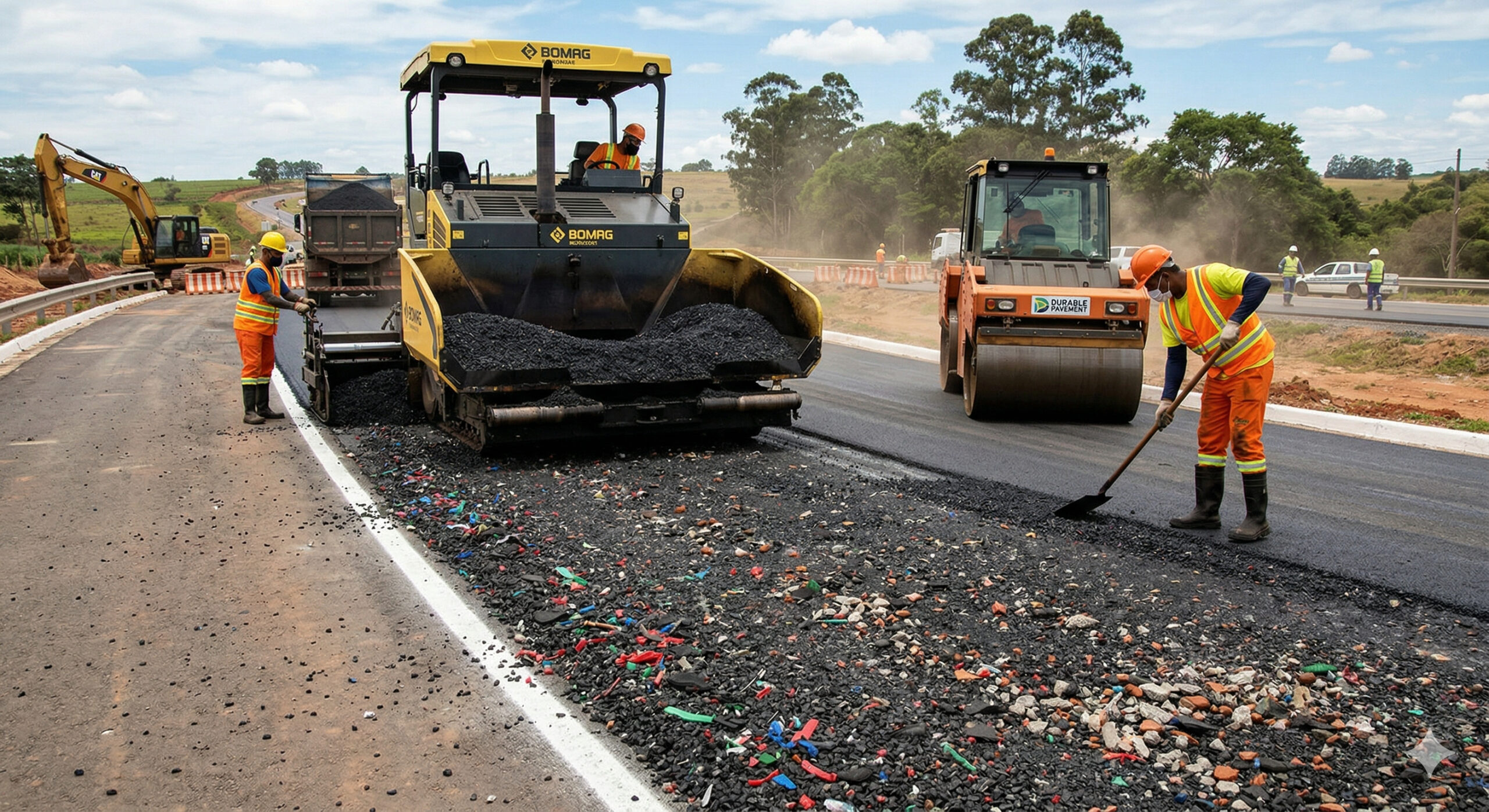
Technologies use plastic, tires, and construction waste to create more durable, sustainable roads with lower maintenance costs.
In 2019 and 2020, industrial projects and public initiatives began to consolidate the use of recycled waste in paving in different countries. According to the chemical company Dow, projects carried out in Indonesia incorporated about 3.5 tons of recycled plastic into a 1.8 km stretch of road, while similar initiatives were also developed in India, demonstrating the viability of the technology in real applications. The advancement is not limited to a single country. According to a report supported by the UK government, the use of recycled plastic in paving has already been tested in countries such as India, the UK, the Netherlands, and Africa, with positive results in stability and durability of asphalt.
The most relevant data is that these technologies allow for the reuse of waste that would go to landfills, while also potentially improving pavement properties. Technical studies indicate that the incorporation of plastic into asphalt mixtures can increase resistance and reduce degradation over time, representing a significant change in a sector historically dependent on virgin raw materials.
How recycled plastic is being incorporated into modern asphalt
The use of recycled plastic in paving consists of adding polymers derived from plastic waste to the asphalt binder. This process modifies the properties of the material, making it more resistant to deformations caused by heat and heavy traffic.
-
Drones have become “insects” and spread native seeds to recover inaccessible areas; the Bacias & Florestas program, for 15 years, has planted 3 million trees and restored 15 thousand hectares, despite costs of up to R$ 25 thousand/ha.

-
Alert in the underwater tunnels: the rubber sealing the entrance of the sea in a structure in China is deteriorating from the inside faster than expected.

-
A cyclone with unprecedented behavior will form in the Atlantic in the coming hours and will move from the sea to the continent instead of following the normal path, with gusts of up to 90 km/h and a risk of hail and waterspouts in southern Brazil.

-
The “white gold” of Thacker Pass: the McDermitt caldera could be worth $1.5 trillion and hold nearly half of the world’s lithium; 40,000 tons/year could provide batteries for 800,000 electric cars already in the U.S.



In countries like India, this technology has already been applied to thousands of kilometers of roads. The plastic used includes bags, flexible packaging, and other post-consumer waste, which are processed and incorporated into the mixture.
By replacing part of the conventional bitumen with recycled plastic, the pavement becomes more resistant to cracks and deformations, especially in regions with extreme temperature variations.
Tire rubber improves elasticity and resistance of the pavement
Another widely used material is crumb rubber from discarded tires. After being shredded, the tires are incorporated into the asphalt mixture, creating a more flexible material.
This flexibility allows the pavement to better absorb the stresses caused by traffic and temperature changes, reducing the formation of cracks. The technique is already used in several countries and has a solid technical basis.
The reuse of tires not only improves the performance of roads but also reduces one of the biggest environmental problems related to the disposal of this type of waste.
Construction waste reduces dependence on virgin materials
Construction and demolition waste also play an important role in this new paving model. Materials such as crushed concrete and remnants of old asphalt can be reused as aggregates in the base or in the wearing course itself.
This reuse decreases the need for gravel extraction and other natural resources, reducing environmental impacts and production costs.
The reuse of these materials transforms waste into inputs, contributing to a more efficient and sustainable approach to highway construction.
Greater durability reduces costs over the life cycle
One of the main arguments in favor of these technologies is the increased durability of the pavement. Modified mixtures with polymers, rubber, and recycled materials tend to perform better over time.
This means fewer interventions, less maintenance need, and reduced operational costs. In high-traffic highways, where wear is more intense, this factor becomes even more relevant.
The savings are not only in the initial cost but mainly in the reduction of expenses over the road’s lifespan.
Environmental impact goes beyond waste reduction
In addition to preventing disposal in landfills, the use of recycled materials reduces the need for the production of new inputs. This implies lower energy consumption and a reduction in emissions associated with the extraction and processing of materials.
The paving sector is beginning to incorporate principles of the circular economy, where waste is reintegrated into the productive cycle.
This change represents an evolution in how infrastructure is planned, integrating sustainability and technical performance.
Large-scale applications show the viability of the technology
Unlike many innovations that remain restricted to laboratory tests, the use of recycled waste in paving is already being applied on a large scale in various countries.
Documented projects show that the technology is viable and can be implemented in different climatic and operational contexts. Adoption by governments and companies indicates confidence in the material’s performance. The transition from pilot projects to real applications demonstrates that the technology has already surpassed the experimental phase.

Despite the advances, the adoption of these technologies still faces challenges. The standardization of processes, regulation, and adaptation to local conditions are factors that influence expansion. The quality of the waste used can also vary, requiring strict control to ensure consistent performance. Additionally, market acceptance and regulatory bodies are still evolving.
These challenges show that, while promising, the technology is still in the process of global consolidation.
Road engineering undergoes a silent transformation
The incorporation of recycled waste in paving is part of a broader transformation in road engineering. The focus shifts from just the initial cost to include performance, durability, and environmental impact.
This change reflects a new approach, where infrastructure and sustainability go hand in hand. The pressure for more efficient and less polluting solutions drives the adoption of innovative technologies.
The sector is beginning to redefine its standards, incorporating materials and methods that until recently were considered alternative.
The use of recycled plastic, shredded tires, and construction waste in paving represents a significant change in how roads are designed and built. By transforming waste into inputs, these technologies offer a solution that combines technical performance and reduced environmental impact.
With real applications already underway and consistent results, these innovations indicate a path where highway construction integrates sustainability, efficiency, and durability, redefining the role of recycled materials in global infrastructure.








Seja o primeiro a reagir!