





 Portuguese
  English
  Spanish
  5 min of reading
  4 comments


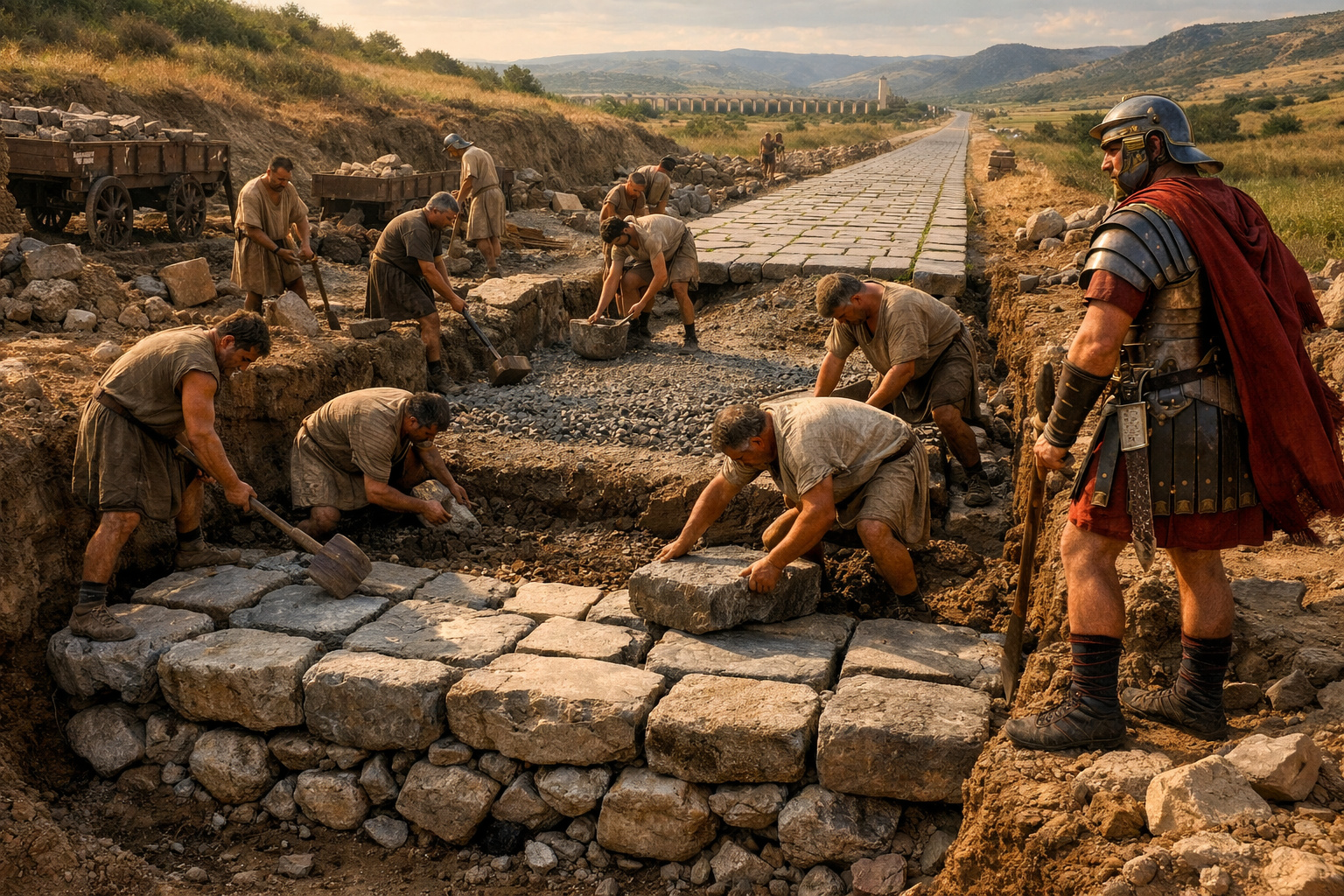


Structures Created in Antiquity Withstand Time, the Elements, and Continuous Use, Revealing Planning Techniques, Materials, and Drainage That Still Surpass Many Solutions Adopted by Modern Engineering
While many modern cities struggle with pothole-filled streets just a few years after paving, a historical phenomenon increasingly draws the attention of engineers, historians, and urban planners: Roman roads. Built over two thousand years ago, many of these roads remain strong, functional, and, in some cases, still in use. This contrast raises an inevitable question: how did an ancient civilization manage to create such durable road infrastructure?
Information has been published by various historical and archaeological studies extensively documented by European universities, in addition to technical analyses published in specialized articles on Roman engineering. According to these surveys, the secret was not in a single factor, but in a combination of rigorous planning, material choice, and extremely disciplined execution.
To understand this feat, we must go back to the year 312 B.C., when the Roman politician Appius Claudius Caecus envisioned the construction of the Appian Way, the first major paved road in Rome. The goal was simple and strategic: to connect Rome to southern Italy quickly and efficiently. However, this decision would forever change how empires organized themselves.
-
A company from Santa Catarina surprises by creating savory ice creams with flavors of smoked pork ribs, Italian salami with wine, and crackling with lemon, which are leaving everyone curious to try this unlikely combination.

-
In the World Cup spirit, a factory in India produces soccer balls with latex, joining cut pieces on a sewing machine as if it were a puzzle, and impresses with a modern and high-quality result.

-
At 53 years old, an entrepreneur closes the sale of the world’s most expensive mansion for R$ 1.8 billion, breaking historical records and transforming an old aristocratic property into the ultimate symbol of global luxury.

-
Created by father and son, a homemade solar-powered drone sets a record with over 5 hours of flight time, promising to transform agriculture, surveillance, and continuous use without relying on batteries.
The Appian Way became so revolutionary that it earned the nickname “Queen of Roads”. For the first time, soldiers could move quickly, merchants transported goods more securely, and messengers delivered official orders to distant regions with unprecedented speed for the time. The most impressive part is that sections of this road can still be traveled today, almost 2,400 years later.
With the success of the Appian Way, Rome did not stop. Over the following centuries, the empire built an estimated network of more than 400,000 kilometers of roads, equivalent to ten complete laps around the Earth. These roads connected Britannia, modern-day England, to North Africa, passing through the Iberian Peninsula, Gaul, the Balkans, and reaching as far as Mesopotamia.
How the Romans Planned Nearly Perfect Roads

The secret to durability began even before the first stone was laid. Before any construction, Rome sent specialists called land surveyors, responsible for studying the terrain. These topographical engineers used instruments like the groma, a cross with plumb lines that allowed for straight lines to be drawn with high precision.
This is why many Roman roads follow surprisingly straight paths, even crossing hills, valleys, and mountainous regions. When detours were unavoidable, the Romans preferred tight curves or zig-zags, preserving the original alignment as much as possible. Small bridges, tunnels, and cuts in rocks were built to maintain the layout.
After planning, came the heavy execution. Soldiers who were not on military campaigns were often designated for the construction. They dug trenches about 1 meter deep and 4 to 5 meters wide. This deep base was not an exaggeration: the Romans knew that a durable road starts underground.
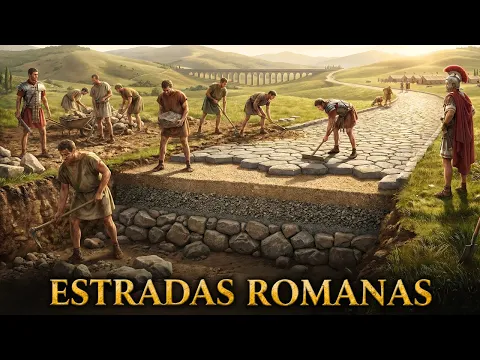
The structure consisted of several layers. The first, called statumen, used large stones fitted together like a puzzle, serving as a foundation. Above it came the rudus, a mixture of smaller stones with mortar. In specific regions, the Romans added volcanic ash, creating a type of concrete that hardened even underwater.
Next, the layer called nucleus was applied, made of fine gravel and mortar, ensuring uniformity. Finally, the summa dorsum formed the surface, composed of large blocks of basalt or granite, precisely cut to fit perfectly together.

Drainage, Logistics, and Maintenance Explain Durability
Another brilliant detail was the shape of the road. The surface was slightly arched, higher in the center and sloping to the sides. This allowed rainwater to drain off, preventing infiltration and erosion. The Romans knew that standing water is the biggest enemy of any pavement.
On the sides, drainage ditches carried water away from the road. In some urban sections, there were even subterranean sewage systems. A typical Roman road was between 4 and 6 meters wide, while main roads, like the Appian Way, reached up to 12 meters. The total thickness of the layers could reach 1.5 meters, requiring about 8,000 tons of material per kilometer built.
This level of engineering resulted in impressive durability. Many roads lasted 50 years without significant maintenance, and several survived for centuries. Not by chance, the Romans classified their roads into well-defined categories.
The viae publicae were main roads, maintained by the State, connecting cities and strategic regions. The viae privatae and viae rusticae connected rural areas to main routes, which could be paved or simply covered with gravel. There were also the viae vicinales, local roads connecting villages and small communities.
Additionally, Rome created a true support infrastructure. Every thousand Roman paces (approximately 1.48 km), there was a milestone indicating the distance to Rome. These milestones functioned like modern kilometer markers. Along the main roads, there were mansiones every 15 or 20 km, providing food, lodging, stables, and workshops.
For official messengers, horse exchange points called mutationes allowed for travel of up to 80 km per day. There are records of messages traveling from Rome to Britannia, over 2,000 km, in less than two weeks. According to historical accounts, during the conquest of Gaul, Julius Caesar sent and received orders in a matter of days, ensuring a decisive strategic advantage.
What Happened to These Roads After the Fall of Rome
With the fall of the Roman Empire in the 5th century, many roads were abandoned. The lack of resources, administrative collapse, and invasions reduced maintenance. Still, even without constant care, numerous roads remained usable.
During the Middle Ages, merchants, pilgrims, and armies followed the same paths laid out centuries before, simply because they were better than any road built during that period. In many cases, modern highways were opened right over ancient Roman routes.
This legacy explains why, even today, engineers study Roman roads as a reference. They were not just transport routes, but the backbone of an empire, connecting borders, ensuring trade, communication, and territorial control.
After learning the secrets of Roman roads, do you still think modern engineering is truly superior to that of Antiquity?





Modern construction will not last as long as Roman construction, or Greek or Egyptian
Several AI-slops. Stone-filled carts moving by themselves; Oxen walking backwards pushing a covered wagon, to name 2.
All roads lead to Rome.Why even the word itself:Rome means to travel:roam.You can’t do that without good roads.All great cities after being built are due to their roads.Why roads and their mile markers are used by everyone to this day.What would we do without Rome.The roads,oh! and the commodes.We’d be in a s— of a mess wouldn’t we.Just a thought to ponder on.