





 Portuguese
  English
  Spanish
  3 min of reading
  3 comments





New Missile From Russia Announced and Can Reach Speeds of Mach 12. Learn How the Kinzhal Missile Works That Is Revolutionizing the Arms Industry.
The new Kinzhal missile, a name that means dagger in Russian, has been gaining prominence as one of the advancements in Russia’s military technology. This hypersonic missile from Russia was developed to be launched from the MiG-31 Foxhound fighter or the Tupolev 22 bomber, both adapted to maximize its destructive capability.
Russian Missile Can Reach Mach 12
Its combination of extreme speed and maneuverability positions the Kinzhal missile as a key asset in the Russian arsenal, capable of overcoming modern air defenses and hitting strategic targets with total precision. The Russian missile consists of seven main parts, starting with the launch capsule and control flaps to the rocket engine and the 500 kg warhead, equivalent to 1,100 pounds.


This unique design of the new missile allows it to reach an impressive speed of Mach 12, or about 14,700 km/h. With a range of 2,000 km, the Kinzhal missile can hit strategic targets in record time.
-
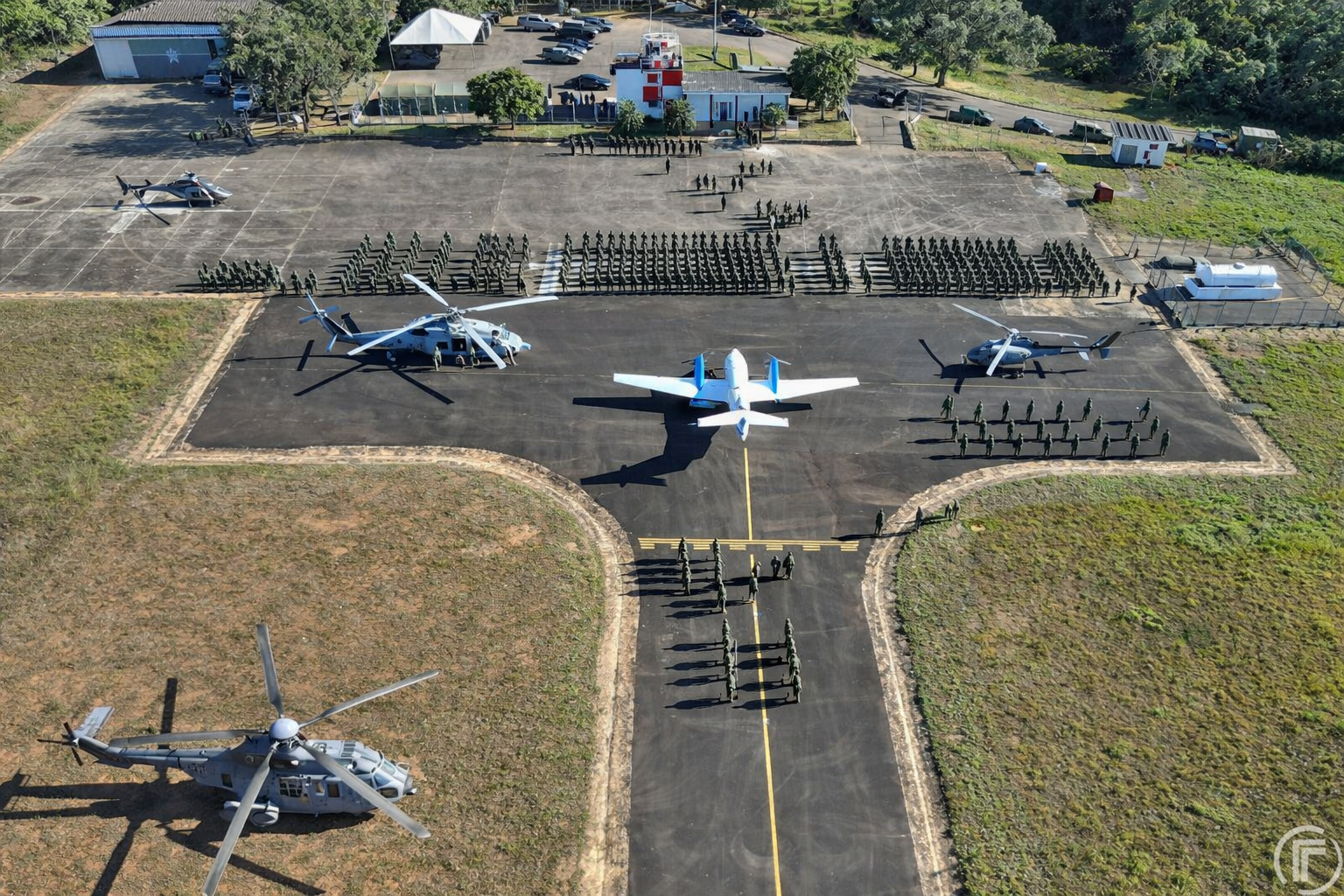
Furnas Airport is handed over to the Navy and becomes a strategic base with complete military operations, attack drones, and international mobilization at Furnas Lake.
-
Few people know, but “mega burst” attacks from the A-10 in the Middle East are intriguing analysts and even experienced former pilots of the U.S. Air Force.

-
Manufactured in Brazil and exported to Saudi Arabia and Malaysia, the ASTROS system is renamed as Fogos in 2026, gaining AI, cruise missiles with a range of 300 km, and air defense costing R$ 3.4 billion, transforming a launcher from the 1980s into the most ambitious multidomain platform in Latin America.
-
The largest military aircraft ever produced in Brazil, the KC-390 Millennium can carry up to 26 tons, refuel fighter jets in flight, and has already been exported to Europe and Asia, placing the country in the select group that designs and sells large military aircraft worldwide.


Inspired by the Soviet-era Iskander ballistic missiles, the Kinzhal utilizes technologies adapted to maximize efficiency in modern scenarios. Its compact and functional structure is a testament to how Russia balances tradition and innovation in the development of cutting-edge weapons.
The launch of the new Kinzhal missile is exclusively planned by Russia to ensure maximum efficiency. The MiG-31 Foxhound, with its ability to reach 1.4 at low altitude, is essential for effectively launching the Russian missile.
After firing, the protective capsule is ejected, allowing the engine to accelerate the missile to its maximum speed. In seconds, the Kinzhal reaches Mach 12, ready to complete its mission.
How the New Kinzhal Missile Is Operated?
The new Russian missile performs zigzag trajectories to avoid detection by enemy radars. When equipped with a nuclear warhead, the new Russian missile reduces structural weight to achieve greater range. In conventional missions, the equipment heads directly to the target, using its advanced guidance system.
Despite being considered a technological marvel, there are debates about its true classification as hypersonic. Reports indicate that systems like the Patriot, with speeds from Mach 3 to Mach 5, can intercept the Russian Kinzhal missile. These technical questions, while relevant, do not diminish the importance of the new Russian missile in the global military landscape.
Combining innovation and power, the new Kinzhal missile is an example of how technology shapes the future of warfare. For those seeking to understand the dynamics of modern conflicts, exploring these advancements offers valuable insights into the forces that define current military power.
Advancements in National Defense With New BrahMos NG Missile
Brazil is about to take a strategic step toward its national defense by considering the powerful BrahMos NG missile, with an impressive range of 800 km, to equip the advanced Gripen fighters of the Air Force and the Riachuelo submarines of the Navy.
This partnership with India not only strengthens military cooperation between the two giants of the Southern Hemisphere but also places Brazil on the map of major powers that dominate cutting-edge military technology with the long-range missile.
Developed through an Indo-Russian joint venture, the long-range missile is considered one of the most modern and longest-range cruise missiles in the world. The Gripen fighters, used by the Brazilian Air Force, are seen as an ideal platform for launching the BrahMos NG missile, especially due to their lighter weight and smaller size compared to the first-generation long-range missile.








Tanta tecnologia para matar seu semelhante. Nada para matar a fome. **** homem, não se cança até se destruir.
Pode ser que sim, pode ser que não, mas o mais provável é talvez.
Excepcional vídeo. Extremamente explicativo e esclarecedor, rico em detalhes.