





 Portuguese
  English
  Spanish
 3 min of reading
  0 comments


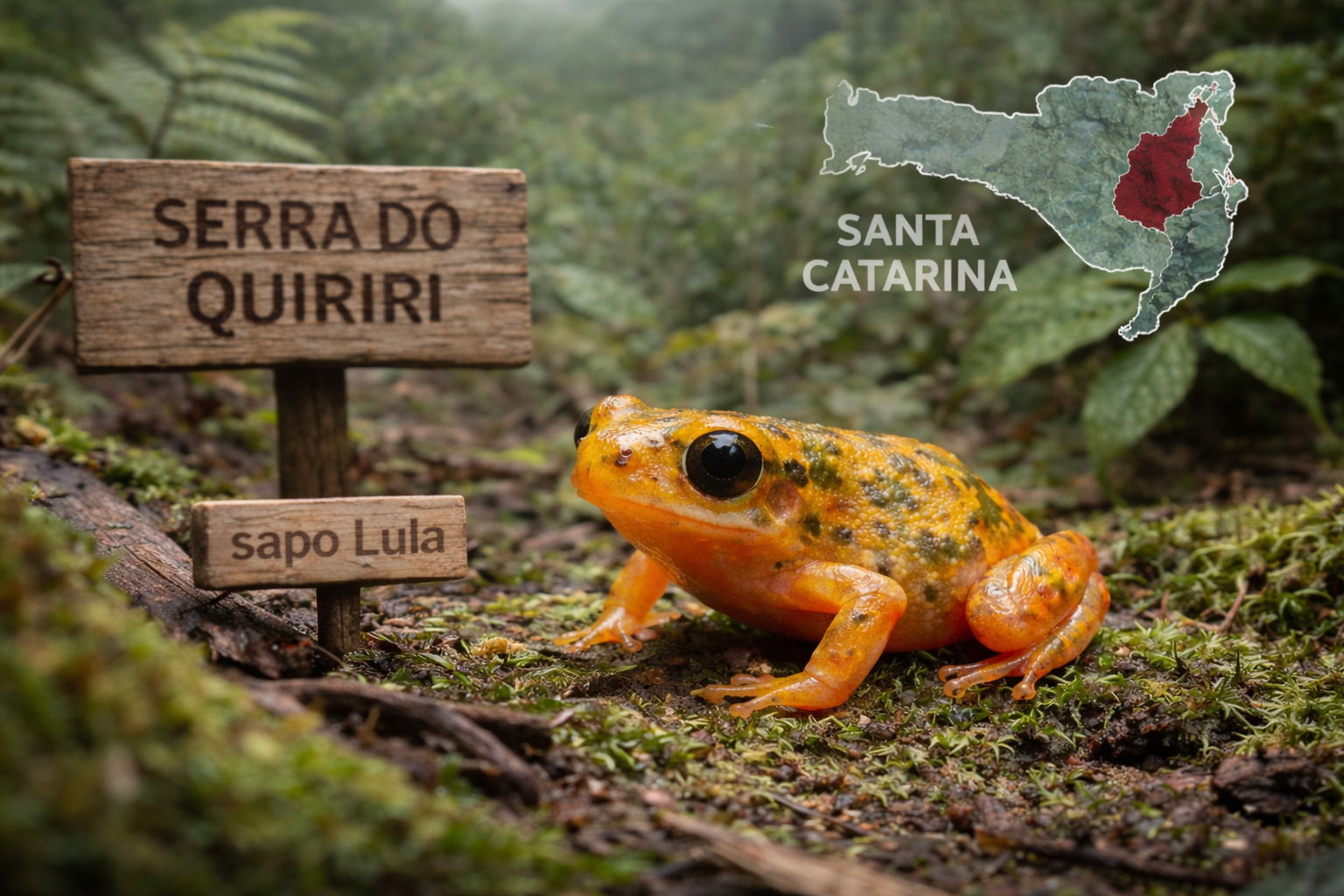
Scientific Discovery Published in 2025 Reveals a Tiny Frog from the Quiriri Mountain Range and Reinforces the Urgency of Atlantic Forest Conservation
A scientific discovery of high environmental relevance was confirmed in Brazil after nearly a decade of continuous research. Researchers identified a new frog species in the Atlantic Forest, in the Quiriri Mountain Range, in northeastern Santa Catarina, and published the formal description in 2025. The study was published in the journal PLOS One and was conducted by scientists affiliated with São Paulo State University (Unesp). Since the announcement, the finding has gained attention because the species was named after President Luiz Inácio Lula da Silva, adopting the designation Brachycephalus lulai.
Since 2016, when the animal was first observed, researchers maintained systematic investigations. Over the course of nine years, the team gathered consistent evidence. Thus, in 2025, the results were consolidated and disclosed, confirming it as a new species for science.
Identification After Nearly a Decade of Studies
Initially, field expeditions registered the animal in mountainous areas. Subsequently, morphological, acoustic, and genetic analyses were integrated. Additionally, 11 scientists from institutions in Brazil, the United Kingdom, the United States, and Germany participated in the work. The coordination was led by Marcos Bornschein from the Institute of Biosciences at Unesp.
-
Brazil has quietly developed an electric tactical drone that takes off and lands vertically without needing a runway, flies at 140 km/h in a fully autonomous manner, and can operate in forests, conflict zones, and remote areas.

-
Novo drone Guardian debuts in the United States with an 8-mile range, robotic battery swapping, and Starlink connectivity for continuous response.

-
100 kW megalasers are already pointing to a new industrial phase, with enough power to cut thick steel, drill through rocks, accelerate mining, and increase productivity in operations previously considered too difficult.

-
Thousands of people in poor countries are paid cents to film household tasks, label images, and operate systems remotely all day long, and this invisible work fuels a $17 billion market that trains the artificial intelligences of Google, Tesla, and Meta.


Consequently, the scientific validation occurred only after the convergence of data. Thus, the publication in 2025 consolidated the official recognition of the species.
A Tiny, Colorful, and Almost Invisible Frog
The Brachycephalus lulai belongs to a group of extremely small and diurnal frogs. The animal measures about 18 millimeters, making it difficult to detect. Furthermore, it lives hidden on the forest floor, primarily in areas with restricted access. Even so, the intense orange coloration, with irregular green and brown spots, distinguishes the species.
For a long time, its call was confused with the sound of crickets, delaying identification. Therefore, vocalization analysis became crucial to separate the species from similar ones.
Technology and Vocalization Confirmed the New Species
As the study progressed, detailed acoustic analyses were combined with high-resolution computed tomography. Additionally, genetic data reinforced the taxonomic distinction. Thus, with the description in 2025, the genus Brachycephalus now comprises 44 recognized species, highlighting the still little-known biodiversity of the Atlantic Forest.

Tribute to the President as an Environmental Alert
According to Marcos Bornschein, the choice of name had environmental and political significance. The intention was to increase the visibility of Atlantic Forest conservation, a biome that has suffered significant historical degradation. Thus, the tribute serves as a public alert and as a tool for scientific communication.
Climate, Isolation, and the Need for Conservation
According to the study published in 2025, climate change influenced speciation. With global warming, forests have advanced to higher areas, isolating populations on mountaintops. As a result, natural processes of speciation were favored.
Although classified as of least concern, researchers advocate for the creation of a conservation unit in the Quiriri Mountain Range. The proposal aims to protect the new frog and other species that depend on the ecosystem. In light of this, the discovery initiated in 2016 and concluded in 2025 reinforces the urgency of preservation policies.
Do you believe that expanding protected areas is the way to prevent the loss of still-unknown species?








Seja o primeiro a reagir!