





 Portuguese
  English
  Spanish
  4 min of reading
  35 comments


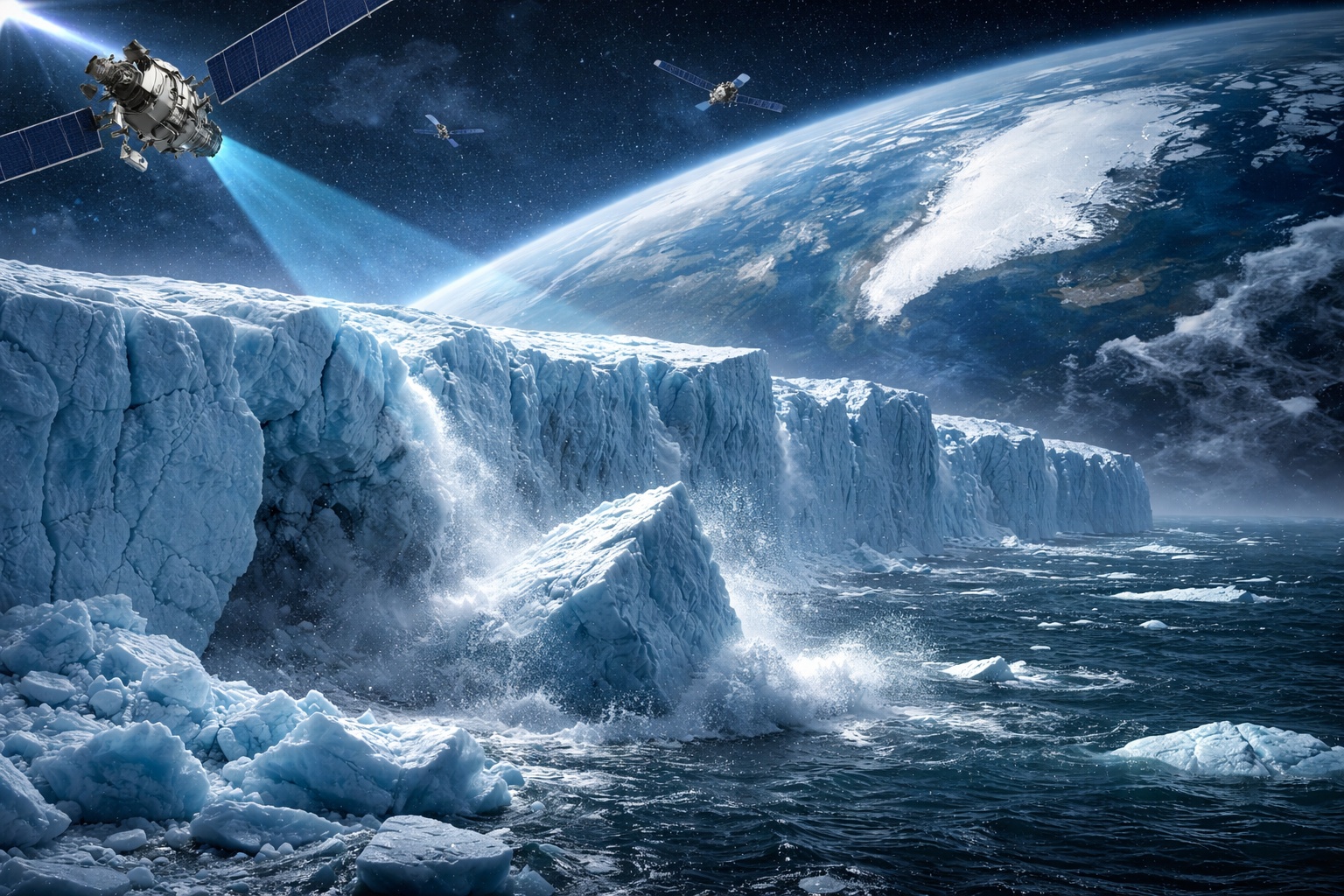


NASA Satellite Data Reveals That Greenland and Antarctica Lose Billions of Tons of Ice Per Year, Accelerating Sea Level Rise.
Since the early 21st century, scientists have been tracking a quiet but massive transformation at the planet’s poles. Using extremely precise satellites, researchers have confirmed that Greenland and Antarctica are losing ice at a rate equivalent to the “disappearance” of entire countries every year. This is not a future projection or computer simulation: these are direct mass measurements, made from space, showing an accelerated collapse of the global climate equilibrium.
The most robust data comes from the GRACE and GRACE-FO missions by NASA, complemented by analyses from the IPCC and studies published in the journal Nature. Together, they form the most detailed picture ever obtained of polar melting.
How Satellites Measure Ice Loss with Absolute Accuracy
Unlike common images, the GRACE (Gravity Recovery and Climate Experiment) satellites do not only observe the surface. They measure variations in the Earth’s gravitational field. When large masses of ice disappear, local gravity changes and this is detected with extreme precision.
-
Chinese submersible discovers a colossal system of giant craters on the Pacific floor, previously unknown, teeming with life and so rich in hydrogen that they may help explain the origin of life on Earth.
-
A mysterious structure has been found beneath an ancient city in Egypt — and the most impressive thing is what technology has revealed hidden for 2,600 years.
-
Astronauts reveal that cities shine so brightly at night that they are visible from space as “artificial constellations,” while highways in the desert appear more than the Great Wall of China, which practically disappears when viewed from orbit.

-
A magnitude 9.2 earthquake in Alaska reshaped the coastline in minutes, sank entire cities, raised sections of the seabed by several meters, and left one of the fastest geographical transformations ever recorded on Earth.

In practice, scientists can calculate how many tons of ice have been lost, month by month, year after year. This methodology eliminates common doubts in visual measurements, making the data highly reliable.
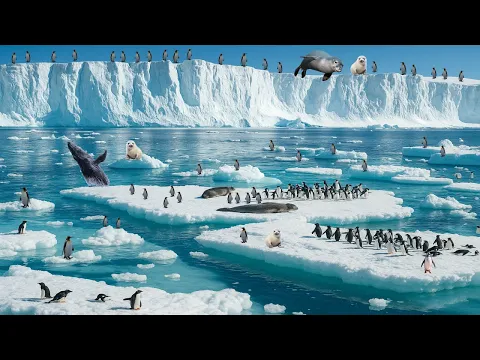

According to NASA, the uncertainties are small compared to the magnitude of the observed losses, which explains the growing scientific consensus about the seriousness of the phenomenon.
Billions of Tons per Year: The Numbers That Redefine the Scale of the Problem
The consolidated data shows that:
– Greenland loses an average of more than 250 billion tons of ice per year
– Antarctica already surpasses 150 billion tons annually, with continuous acceleration
Together, the two regions account for hundreds of billions of tons of ice lost every year. For comparison, this volume is equivalent to the total mass of large countries disappearing in the form of water.
The most alarming fact is that the rate of loss is increasing, not stabilizing.
Why Greenland and Antarctica Respond Differently to Warming
Although both are losing ice, the mechanisms are distinct. In Greenland, the main factor is surface melting, intensified by longer, warmer summers. Melting water seeps into the ice, accelerating fractures and increasing runoff to the ocean.

In Antarctica, the process is more treacherous. Much of the ice is being lost from below, as warmer ocean currents erode the bases of floating ice shelves. This reduces the “natural brake” that held back the continental glaciers, allowing them to advance more rapidly toward the sea.
This effect is considered potentially irreversible on a human scale.
Direct Impact on Sea Level: Centimeters That Change Everything
Each centimeter of sea level rise represents global impact. According to the IPCC, polar melting already accounts for a significant portion of the rise observed since 1993.
It may seem small, but a few centimeters are enough to:
– drastically increase the risk of coastal flooding
– accelerate the erosion of coastal cities
– salinize aquifers and agricultural areas
– displace millions of people over the coming decades
The problem is not just the average rise, but the combination with tides, storms, and extreme events, which become more destructive.
The Critical Point: When Melting Becomes Uncontrollable
Studies published in Nature indicate that some regions of West Antarctica may have already surpassed tipping points, where even the stabilization of global temperature would not prevent the continuous loss of ice.
This means that part of the sea level rise is already “contracted”, regardless of future decisions. What can still be controlled is the speed and scale of the impact.
Why Scientists Regard This Phenomenon as a Turning Point
Polar melting is not just a side effect of climate change. It is considered a global amplifier, capable of altering ocean currents, atmospheric patterns, and even the distribution of heat on the planet.
For this reason, the IPCC classifies the loss of ice in Greenland and Antarctica as one of the key indicators of Earth’s climate stability.
It is no longer a question of “if” sea level will rise, but how much, how quickly, and with what social, economic, and geopolitical consequences.
A Slow But Measurable Collapse Seen from Space
Perhaps the most disturbing aspect is this: the collapse is not invisible. It is being observed, measured, and confirmed by satellites, month after month, with public and verifiable data.
Science has already done its part by revealing the size of the problem. Now, the question that remains is whether humanity can respond at the same scale as the challenge that is unfolding at the planet’s poles.








Acho pra lá de interessante esse assunto, porém o autor do blog, não cita quantos centímetros já aumentou desde 1993. Se considerarmos os dados apresentados aqui nesse artigo, como sendo reais, temos 250 bilhões de um lado e 150 de outro, o que dá 400 bilhões de toneladas de gelo que foi pro saco, segundo esse artigo todo ano, e que essa massa equivale a alguns países. Bom, fazendo uma conta básica de padeiro, 400 bilhões de toneladas multiplicada por 32 anos … 12 trilhões e 800 bilhões de toneladas de gelo, que foram para os acessos e que na minha humilde opinião, já deveria ter elevado um mísero centímetro! Não acham? Então é evidente que as geleiras dos pólos estão dentro do oceano, e não faz a menor diferença se derrete ou não. O nível jamais vai se elevar com seu derretimento.
Todo anos essa mentira sobre as camadas de gelo que só aumentam
Ja dizia meu finado pai
A tecnologia será a extinção do seres no planeta