





 Portuguese
  English
  Spanish
  7 min of reading
  1 comment




Satellites Reveal That Earth Has Lost 28 Trillion Tons of Ice Since 1994 and Global Ice Loss Rate Has Already Exceeded 1.2 Trillion Tons Per Year
The measurement could only be made from space. The ice that Earth is losing is not concentrated in a single location but spread across extremely remote regions that are difficult for humans to access. Some of this ice is in the Arctic, another portion in Antarctica, as well as hundreds of thousands of mountain glaciers distributed across practically all continents. These formations include approximately 215,000 cataloged glaciers, in addition to the massive ice shelves floating around Antarctica and enormous frozen masses covering Greenland.
Monitoring all these areas with direct field measurements would be impossible on a continuous basis. Therefore, scientists turned to orbital observation. In January 2021, an international team of researchers from the University of Leeds, the University of Edinburgh, and University College London (UCL) published in the scientific journal The Cryosphere the first global assessment of ice loss based solely on satellite data.
The study utilized three decades of observations obtained from different orbital missions specialized in climate monitoring and cryosphere. The results surprised even the authors themselves.
-
What if the Sun disappeared suddenly? Simulation shows Earth in darkness within minutes, extreme cold, and rapid collapse of life on the planet.
-
A 2,400-year-old iron foundry has been discovered in Senegal with 100 tons of slag, 35 furnace bases, and signs of nearly eight centuries of continuous metallurgical activity.

-
Four humans are flying towards the Moon inside the Orion capsule launched by the SLS rocket, and on April 6, Artemis II will disappear behind the far side of the Moon without communication with Earth for nearly an hour.
-
Worlds covered by water, atmospheres filled with hydrogen, and the possibility of life beyond Earth: ocean planets are rewriting the map of cosmic search and forcing scientists to rethink where to look.

The Number Recorded by Satellites: 28 Trillion Tons of Ice Disappeared
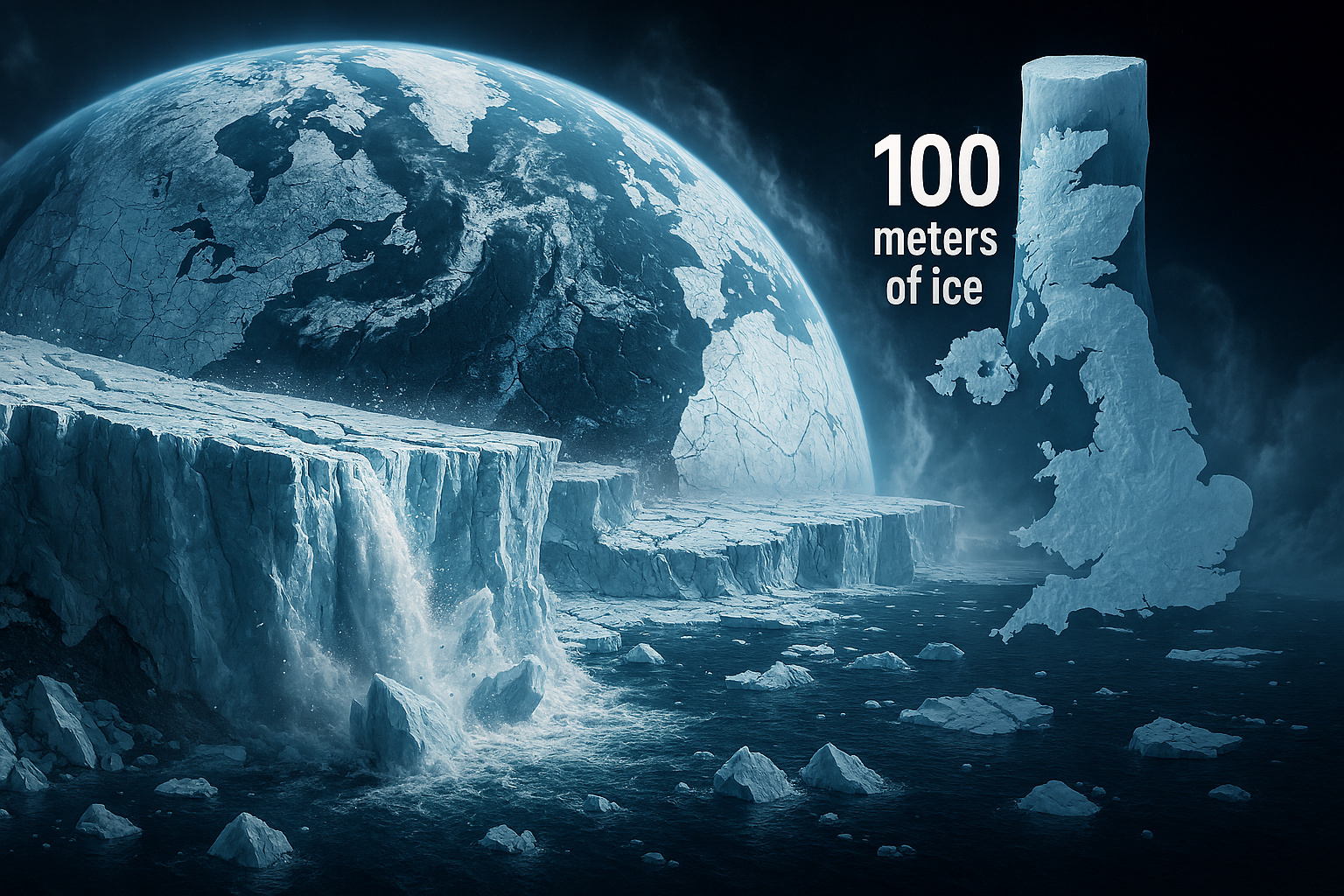
Between 1994 and 2017, the planet lost approximately 28 trillion tons of ice. Researcher Thomas Slater, the lead author of the study and a scientist at the Centre for Polar Observation and Modelling at the University of Leeds, tried to translate this gigantic number into a comprehensible scale.
According to him, this amount of ice would be enough to cover the entire surface of the United Kingdom with a layer of ice approximately 100 meters thick.
In Slater’s own words:
“It is simply astounding.”
The analysis divided the total ice loss into six major categories of the Earth’s cryosphere:
- Arctic Sea Ice: 7.6 trillion tons
- Antarctic Ice Shelves: 6.5 trillion tons
- Mountain Glaciers: 6.1 trillion tons
- Greenland Ice Sheet: 3.8 trillion tons
- Antarctic Ice Sheet: 2.5 trillion tons
- Southern Ocean Sea Ice: 0.9 trillion tons
All categories showed a net loss of mass. None exhibited stability or growth.
Acceleration of Global Ice Loss Observed in Recent Decades
Although the total volume of ice lost is impressive, the most concerning data identified by the researchers is the acceleration of the loss rate.
During the 1990s, the planet was losing about 0.8 trillion tons of ice per year. By 2017, that number had already increased to approximately 1.2 trillion tons per year.
This represents a 57% increase in the loss rate in less than three decades.
More importantly, the trajectory observed in satellite data does not indicate any signs of slowing down.
New Study Shows Extreme Acceleration of Mountain Glacier Melting
A subsequent study, published in the scientific journal Nature in February 2025, specifically analyzed mountain glaciers, excluding the large polar ice sheets of Greenland and Antarctica.
These smaller glaciers are extremely important because they supply rivers and natural freshwater reservoirs in various regions around the planet.
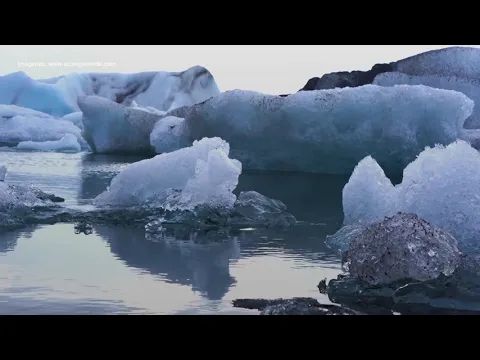

The data showed an even more intense acceleration. Between 2000 and 2011, mountain glaciers lost about 255 billion tons of ice per year. In the next decade, that rate increased to 346 billion tons annually.
In 2023, the last year analyzed in the study, the highest annual melting ever recorded occurred: 604 billion tons of ice disappeared in just one year.
This amount represents the historical record of annual glacial mass loss since the beginning of modern measurements.
The Role of Albedo: Why Ice Loss Accelerates Global Warming
When ice disappears, the problem is not limited to rising sea levels. There is a critically important physical mechanism involved in this process called albedo.
Albedo measures the ability of a surface to reflect solar radiation back into space. Fresh snow reflects between 80% and 90% of the sunlight it receives. The dark ocean, exposed after the ice melts, absorbs more than 90% of the incoming solar radiation.
This means that every square meter of lost ice is replaced by a surface that absorbs heat instead of reflecting energy back into space. This process is known as ice-albedo feedback. It acts like a climate amplification mechanism:
- More heat causes more melting.
- More melting exposes more dark water.
- More dark water absorbs more heat.
- More heat accelerates melting even further.
The cycle continuously reinforces itself.
Sea Ice Melting Does Not Directly Raise Sea Levels — But Amplifies Warming
Not all lost ice contributes equally to rising ocean levels. Sea ice, which is already floating in water, does not directly increase ocean volume when it melts.
This phenomenon can be compared to ice in a glass of water: when it melts, the liquid level remains practically the same. However, the loss of sea ice remains extremely serious due to its impact on albedo and polar ecosystems.
Continental Ice is the Main Contributor to Sea Level Rise
The ice that really contributes to rising sea levels is the one stored on land.
This includes:
- the Greenland Ice Sheet
- the Antarctic Ice Sheet
- the mountain glaciers
Between 1994 and 2017, the loss of this land ice caused an average global sea level rise of approximately 35 millimeters. Although it may seem small, the process is accelerating rapidly.

Climate models from the Intergovernmental Panel on Climate Change (IPCC) indicate that by 2100, sea levels could rise:
- 0.3 meter in the most optimistic scenario
- up to 2 meters in scenarios of high emissions and accelerated polar ice sheet collapse
The difference between these two scenarios represents the difference between coastal adaptation and abandonment of large urban areas.
Human Impact: Billions of People Living in Vulnerable Areas
Studies published in Nature Communications indicate that approximately 1 billion people currently live in areas less than 10 meters above sea level.
According to IPCC estimates, each additional centimeter of sea level rise puts about 1 million people at risk of displacement.
This means that even seemingly small changes in the average ocean level can have massive consequences for coastal populations.
The Critical Role of Mountain Glaciers in Freshwater Supply
Much of the disappearing glaciers are not located in polar regions. They are distributed across mountain ranges such as:
- Andes
- Alps
- Himalayas
- Rocky Mountains
- Caucasus
These glaciers act as natural freshwater reservoirs. During the summer, when rainfall is scarce, the gradual melting of these ice masses maintains the flow of essential rivers for agriculture, urban supply, and hydroelectric power generation.
This process is known as glacial hydrological peak. While the glacier exists, melting provides water. When the glacier completely disappears, the additional water flow disappears as well.
Regions Where Melting Is Occurring More Rapidly
The study published in Nature identified some regions where melting is occurring at a particularly accelerated rate. Alaskan Glaciers have lost about 67 billion tons of ice per year over the last two decades.
In Central Europe, glaciers have already lost approximately 39% of their total volume since 2000. The European Alps have been especially affected, with consecutive summer temperature records since 2018.
Scientists Warn That Climate Models May Be Underestimating Melting
Researchers involved in the study at the University of Leeds say that the large ice sheets of Greenland and Antarctica are following trajectories close to the most extreme scenarios projected by the IPCC.
This suggests that some climate models may be underestimating the actual speed of melting. A particular concern involves West Antarctica. According to glaciologist Eric Rignot, ocean warming is eroding the ice shelves from below.
This process was described by him directly:
“It’s like cutting the feet of the glacier instead of melting the entire body.”
When the base is weakened, the entire structure can collapse much faster than the original models predicted.
Historical Record of Ice Loss Registered in 2023
The global study published in 2025 gathered data collected by about 60 researchers in various countries and analyzed approximately 275,000 cataloged glaciers on the planet. The final figure caught the attention of the scientific community.
In 2023, mountain glaciers lost 604 billion tons of ice. It was the highest annual value ever recorded.
Glaciologist William Colgan from the Geological Survey of Denmark and Greenland summed up the current state of scientific knowledge directly:
“The glaciers are retreating exactly as we predicted. What surprises us is the speed at which this is happening.”
Ice Responds Only to Temperature — Not to Climate Agreements
Unlike public policies or international agreements, ice does not respond to political decisions. It only responds to the physical conditions of the environment. Since 1980, global average temperatures have increased by approximately:
- 0.26°C per decade in the atmosphere
- 0.12°C per decade in the oceans
As long as these temperatures continue to rise, melting will continue. And satellites will continue to record the numbers.
The data shows that Earth’s cryosphere is already changing, and the pace of these changes continues to accelerate.









One thing which is never mentioned is that most natural cycles seem to work in exponentials unless some constraint is put in place. The world is now entering a more extreme phase of temperature rise which has been going on for many thousands of years. It is being accelerated even more by anthropogenic warming.