





 Portuguese
  English
  Spanish
  5 min of reading
  0 comments


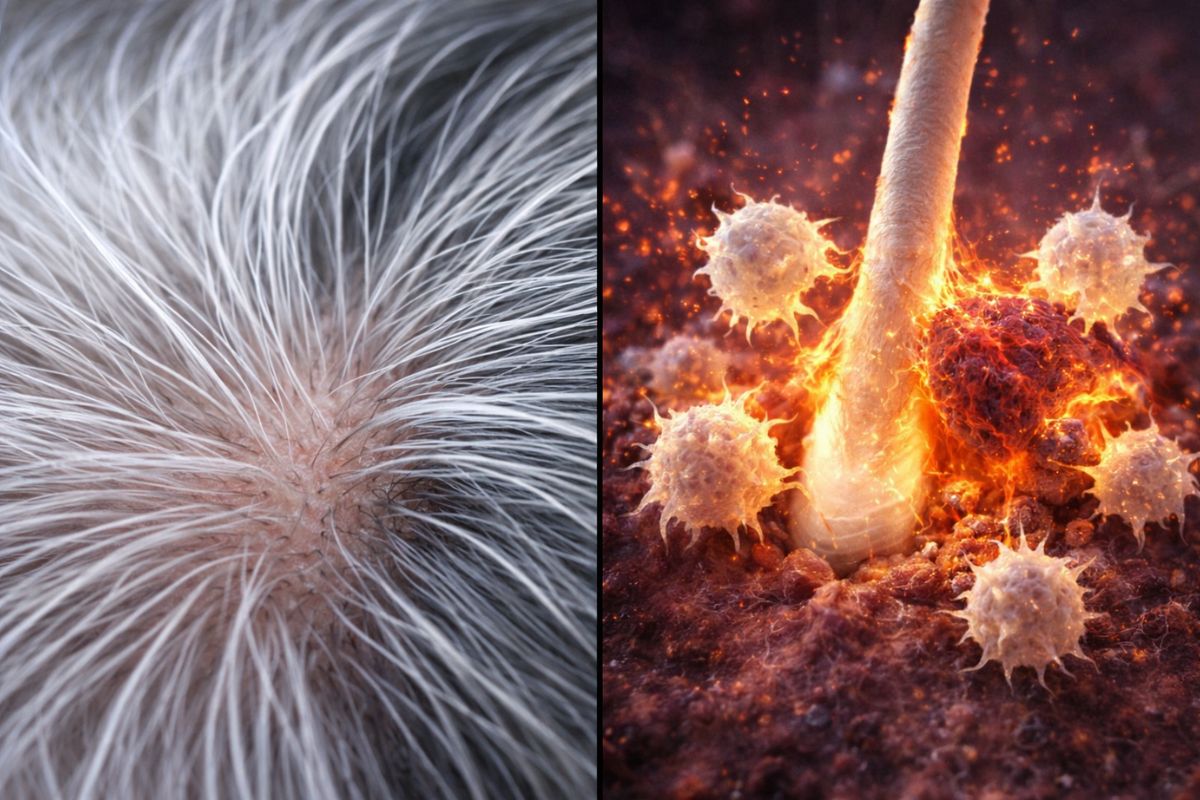
Research has revealed that white hair appears when the body activates a mechanism called cellular senescence, which blocks the division of damaged cells in the follicle to prevent disordered growth, sacrificing melanin production and hair color to preserve the health of the hair root.
Most people view white hair as an undesirable sign of aging, something the body does mistakenly or due to wear and tear. But recent research on hair biology has revealed something surprising: white hair is not a failure of the body, but rather an active protective mechanism. When the hair follicle accumulates damaged cells or those with genetic material failures, the body activates a process called cellular senescence, which blocks the division of these cells to prevent them from replicating uncontrollably. The cost of this protection is precisely the loss of hair color.
What happens is a concrete biological exchange. By blocking cell division in the follicle, the body also interrupts the renewal of melanocytes, which are the cells responsible for producing melanin, the pigment that gives color to hair that was previously dark, blonde, or red. Without new functional melanocytes, the hair fiber that grows from there is colorless. The body sacrifices the aesthetics of the hair to preserve the integrity of the tissue and avoid growths that could pose health risks, such as the development of tumors.
How the mechanism that transforms colored hair into white hair works
The natural color of hair directly depends on melanin, produced by melanocytes located within the hair follicle. During the hair growth phase, these pigments are injected into the hair fiber, giving each person their characteristic shade.
-
Scientists believed that this marsupial had disappeared 6,000 years ago, but an expedition found two living specimens in a remote forest in New Guinea with a finger that no other animal on the planet possesses.

-
Extreme drought lowered the level of a reservoir in Iraq and revealed an entire city that is 3,400 years old, with walls, palaces, and over 100 clay tablets from an empire that almost no one knows about.

-
Astronomers have found signs of a planet hidden for decades in forgotten telescope data, and if it really exists, it will be the first new world in the solar system in over 170 years.

-
Scientists have caught a star 450 light-years from Earth, only 200 years old, spewing gas and energy in bursts, and no one knows for sure what is happening with it.

As the years go by, the stem cells responsible for renewing melanocytes progressively reduce their activity until pigment production ceases and new hair grows colorless.
This process, known as canities, is universal and occurs at different rates depending on genetics, lifestyle, and environmental factors. Oxidative stress, caused by both external aggressions such as pollution and sun exposure as well as internal processes of cellular aging, accelerates the wear of follicle cells.
The progressively appearing white hair is the visible result of a protective system that prioritizes the integrity of the root over appearance.
The factors that make white hair appear earlier
Although genetics is the main determinant of the rate at which white hair appears, several factors can accelerate the process. Intense oxidative stress, caused by inadequate diet, sedentary lifestyle, and exposure to pollution, damages the cells of the follicle and accelerates the wear of melanocytes.
Excess free radicals in the body act as agents of cellular aging that force the body to activate the senescence mechanism earlier than programmed by genetics.
Research indicates that chronic emotional stress also contributes to the early appearance of white hair. Prolonged periods of tension elevate the production of norepinephrine, a substance that compromises the stem cells of the hair follicle and reduces the capacity for melanocyte renewal.
Deficiencies in B vitamins (especially B12), iron, zinc, and copper are also associated with weakened melanin production. Smoking is another documented factor: smokers are more likely to develop canities early because the compounds in cigarettes increase oxidative stress in hair cells.
Why white hair has different texture and behavior
Those who already have white hair notice that it does not behave like colored hair. The colorless strands tend to be thicker and have a different texture, which is often described as a feeling of more rebellious or harder-to-control strands.
This happens because, without melanin, the internal structure of the hair fiber organizes itself slightly differently, altering the natural distribution of keratin along the strand.
White hair also has a greater tendency to dryness. Melanocytes do not only produce pigment. They participate in processes that contribute to the hydration and protection of the hair fiber.
With the reduction of these cells, the strands become more porous and lose moisture more easily. Therefore, white hair requires a more frequent hydration routine, with products that reinforce keratin, increase shine, and reduce the frizz characteristic of colorless strands.
What science is developing to delay white hair
A deeper understanding of why white hair appears is driving research that goes beyond artificial coloring. The current focus of science is on revitalizing the hair follicle and protecting the still-active melanocytes, aiming to delay whitening rather than just disguise it.
Antioxidant therapies with vitamin C, vitamin E, and plant extracts rich in polyphenols protect melanocytes from premature wear, while actives like niacinamide and specific peptides stimulate the renewal of stem cells in the scalp.
Targeted nutritional supplementation with B vitamins, biotin, zinc, and copper also appears among the promising strategies to delay white hair. These nutrients are essential for the functioning of melanocytes, and their deficiency is directly associated with premature whitening.
For those who already have white hair, cosmetics with filters that protect against yellowing caused by sun and pollution maintain the silver and luminous appearance of the strands.
Why accepting white hair as protection changes the way to care for them
Viewing white hair as a defense mechanism, rather than a defect to be fought against, represents a significant shift in the approach to hair care.
Understanding that the body sacrifices color to protect cellular health opens the door to treatments that respect the biology of the follicle instead of merely masking the result with dyes. This does not mean that coloring the strands is wrong. It means that caring for the health of the follicle is more important than hiding white hair.
The colorless strands are evidence that the body is functioning to protect hair and cellular health. The care routine for white hair should prioritize deep hydration, protection against environmental damage, and scalp nutrition, creating conditions for the remaining melanocytes to remain active for as long as possible.
Those who understand why white hair exists take better care of it, and the result is a mane that ages healthily regardless of color.
What did you think of discovering that white hair is a protective mechanism and not a failure of the body? Would it change the way you care for your strands knowing this? Share in the comments. Information that changes people’s relationship with their own body deserves to be shared.








Seja o primeiro a reagir!