






 Portuguese
  Spanish
  4 min of reading
  0 comments


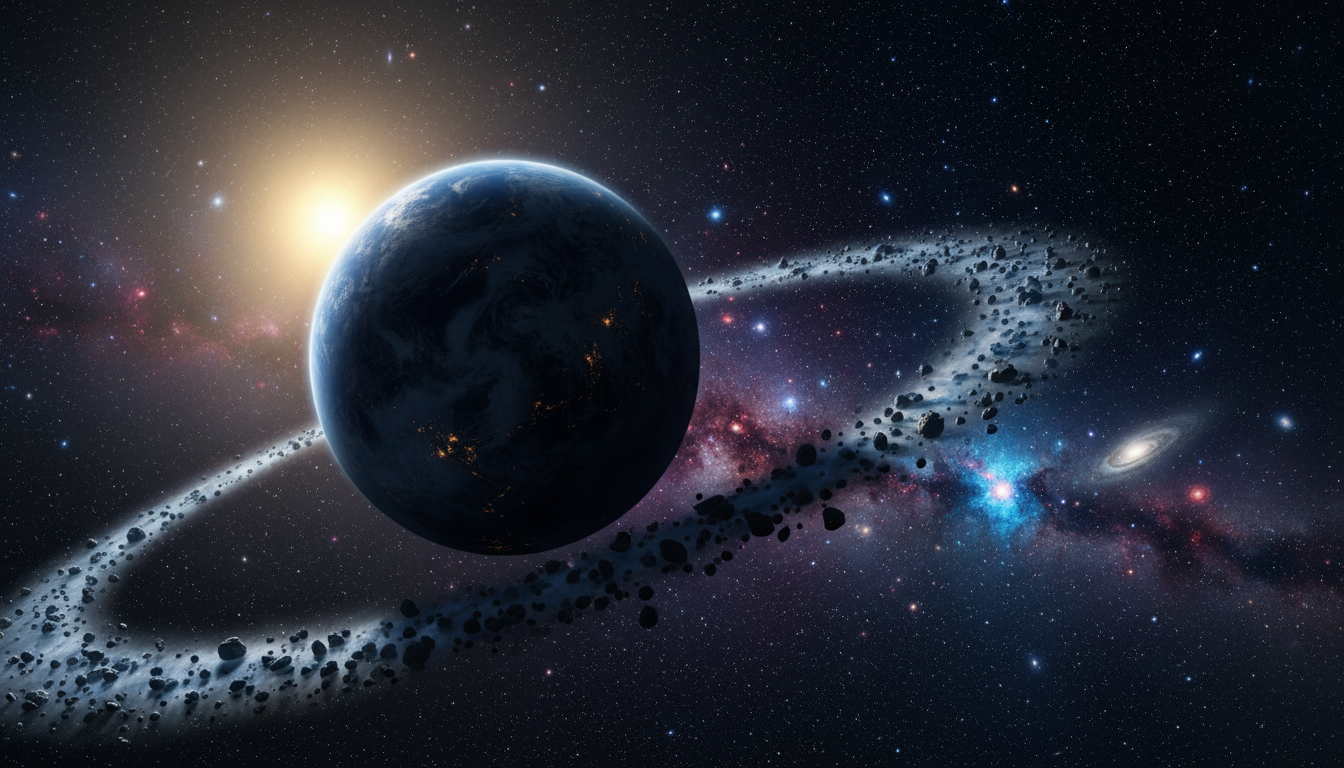
Researchers from Caltech, Princeton, and Tsing Hua University in Taiwan reanalyzed infrared telescope data from the 1980s and 2000s and found 13 candidates for a body with 5 to 17 times the mass of Earth orbiting up to 105 billion km from the Sun — a world that, if confirmed, would redefine the map of the solar system
The possibility that a giant planet is hiding in the far reaches of the solar system gained strength again in 2025 and 2026, after three independent teams of astronomers presented new evidence — all drawn from data that already existed but had never been analyzed with the right focus. If the so-called Planet 9 is confirmed, it will be the first new world added to the solar system since the discovery of Neptune over 170 years ago.
The hypothesis took shape in 2016 when astronomers Konstantin Batygin and Mike Brown from the California Institute of Technology (Caltech) published a study in the Astronomical Journal showing that six distant objects in the Kuiper Belt exhibited clustered and tilted orbits — a behavior that makes no sense without the gravitational influence of a massive and invisible body.
Since then, the search has intensified. Moreover, what is surprising is that the most recent clues did not come from new telescopes but from a reinterpretation of data that had been forgotten in digital archives for decades.
-
Embrapa takes cashew, peanuts, and sesame to the world’s largest seed bank in Norway, where Brazil has already stored more than 8,000 samples since 2012 against pests and climate change.

-
Finnish company creates recycled plastic and biomass blocks that fit together without cement, are 10 times lighter than common blocks, and have already been used to build schools in earthquake-affected areas.
-
A US startup wants to build a 10 km space cannon to launch multi-ton payloads into orbit at Mach 23, replacing part of the rockets with a colossal structure that looks like a science fiction weapon.

-
Extreme droughts and floods have doubled on the planet since 1901, according to a study of 1,300 river basins that reveals increasing pressure on agriculture, rivers, soils, ecosystems, and water supply.


Forgotten data from the IRAS and AKARI telescopes reveal 13 candidates
Researchers from Tsing Hua National University, Taiwan, conducted a reanalysis of data collected by the infrared telescopes IRAS (launched in 1983) and AKARI (operational between 2006 and 2011). In this way, the team identified 13 candidates that could be Planet 9.
One of the candidates stood out for having an estimated temperature between -223°C and -218°C, a mass of 7 to 17 times that of Earth, and an orbit between 75 and 105 billion kilometers from the Sun. For comparison, Neptune orbits at about 4.5 billion km — meaning the possible planet would be at least 16 times farther away.
However, the detection is still indirect. The infrared signals need to be confirmed by modern telescopes, and the team warns that other objects may produce similar signatures. Consequently, the result is promising but not definitive.
Princeton proposes “Planet Y” — a second hidden world
In August 2025, a study published in the Monthly Notices of the Royal Astronomical Society: Letters brought a twist. Astronomers from Princeton University, led by Amir Siraj, proposed the existence of a second hidden body, dubbed Planet Y — distinct from Planet 9.
“This paper is not the discovery of a planet, but certainly the discovery of a puzzle for which a body is the most likely solution,” Siraj stated.
According to the study, Planet Y would have a mass between that of Mercury and Earth, orbiting at 100 to 200 times the Earth-Sun distance (about 15 to 30 billion km), with an orbital inclination of at least 10 degrees. Therefore, it would be a smaller and closer world than Planet 9, but equally invisible to conventional optical telescopes.
- Planet 9 (Caltech, 2016): 5 to 10 times the mass of Earth, 60 to 120 billion km from the Sun, orbital period of 10,000 to 20,000 years
- Tsing Hua Candidate (2025): 7 to 17 times the mass of Earth, 75 to 105 billion km, temperature of -223°C to -218°C
- Planet Y (Princeton, 2025): mass between Mercury and Earth, 15 to 30 billion km, inclination of ~15 degrees

Orbits that make no sense without a giant planet
The main evidence behind all these hypotheses is the anomalous orbits of trans-Neptunian objects (TNOs). These bodies — pieces of rock and ice that orbit beyond Neptune — should move randomly. Yet, at least six of them exhibit clustered and tilted orbits relative to the plane of the solar system.
Additionally, the dwarf planet 2017 OF201, discovered in images from telescopes in Hawaii and Chile between 2011 and 2018, has an estimated diameter of 700 km and an orbit of 25,000 years that takes it more than 13 billion km from Earth — more than double the distance of Pluto. Thus, it is visible for less than 1% of its orbital cycle, suggesting that many similar objects may be hidden.
Computational simulations by the Princeton team showed that the observed perturbations are not fully explained by Planet 9 alone — hence the need to propose a second body, Planet Y. On the other hand, the Solar Orbiter spacecraft, which recently photographed the Sun’s pole from a unique angle, shows how the exploration of the solar system continues to reveal surprises.

Vera Rubin Observatory may settle the debate
The main hope for confirmation lies with the Vera C. Rubin Observatory in Chile, which will begin a comprehensive survey of the southern hemisphere sky. With the ability to map extremely faint objects, the telescope may detect — or rule out — the existence of Planet 9 and Planet Y in the coming years.
However, until then, the scientific community remains divided. Up to 200 dwarf planets may exist in the Kuiper Belt, according to recent estimates, and their mutual gravitational interactions could explain some of the orbital anomalies without the need for a giant planet.
All evidence presented so far is indirect, based on simulations and reanalyses of data. None of the proposed bodies have been visually detected, and the most recent studies are still awaiting complete peer review. NASA acknowledges that, if confirmed, the finding would redefine the map of the solar system — but for now, Planet 9 remains a fascinating hypothesis awaiting proof.





-

-

-

-

-

-

19 people reacted to this.