





 Portuguese
  English
  Spanish
  4 min of reading
  0 comments


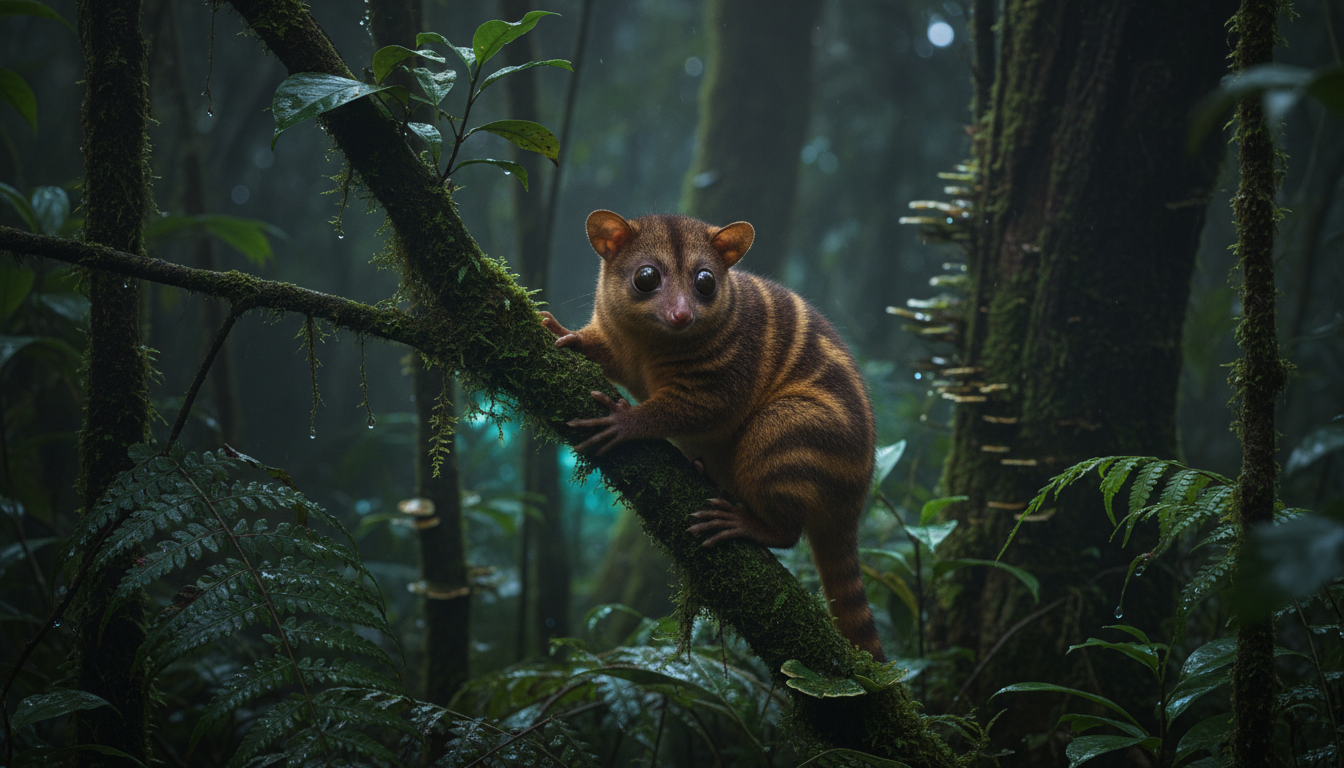
Two marsupials that science considered extinct for 6,000 years have been found alive in West Papua — one of them weighs 200 grams, has a finger twice the size of the others, and does not exist in any other animal on the planet
An extinct marsupial in New Guinea has just proven that science was wrong for six millennia. An expedition led by Australian scientist Tim Flannery from the Australian Museum found two living specimens of species that had not been seen since the Ice Age. The team located the animals in remote tropical forests of West Papua, a province of Indonesia, and confirmed the discovery in March 2026.
The two species are the long-fingered pygmy possum (Dactylonax kambuayai) and the ring-tailed glider (Tous ayamaruensis). Until now, science knew both only from fossilized teeth excavated in the 1990s in caves in New Guinea.
“Although we only knew them previously from the fossil record, I always thought that they might still exist as living animals. Now we know they do,” declared Helgen, a mammal specialist at the Australian Museum.
-
68 researchers from 15 countries deciphered the tremor that made the Earth vibrate like a bell for nine days: 25 million m³ of rock and ice, a volume sufficient to fill about 10,000 Olympic swimming pools, collapsed into a fjord in Greenland, triggered a 200-meter megatsunami, and revealed a climate catastrophe that science did not expect to see on this scale.

-
Country begins releasing crocodiles into protected area to try to save critically endangered species and restore degraded freshwater ecosystem in Cambodia

-
Physics has been challenged: researchers have discovered something that moves faster than the speed of light, but the phenomenon does not break relativity because it involves dark patterns within optical vortices.
-
Europe is “frying” with records: United Kingdom records 35°C, France reaches 35°C, and Spain and Portugal face heat close to 40°C in May as a heatwave advances across the continent.





The finger that makes the extinct marsupial in New Guinea unique on the planet
The long-fingered pygmy possum weighs only 200 grams. This makes it the smallest living striped possum in the world. However, what truly impresses researchers is on the animal’s paws.
The fourth finger of each paw measures twice the length of the others. The animal uses this elongated finger to insert under tree bark and extract insect larvae and small invertebrates hidden in the wood. No other living marsupial has this adaptation.
The species belongs to the family of striped possums and is related to the Petauroides volans, a gliding marsupial from eastern Australia. Thus, the rediscovery expands knowledge about the diversity of marsupials that survive in the region.
How the expedition found the animals after 6,000 years
Tim Flannery led the expedition alongside Dr. Ken Aplin, who described the species from fossils in the 1990s. Aplin always suspected that the animals still lived in remote areas. Helgen, a collaborator of Flannery at the Australian Museum, gathered evidence over the years until convincing the team to organize the search.
The identification occurred through direct observation in the field. The researchers combined morphological analysis with comparisons to known fossils. Local indigenous communities collaborated with the expedition, indicating areas where small nocturnal marsupials still appeared.
The Bishop Museum in Hawaii and the Australian Museum officially announced the rediscovery. So far, no paper in an indexed journal details the findings — the formal publication is still in progress.

Lazarus species: when the extinct returns from the dead
Science refers to any animal or plant that reappears after being declared extinct as a “Lazarus species.” The extinct marsupial in New Guinea now enters this select list. The term refers to the biblical character who was resurrected — and aptly describes the emotional impact these rediscoveries have on the scientific community.
Similar cases have happened before. The rare frog declared extinct that reappeared as a “living relic” of evolution follows the same pattern. Additionally, the discovery of the first fossil egg of a mammalian ancestor in South Africa shows how paleontology and field biology complement each other to recount the history of life on the planet.
Why the extinct marsupial in New Guinea now needs protection
The rediscovery brings hope but also urgency. The forest habitats of West Papua are facing increasing pressure from deforestation and mining. Researchers classify the two species as an immediate conservation priority.
Helgen warned that these animals live in habitats that “although currently endangered, have not faced many threats until the recent past.” The risk is that the species may disappear again — this time permanently.

What still needs to be confirmed
Sources differ on the presumed time of extinction. Some cite 6,000 years, while others exceed 7,000 years. The exact location remains restricted to “remote forests of West Papua,” without precise coordinates. Researchers have not yet released data on the current population size or a formal conservation plan.
Furthermore, the complete scientific publication has not yet been released. All announcements so far have come from museums and media outlets. Definitive confirmation will depend on detailed genetic and morphological analyses that are still ongoing.







Be the first to react!