





 Portuguese
  English
  Spanish
  4 min of reading
  0 comments


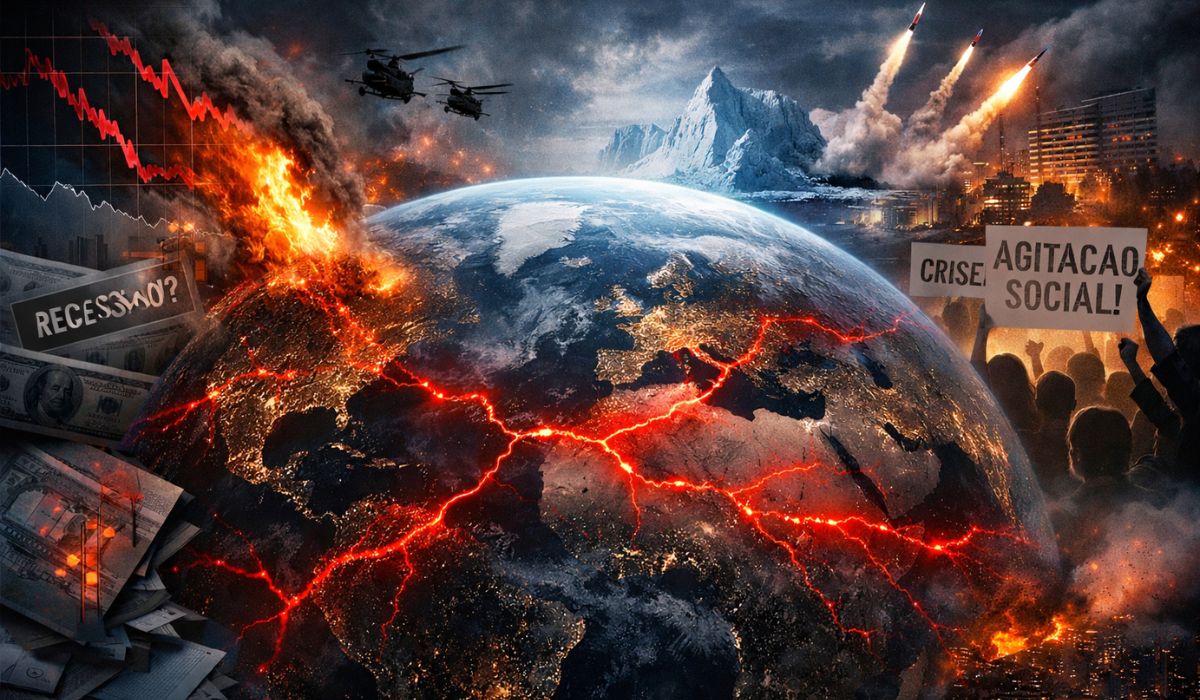
Historical models, political instability, and inequality return to the center of the debate with the new repercussions of the analyses of Peter Turchin, a researcher who relates social crises to structural pressures accumulated over decades.
Peter Turchin, a researcher known for applying mathematical models to the study of historical crises, has drawn attention again by asserting that several democracies are going through a period of structural instability that could extend over the next few years.
The association between his name and the idea that he “predicted” the pandemic, however, requires precision: in 2010, Turchin wrote in the journal Nature that the following decade would likely see an increase in political instability in the United States and Western Europe.
What is cliodynamics and why did Peter Turchin return to the debate
Professor and researcher, Turchin works with the so-called cliodynamics, a field dedicated to identifying long-term historical patterns with the support of databases, time series, and comparative models.
-
NASA released a photo taken from the International Space Station showing a lightning bolt shooting upwards into space instead of falling to Earth, reaching nearly 100 kilometers in altitude at the top of a storm.

-
Forget the idea that your brain stops developing at 25: a study with over 4,000 people proved that it continues to rebuild itself until 32 and goes through five phases throughout life.

-
Researchers from USP have discovered how to use Brazilian arnica to produce silver nanoparticles without generating toxic waste, and the innovation already has a patent application and practical application underway in the market.

-
A study published in one of the world’s most respected medical journals shows that just two tablespoons of olive oil per day can reduce the risk of heart attack by up to 30% and also silently protect the liver.

According to the definition he presented in texts and promotional materials, the proposal is not to anticipate isolated events, but to observe factors that, together, increase the risk of political crises, internal conflicts, and institutional wear.
At the center of this formulation are three recurring vectors: loss of material well-being, fiscal fragility of the state, and increased competition among groups seeking power, influence, and prestige.
In an article published in PLOS ONE, Turchin and Andrey Korotayev revisited the prediction made years earlier and stated that the model considered, among other factors, relative impoverishment, intra-elite competition, and state weakening as drivers of instability.

Overproduction of elites and inequality at the center of the analysis
Among the concepts most associated with the researcher is that of “overproduction of elites”.
In the formulation used by Turchin, the expression describes situations where the number of people or groups competing for space in the ruling layers increases without enough positions to accommodate this competition.
When this movement coincides with economic pressures and polarization, the political environment can become more tense, according to the interpretation he presented in academic texts and interviews.
Another recurring notion in his argumentation is that of wealth pump, a term that appears in materials from the researcher himself and is often translated, in part of the coverage, as “wealth bomb”.
The idea, according to Turchin, is of a process in which income and economic gains concentrate at the top of the social pyramid, while broader groups lose relative participation.
In his analysis, this dynamic amplifies inequalities and pressures social cohesion.
Why 2020 appears as a milestone in the predictions
The projection made in 2010 gained greater repercussion because it placed around 2020 a peak of socio-political tensions.
Years later, when revisiting the topic, Turchin and Korotayev wrote that the original estimate pointed to the decade from 2010 to 2020 as a likely period of increasing instability in the United States and Western Europe.
The reading began to be frequently cited after the sequence of pandemic, economic contraction, protests, and polarization recorded during that period in several countries.
When addressing the reach of these models, the researcher himself makes an important distinction.
In his texts, Turchin indicates that the utility of cliodynamics lies in measuring accumulated structural pressures, and not in identifying the exact trigger of each crisis in advance.
In this sense, the proposal is to work with historical trends and risk factors, not with the detailed prediction of specific events.
Historical database and crisis patterns
To support this type of analysis, the researcher also relies on the project Seshat: Global History Databank, a database created to gather historical and archaeological information from different societies.
According to the project’s description, the bank was structured to allow comparative tests on state formation, institutional development, and transformation of complex societies over time.
The reading proposed by Turchin starts from the comparison between moments of stability and phases of crisis observed in different historical contexts.
In his works, he argues that periods of social integration can be followed, over the decades, by scenarios of greater inequality, competition among ruling groups, and loss of institutional trust.
The researcher treats this movement as a recurring pattern, subject to variations according to each society.
Reforms, risks, and criticisms of Peter Turchin’s theory
At the same time, Turchin does not present collapse as an inevitable result.
In the promotion of End Times and in other public materials, he states that societies can reduce risks when they face distributive imbalances, expand inclusion mechanisms, and adopt reforms before tensions worsen.
In this line, the warning appears as a diagnosis of accumulated pressures and possible institutional responses, and not as an announcement of an obligatory outcome.
However, the researcher’s theses also encounter resistance.
Part of the criticisms comes from historians and social science scholars who question the degree of precision possible in mathematical models applied to complex historical processes.
Among the most frequent caveats are the quality and breadth of the data, the choice of variables, and the weight of factors that vary from country to country, such as political culture, institutional design, and international context.
Even with these objections, Turchin’s work continues to mobilize debate because it attempts to transform dispersed historical signals into measurable indicators of political risk.
The central point of his formulation is that deep crises tend to be preceded by identifiable structural pressures, although the concrete form of these crises depends on specific circumstances.






Seja o primeiro a reagir!