





 Portuguese
  English
  Spanish
  5 min of reading
  0 comments


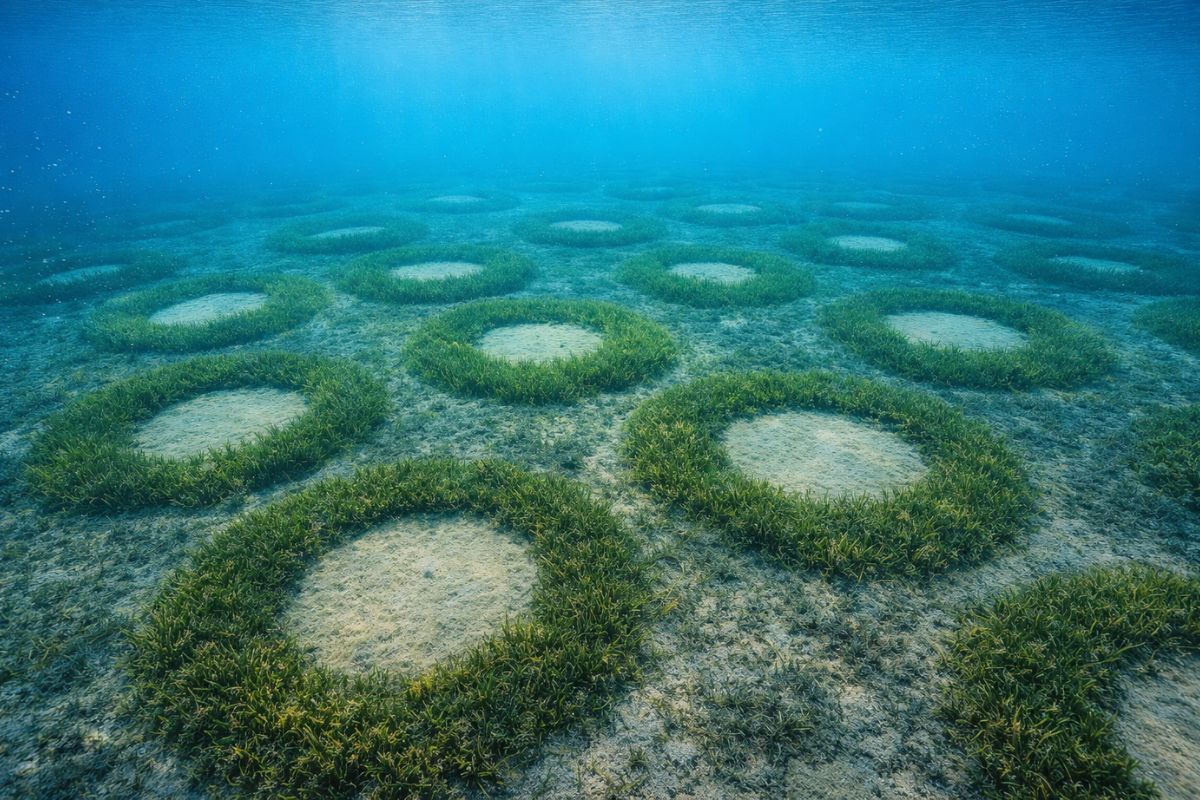
Hundreds of perfect circles formed by seagrass meadows were filmed for the first time in the Barra Strait, in the Outer Hebrides of Scotland, and the NatureScot agency confirmed that no one knows for sure what mechanism draws these gigantic rings on the seabed, while researchers from other countries offer clues involving plant self-organization and natural toxins
Hundreds of perfect circles have emerged on the seabed off the coast of Scotland, appearing as if they are from a science fiction movie. Viewed from above, the formations resemble turquoise halos over darker waters, each one an almost geometric ring formed by living seagrass meadows. They are not ruins of lost constructions nor marks left by vessels: they are marine plants growing in patterns that scientists are just beginning to study and that no one has yet been able to fully explain.
According to NatureScot, the hundreds of perfect circles were filmed in the Barra Strait, a shallow channel in the Outer Hebrides, and NatureScot, the Scottish nature agency, confirmed that this is the first time such formations have been recorded on video in the waters of Scotland. Officials call them seagrass doughnuts, while researchers from other countries know them as sea fairy circles, and the central question remains open: what is drawing these hundreds of perfect circles on the ocean floor?
What scientists found on the seabed of Scotland

The hundreds of perfect circles are formed by Zostera marina, a species of seagrass that typically grows in continuous green carpets in shallow, sheltered bays. In the Barra Strait, however, these carpets have organized into intricate circular patterns visible from aerial images.
-
The energy consumption that goes unnoticed in millions of Brazilian homes does not come from the refrigerator or the air conditioner; it occurs even when everything seems to be turned off and can represent up to 12% of the electricity bill according to the International Energy Agency.

-
China has completed the world’s first terrestrial network capable of monitoring the entire space between the Sun and the Earth, an infrastructure with over 30 stations created to track solar storms in 3D and anticipate failures in satellites, communications, and power grids.

-
Hidden giants at the bottom of the North Sea reveal how 18,000-year-old icebergs help predict glacier collapse and rising oceans.
-
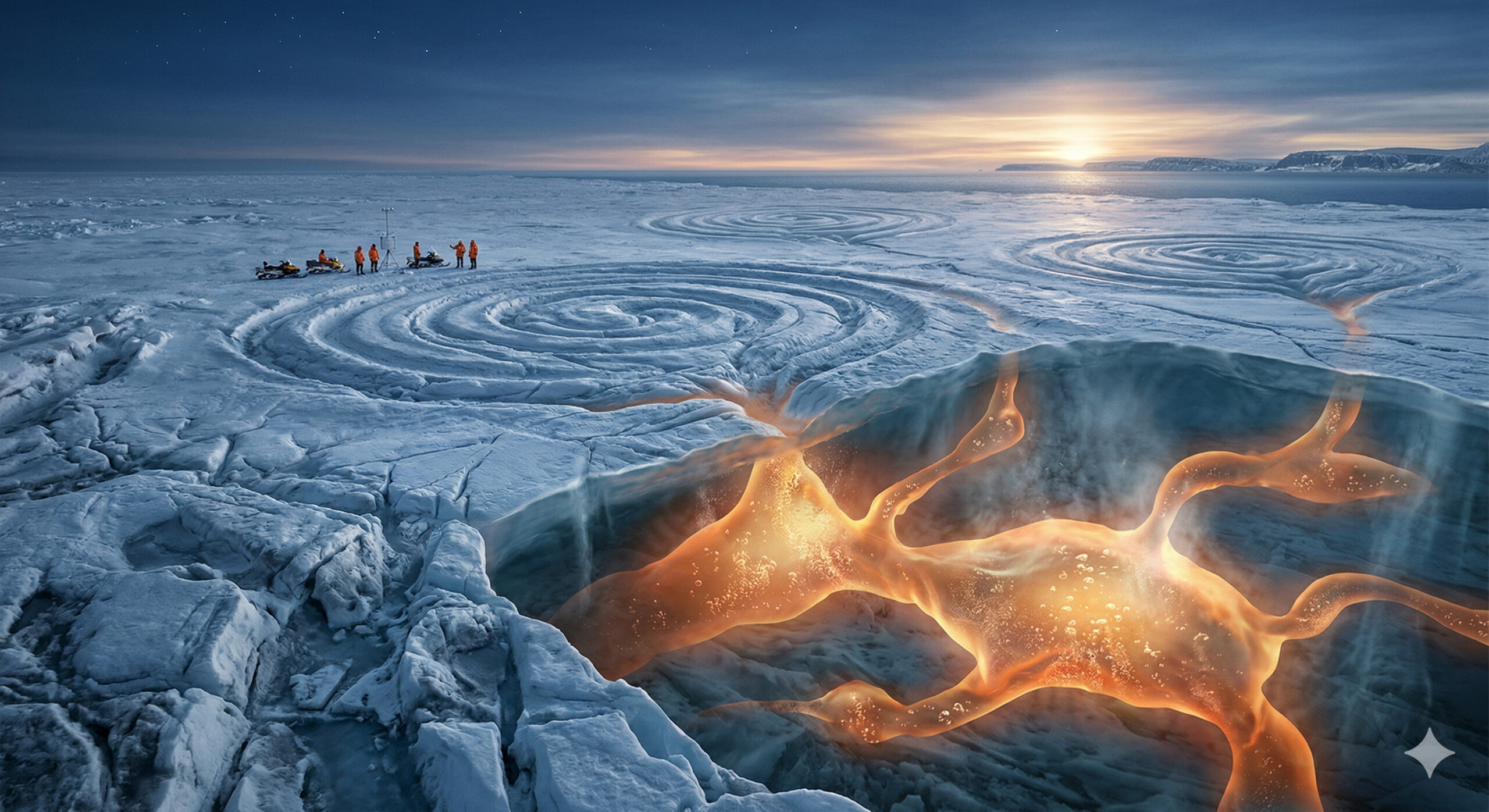
For more than 10 years, scientists have observed the ice of Greenland deforming into giant spirals without explanation; they have now discovered that solid ice can “boil” from within like magma, an invisible phenomenon that could alter climate predictions and involves a mass capable of raising sea levels by up to 7 meters.
Each ring is almost geometric, with denser vegetation forming the outer circle and the center featuring sparser plants or exposed soil.
Sarah Cunningham from NatureScot stated that as far as is known, this is the first video of seagrass fairy circles in the seas of Scotland. Similar formations have been documented in the Mediterranean, off Denmark, and near the Scilly Isles in England.
But the hundreds of perfect circles in Scotland are especially impressive due to the quantity and regularity of the patterns in a relatively concentrated area, which has heightened the interest of the scientific community.
The hypotheses attempting to explain the hundreds of perfect circles in the ocean

NatureScot is clear: the circles form naturally and are rarely seen, but the exact processes behind the hundreds of perfect circles in Scotland are still unknown. Research in other regions, however, offers clues.
Studies have associated similar formations with a combination of factors: changes in seabed sediments, accumulation of toxic hydrogen sulfide that kills older plants in the center, and the way seagrass expands from a central point while older shoots in the middle die off slowly.
Scientifically, these formations resemble self-organized patterns: plants help each other over short distances and compete for space and nutrients over longer distances, which can naturally create rings, stripes, or spots similar to those of a leopard in the vegetation.
This theory has been tested for seagrass patterns in the Mediterranean, but still needs to be verified for the hundreds of perfect circles in the Barra Strait. For now, the mystery remains open.
Why seagrass meadows are disappearing and what this has to do with the circles
Seagrass meadows once covered much of the Scottish coastline. Historical accounts describe beds so abundant that the inhabitants of the Orkney Islands used dried seagrass to cover roofs.
In the 1930s, a disease caused by a fungus devastated European beds, and many never recovered. A national analysis estimates that at least 44% of the seagrass in the UK has disappeared since the 1930s, with long-term losses possibly much greater.
Modern pressures such as pollution, coastal construction, and seabed dredging continue to reduce the meadows that still exist.
The hundreds of perfect circles in the Barra Strait are not just a visual curiosity: they may indicate how seagrass meadows behave when recovering or reorganizing after periods of environmental stress.
Understanding what is forming these patterns can help scientists assess the health of coastal marine ecosystems and plan restoration strategies.
The invisible role that seagrass meadows play in climate and coastal protection
The seagrass meadows where the hundreds of perfect circles appeared perform functions that go far beyond beauty. Their roots stabilize sediments and reduce wave energy, protecting low-lying coasts, roads, and homes from erosion and storm damage.
Their leaves slow down water flow and allow particles to settle, improving water clarity and reducing contamination.
Seagrasses are also part of the planet’s blue carbon system. They retain carbon in seabed sediments for centuries, and global seagrass meadows store carbon in the order of tens of billions of tons.
The loss of these meadows not only releases some of this stored carbon but also eliminates a natural line of defense against climate change. For coastal communities, healthier seagrass meadows mean better water quality, more habitat for fish, and a natural barrier against winter storms.
A mystery on the seabed that science has yet to solve
Hundreds of perfect circles have appeared on the seabed in Scotland, formed by living marine plants in patterns that look as if they are drawn by human hands.
No one knows for sure what created them: it could be plant self-organization, it could be toxin accumulation, it could be something that science has yet to identify.
What is known is that the seagrass meadows forming these rings are disappearing worldwide, and each pattern that emerges may hold clues about how these ecosystems function, recover, and what they need to survive.
Have you ever seen formations like these on the seabed? Do you think it is nature organizing itself or is there something that science has yet to discover? What might these circles be saying about the health of the oceans? Leave your thoughts in the comments and share this article with anyone fascinated by ocean mysteries and marine science.








Seja o primeiro a reagir!