





 Portuguese
  English
  Spanish
  5 min of reading
  0 comments


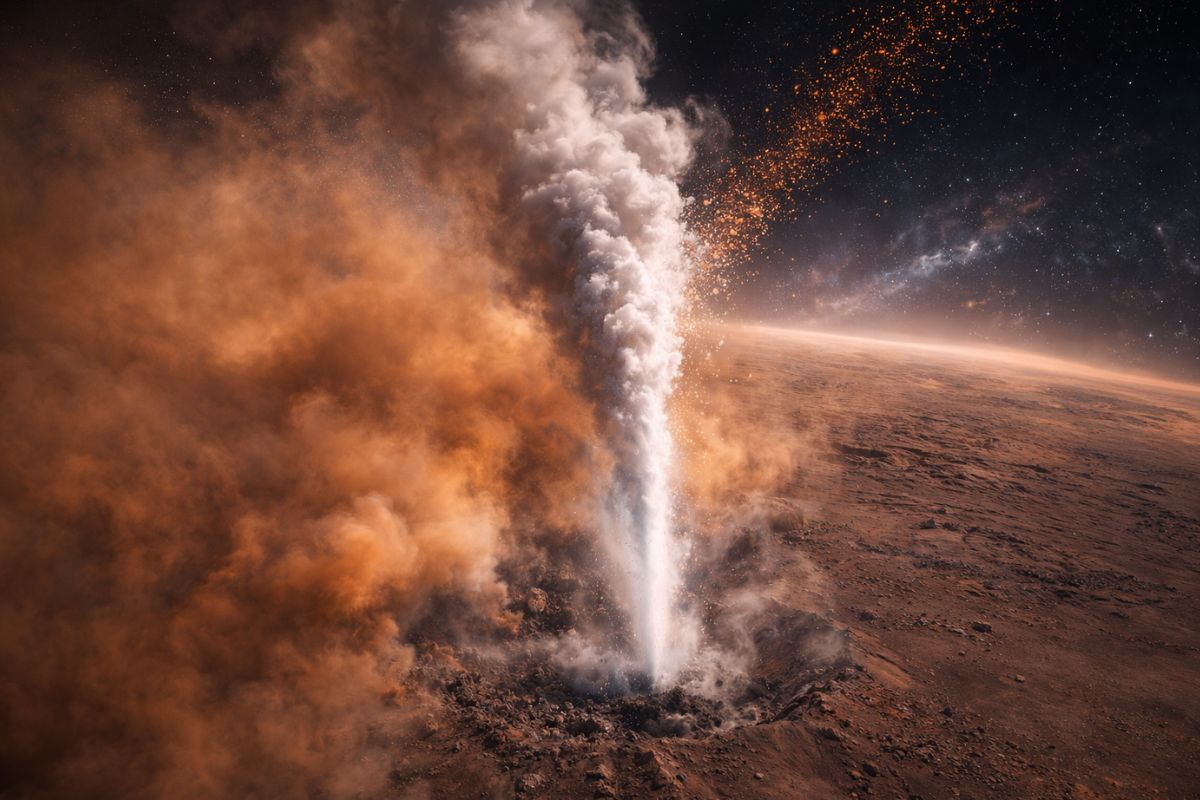
An unexpected Mars dust storm launched water vapor into the atmosphere above 80 kilometers altitude and the ExoMars Trace Gas Orbiter recorded that water on Mars escaped into space 2.5 times faster, revealing a previously underestimated planetary water loss mechanism
Water on Mars was expected to be protected during the summer of the planet’s northern hemisphere, a season that climate models considered relatively calm and safe for the Martian water balance. But a short-lived Mars dust storm broke this rule by launching water vapor into the atmosphere at altitudes between 60 and 80 kilometers, where solar radiation breaks molecules and releases hydrogen into space, accelerating planetary water loss by approximately 2.5 times.
The discovery was made by scientists from the Institute of Astrophysics of Andalusia and the University of Tokyo using data from the ExoMars Trace Gas Orbiter, NASA’s Mars Reconnaissance Orbiter, and the Emirates Mars Mission. The phenomenon was recorded during Martian year 37 and revealed that the amount of water vapor in the atmosphere above in the high northern latitudes reached ten times higher than normal at those altitudes, forcing researchers to reconsider when and how water on Mars actually escapes.
A Mars dust storm that should not have happened in that season

Mars climate models associated most of the planetary water loss with the summer of the southern hemisphere, when larger storms heat the atmosphere and allow the water vapor in the atmosphere above to rise before freezing.
-
The Brazilian Navy launched the NPa Mangaratiba (P-73) on April 27: a 54.2 m Macaé-class patrol vessel, with 43 crew members, 6 days of autonomy, and a range of 4,000 km to monitor the entire Blue Amazon.

-
Chinese scientists have identified 122 viable asteroids for large-scale asteroid mining and outlined the Tiangong Kaiwu plan to explore space water ice and metals throughout the Solar System by 2100.
-
Does compulsive lying exist? What does science know about mythomania and why does it go beyond ‘lying too much’?

-
Marine fossils found at over 8,800 meters altitude on Everest and in large mountain ranges have proven that entire continents move, oceans disappear, and tectonic plates collide over millions of years, revolutionizing science in the 20th century.

The northern summer was considered cooler and cleaner, a time when water would tend to freeze in clouds and remain trapped in the lower layers.
The Mars dust storm recorded in Martian year 37 contradicted this expectation. Even though it was a short-lived event, the storm heated the local atmosphere enough to prevent the vapor from freezing, pushing water on Mars to altitudes it normally would not reach.
The excess moisture spread rapidly across the planet, creating conditions that scientists did not expect to find outside the storm season of the southern hemisphere.
ExoMars Trace Gas Orbiter and other probes caught the phenomenon in real time
Recording the vapor explosion required the collaboration of three orbital missions working simultaneously.
The ExoMars Trace Gas Orbiter measured the atmospheric composition and detected the water vapor in the atmosphere above at high altitudes, while NASA’s Mars Reconnaissance Orbiter provided complementary data on the storm’s dynamics.
The Emirates Mars Mission completed the picture by recording a sharp increase in hydrogen density at the exobase, the region where the atmosphere dissipates into space.
The escape rate of hydrogen reached approximately 500 million atoms per square centimeter per second, a value 2.5 times higher than recorded during the previous summer in the northern hemisphere.
This measurement from the ExoMars Trace Gas Orbiter and other probes transformed what seemed like an isolated Mars dust storm into evidence of a significant planetary water loss mechanism.
How water vapor in the atmosphere turns into hydrogen escape
The process that connects water on Mars to outer space is straightforward. When the water vapor in the atmosphere above reaches sufficient altitudes, sunlight separates the molecules into oxygen and hydrogen.
The hydrogen atoms produced in these reactions are light enough to escape Martian gravity and disperse into space permanently.
Under normal conditions, the cold layers of the atmosphere act as a filter that prevents the vapor from rising. But the Mars dust storm recorded in Martian year 37 disabled this filter by locally heating the atmosphere, allowing water on Mars to reach altitudes where photolysis is intense.
The result is a destructive cycle: each out-of-season storm opens what researchers describe as “a larger drain” for the remaining water on the planet, contributing to the accumulated planetary water loss over billions of years.
Mars once had enough water to cover the entire planet
Geological traces of ancient river channels and hydrated minerals indicate that Mars once harbored water sufficient to cover it with a global ocean hundreds of meters deep.
The question scientists have been trying to answer for decades is how all that water on Mars disappeared, and this discovery adds an important piece to the puzzle.
A single Mars dust storm does not dry out a planet on its own. But the research team argues that many out-of-season events like this, accumulated over billions of years, may have significantly contributed to transforming a world of rivers and lakes into the cold desert that the probes observe today.
Data from the ExoMars Trace Gas Orbiter show that planetary water loss is not limited to large global storms: local and unexpected events also measurably drain the water vapor in the atmosphere.
What this discovery changes for future missions to Mars
For researchers, the next step is to monitor more out-of-season storms and adjust climate models so they do not underestimate planetary water loss during the northern hemisphere summer.
This requires more frequent long-term orbital monitoring and instruments capable of measuring the water vapor in the atmosphere in real time, something that the ExoMars Trace Gas Orbiter has already demonstrated is possible.
For future missions seeking buried ice or traces of ancient life, understanding when and how water on Mars escapes is crucial.
If out-of-season Mars dust storms can accelerate hydrogen escape by 2.5 times, the planet’s water balance is more unstable than previously thought, which directly affects estimates of how much buried ice remains and where future missions should search.
Is Mars losing water faster than we thought?
The discovery made by the ExoMars Trace Gas Orbiter and partner probes shows that water on Mars is more vulnerable than models predicted.
A single out-of-season Mars dust storm was enough to multiply planetary water loss by 2.5, launching water vapor into the atmosphere above at altitudes where hydrogen escapes permanently into space.
What do you think of this discovery? Does Mars still have significant reserves of underground water, or is the planet drying out faster than we can measure? Leave your opinion in the comments.






Seja o primeiro a reagir!