






 Portuguese


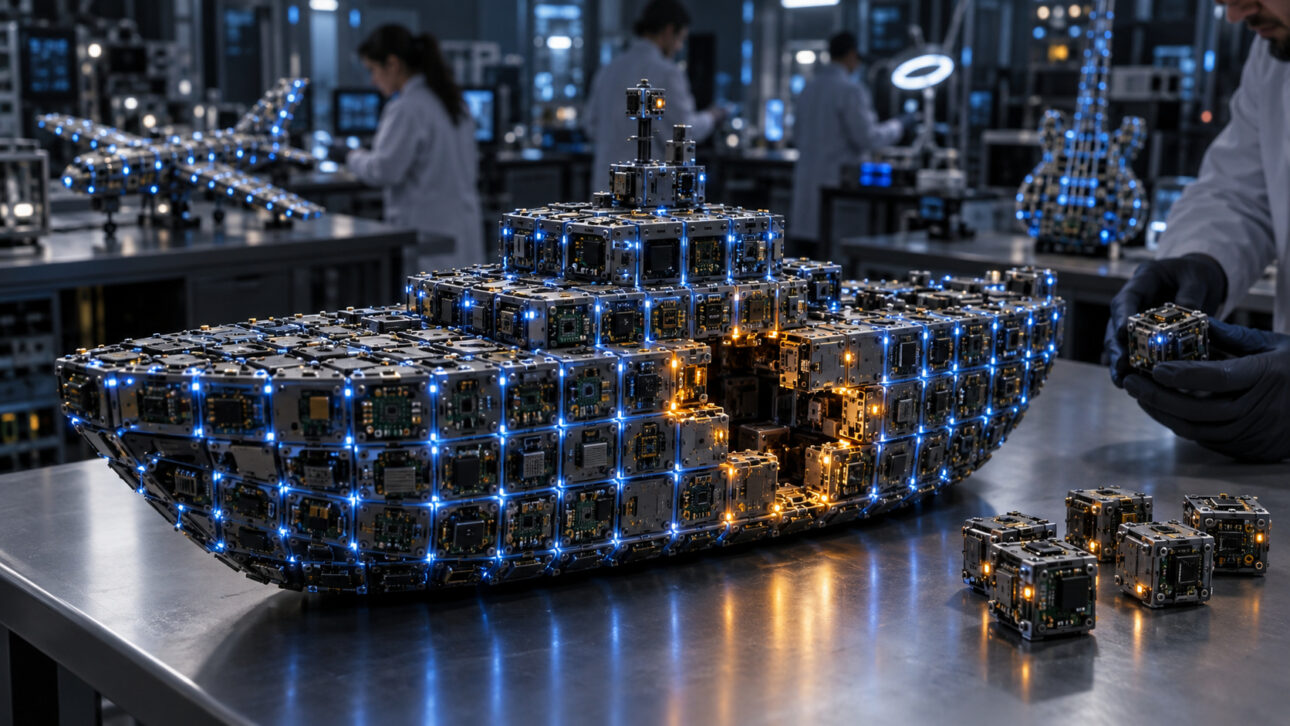

Cubes of a Few Centimeters Only Exchange Information with Their Neighbors, Without a Central Computer or Construction Map. The System Inspired by Cell Behavior Recognized Shapes with Up to 197 Real Pieces and, in Simulations, Continued to Operate with More Than 18,000 Modules
Imagine assembling nearly 200 small electronic blocks into the shape of an airplane, boat, guitar, or table, and without telling each piece what object was being constructed, asking the blocks themselves: “What are you a part of?” This was precisely the challenge faced by researchers who developed the so-called “smart cellular bricks”. According to a report published by Scientific American on September 6, 2026, each cube can only communicate with the neighbors directly connected to it. Even so, by working collectively, the physical blocks achieved the correct answer in 100% of the tests conducted with four shapes, including an assembly with 197 pieces.
Moreover, the research goes far beyond toys capable of recognizing what someone has assembled. In simulations, the system achieved 98.97% overall accuracy in classifying seven categories of objects and managed to continue recognizing structures even after parts were removed. The researchers also scaled the virtual experiments up to more than 18,000 cells, indicating that the strategy does not necessarily rely on a small set of modules. The long-term goal is to apply this decentralized intelligence to modular robots, machines capable of detecting damage, and systems that can identify which components need to be recovered, without relying on a single “brain” controlling everything.
However, there is a fundamental distinction: the bricks are not conscious and do not “know” that they are a guitar in the same way a person recognizes a guitar. Each module executes a neural network, maintains a small internal state, and exchanges data locally. Intelligence emerges from collective behavior. The study, published in Nature Communications, attempts to technologically reproduce a principle found in biology: individual cells have local information, but together they can form and maintain much larger and more complex structures.
-
Foreign Executives Spend Up to $15,000 to Access Chinese Factories, Study Robots, AI, and Electric Cars, and Decipher the Country’s Rapid Tech Advancement

-
5,000-Year-Old Necklace Made of 42 Teeth Discovered in Prehistoric Tomb in Poland Alongside Skeleton of a Man, Axe, Spearhead, and Flint Knife, While Two Additional Human Skulls Raise Suspicions of Ritual and Lead Archaeologists to Consider the Deceased as Someone Important

-
Four U.S. Companies Announce $2 Billion Investment in South Korea, Expanding Chip and Advanced Materials Factories and Advancing 3.2 GW Offshore Wind Complex
-
Japan Hides a 50 Million Liter Pure Water Giant Under a Mountain: Super-Kamiokande Detects Almost Invisible Particles and Helps Reveal Some of the Universe’s Greatest Mysteries


Each unit measures approximately 44 × 44 × 47 millimeters and features six faces made with printed circuit boards. Inside the module is a 32-bit microcontroller, along with memory, electronic components, and a programmable LED.
The faces have connectors that carry power and data.

Consequently, when two cubes are joined together, they can exchange information.
However, there is a deliberate limitation:
one block does not get a global view of the construction.
It only knows its own state and the information sent by neighbors directly connected to its faces.
Thus, a cube in the middle of a table does not initially know it is inside a table.
It only knows which sides have neighbors and what messages those neighbors have sent.
From this local information, the entire network must reach a global conclusion.
The Researchers Gave Everyone Exactly the Same “Brain” and Prohibited Any Piece from Assuming Control
This detail makes the experiment particularly interesting.
All modules run the same neural network.
There is no “chief brick.”
Moreover, no cube is pre-assigned its absolute position within the structure.
The system also does not utilize an external sensor observing the entire construction.
Instead, each unit repeatedly updates its internal state as it receives information from neighboring pieces.
The technology used is called Neural Cellular Automata.
To simplify, imagine a crowd in which no one can see the entire square.
Each person only talks to those immediately around them.
These individuals talk to their other neighbors.
After several rounds, local information starts to permeate the crowd.
Eventually, everyone can infer some global characteristic without anyone having received an aerial photograph.
It is approximately this logic that the cubes explore.
Before Building the Real Blocks, the Team Places Virtual Cubes Inside Almost 500 Different Objects
Initially, the researchers worked in simulation.
They used three-dimensional representations of objects belonging to seven categories:
airplanes, boats, cars, guitars, houses, tables, and chairs.
The team trained the system so that each cell updated its internal information as it observed the states of neighboring cells.
Over time, information traversed the structure.
Then the modules needed to reach a consensus about what they were forming.
The result drew attention.
Considering all categories, the overall accuracy reached 98.97%.
That is, even without a central controller knowing the entire geometry, the distributed network almost always managed to identify the correct category.
Airplanes reached 99.54% accuracy, chairs 99.71%, but houses confused the blocks more
The results also reveal that some geometries are easier to distinguish than others.
In the simulations, accuracy reached 99.54% for airplanes, 99.71% for chairs, 98.60% for cars, 99.66% for tables, 96.98% for guitars, and 99.27% for boats.
Houses were the most complicated category.
Even so, they recorded an 85.04% accuracy.
This difference makes sense because the system is not looking for an exact replica that is pre-stored.
It needs to recognize classes of shapes, including variations within the same category.
Therefore, the task is more interesting than simply comparing an assembly with a single digital mold.
Then comes the most important test: researchers take the intelligence out of the simulation and place it inside real cubes
Simulations allow for control over practically everything.
Real hardware, however, brings problems.
Connectors can fail.
Messages can arrive incomplete.
Components have physical limitations.
Moreover, signals need to actually traverse a structure made up of dozens or hundreds of pieces.
That’s why the researchers built the cubes.
Each module received the necessary electronics to locally perform calculations and exchange messages with its neighbors.
Then the team assembled four physical structures: airplane, guitar, boat, and table.
The smallest used 26 bricks, while the largest reached 197 units.
And it was precisely there that one of the most striking results of the study appeared.
With up to 197 connected bricks, all pieces reached the correct answer in 100% of the physical tests
The researchers repeated each physical test three times.
In all of them, the modules collectively arrived at the correct category.
This means a success rate of 100% across the four physical forms tested, under the specific conditions of the experiment.
This caveat matters.
The result does not mean that any object assembled with these bricks will be perfectly recognized.
The physical tests involved four categories and configurations determined by the team.
Still, demonstrating the algorithm functioning in nearly 200 independent physical modules represents an important step forward compared to purely virtual experiments.
Scientific American highlighted precisely this transition from simulation to real objects.
They don’t respond immediately: the “conversation” between the blocks takes about three minutes
The bricks need several rounds to reach a consensus.
When power is turned on, the modules start executing a cycle repeatedly.
First, each unit runs its neural network.
Then, it sends its state to its neighbors and receives their states.
Next, it recalculates its own information.
This process continues for 60 self-classification cycles.
On the hardware used by the researchers, recognizing the complete structure takes approximately three minutes.
Therefore, we are not facing instantaneous recognition.
However, the study’s goal was not to break speed records.
The priority was to demonstrate that hundreds of components can build a global understanding using only local communication and decentralized processing.
The experience becomes even more interesting when scientists start removing parts of the object
Recognizing an intact structure represents only half of the problem.
A truly adaptable machine also needs to perceive when something has gone wrong.
For this reason, the researchers began testing for damage.
In simulations, they removed cells from the structures and checked whether the system could still determine which object was being formed.
According to Scientific American, the models often continued recognizing the shape even when 15% of the cubes had been removed.
Additionally, the structure could identify which components were missing and guide a recovery step.
It is precisely this characteristic that aligns the research with potential damage-tolerant machines.
An airplane can still understand that it is an airplane even after losing part of its structure
Imagine a construction made of hundreds of modules.
Some break.
Others lose communication.
A traditional architecture might rely on a central computer that maintains a complete map of all of them.
However, if that controller fails, the entire system is at risk.
In the decentralized approach, each module has its own capability.
Consequently, losing some pieces does not necessarily eliminate the knowledge distributed by the remaining structure.
This principle appears increasingly in systems where technology needs to keep functioning even when individual components fail.
In the case of the bricks, however, the objective goes beyond simply staying connected.
The structure needs to recognize that its own shape has changed.
The system can point out where components are missing, but the bricks still do not walk on their own to repair the gap
Here, there is also an important difference.
The physical blocks used in the study do not have mechanisms to move autonomously and rebuild the structure.
Therefore, we are still not facing a table that loses a leg, recognizes the problem, and makes bricks walk across the floor to reconstruct it.
What the researchers demonstrated was the computational capability necessary to detect structural inconsistencies and locate damages.
Additionally, in simulation, the framework was extended to guide recovery processes.
The next challenge would be to combine this decentralized “morphological awareness” with modules capable of movement and physical reconfiguration.
Then the idea of machines that truly recover becomes much more concrete.
Researchers Increase Virtual Construction to Over 18,000 Pieces, Still Capable of Identifying What They Are
Another test investigated scalability.
A strategy that works with 30 cubes may collapse when the network reaches thousands.
After all, no module has global information.
The larger the object, the greater the distance certain information needs to travel.
Still, the team was able to virtually test systems with over 18,000 cells, and the structures remained capable of inferring the categories of the objects.
This does not mean that the researchers physically built 18,000 smart cellular bricks.
This experiment took place in simulation.
In the real world, the maximum reported in classification tests reached 197 physical modules.
Distinguishing these two numbers prevents transforming a computational demonstration into a physical prototype that does not yet exist.
The Secret Lies in a Tiny Memory Distributed Across All Cubes
Each virtual cell maintains a state vector with 28 dimensions.
One of them indicates whether the cell is considered active or “alive”.
Another 20 function as hidden internal channels, serving as a kind of computational memory.
Finally, seven channels correspond to the seven categories of objects that the system needs to distinguish.
Therefore, each cube updates this state as it receives local information.
In isolation, these data appear insufficient.
However, after several interactions, patterns emerge that allow the set to reach a classification.
Thus, the information about “being an airplane” does not need to be stored on an external server observing everything.
It emerges from the interaction between the parts.
Each Piece Currently Costs About €20, But Larger Production Would Already Lower the Value
The study also provides some uncommon details in experimental work: how much it costs to build the modules.
With components purchased to produce approximately 100 units, each brick is priced around €20, not including all assembly costs.
However, by purchasing enough components for 1,000 units, the estimated material cost drops to approximately €15 per brick.
Furthermore, the researchers claim that specific tools could reduce the assembly time to just a few minutes.
Automated manufacturing could further decrease this interval.
Therefore, the architecture was deliberately designed with relatively simple and replicable components.
A Machine Made of Identical Parts May Be Much Easier to Repair Than One Made of Hundreds of Unique Components
This point helps visualize future applications.
Conventional machines have highly specialized components.
If a specific part breaks, it may be necessary to find that exact piece.
Modular systems follow a different logic.
If hundreds of units are essentially the same, a damaged unit can, in principle, be replaced by another equivalent one.
Additionally, if the assembly itself can identify where the failure occurred, maintenance becomes potentially simpler.
The idea recalls other attempts to transform rigid infrastructures into more adaptable systems, although the smart cellular bricks take the concept in a very different direction: here, the structure itself participates in the diagnosis.
In the short term, the most fun application may emerge first in toys
Sebastian Risi mentions a much simpler possibility than self-repairing robots.
Imagine electronic building blocks.
A child assembles a dinosaur.
When the blocks collectively realize they form a dinosaur, the construction lets out a roar.
Then, the child takes everything apart and builds a car.
Now the same blocks recognize a different category and exhibit another behavior.
Another possibility would be to create pieces capable of informing the user where to place the next block.
Therefore, educational and entertainment applications may arrive long before autonomous industrial machines.
But the long-term goal is much more ambitious: robots that discover their own shape without an assembly manual
The ultimate vision involves self-organizing modular robotics.
Imagine sending thousands of identical modules to a remote environment.
Instead of manually assembling a specific robot, the pieces could form different structures as needed.
If one part were damaged, the rest would notice the change.
Then, available modules could take on new positions.
This scenario still requires technologies that the current experiment lacks, especially autonomous movement and connection.
However, recognizing one’s own morphology is one of the fundamental problems.
After all, before repairing a body, a machine needs to know what body it should have and where something is missing.
The research copies a curious property of living organisms: to survive even when no cell controls everything
A multicellular organism offers a powerful comparison.
Its body does not depend on a single cell that has a complete map of all the others.
Instead, there is a tremendous amount of local communication, chemical signals, developmental mechanisms, and distributed responses.
Moreover, organisms can respond to injuries.
Salamanders represent a particularly impressive example because they can regenerate complex body structures.
The authors specifically highlight such decentralized responses as inspiration for artificial systems capable of inferring missing structures.
Consequently, engineering is beginning to look at biology not only to copy materials or shapes but also at forms of organization.
There is no “table brain”: knowledge about the table is spread throughout the table itself
This may be the most intuitive way to understand the experiment.
In a conventional machine, asking “what is the shape of the system?” usually requires consulting a model stored in some central computer.
In smart bricks, not so.
Each block holds only a small part of the information.
However, as the states circulate locally, the whole converges on a conclusion.
Therefore, the representation of the shape is distributed throughout the structure itself.
It’s an interesting inversion.
The computer ceases to be a separate box controlling the object.
To some extent, the entire object becomes the computer.
This model also reduces the risk of a single failure bringing down the entire system
Centralized architectures have an obvious vulnerability.
If the main controller stops, perfectly functional components can become useless.
A decentralized network distributes this risk.
Naturally, it creates other challenges, especially around communication, synchronization, and consensus.
However, research has shown tolerance for both communication failures and faulty modules, according to the article in Nature Communications.
This explains why researchers see future applications in robust systems.
A machine built for challenging environments—space, the ocean floor, remote industrial sites, or hazardous areas—can greatly benefit from the ability to continue operating after localized damage.
Circuits that can detect their own damage emerge as another future possibility
Scientific American also highlights a less visible but potentially huge application:
circuits capable of assessing and repairing damage while functioning.
Today, detecting an electronic failure may require additional sensors or external diagnostic systems.
However, imagine an architecture where each component knows only its neighbors yet the whole system can tell when its configuration no longer matches the expected structure.
This would allow for quick fault localization.
Then, redundant systems could take over lost functions.
The idea follows a broader trend of using solutions inspired by natural structures to solve engineering problems.
In this case, however, the researchers did not copy the appearance of an organism.
They copied its decentralized logic.
The bricks are neither a generative artificial intelligence nor do they function like ChatGPT
The term “neural network” can cause confusion.
The modules do not use a large language model.
They also do not converse, write texts, or reason about objects like humans do.
The neural network used in the experiment has a very specific task:
updating the state of each cell based on local information received from its neighbors.
By repeating this process, the system converges toward a category.
Therefore, we are dealing with a specialized and distributed artificial intelligence.
Its interest is less in the complexity of each individual processor and more in the behavior that emerges when hundreds or thousands of simple units start to cooperate.
Not even the brick needs to know where it is to help the whole discover the shape
This characteristic separates the system from several traditional approaches.
There is no GPS telling the cube its coordinates.
There is also no list that says, “you are piece 127 and must stay in the left corner of an airplane.”
The module only discovers what is immediately around it.
Still, these local relationships carry geometric clues.
A block with neighbors on certain faces has a different situation than another located on an edge.
Then, information about these differences propagates.
Thus, global geometry emerges from thousands of small local relationships.
The house was the most challenging object, revealing an important limitation of the current system
The result of 85.04% for houses shows that the technology still makes mistakes.
Moreover, the system only understands the categories used during training.
If someone builds a shape completely outside of those classes, there is no guarantee that the blocks will correctly understand the new object.
Therefore, saying that the bricks “know what they are” requires caution.
More precisely, they can collectively infer the geometric class to which they belong within the learned categories.
Still, the result remains surprising because no piece has access to the complete shape.
The study did not create blocks that build objects on their own — at least not yet
Another caveat is essential.
The current bricks need to be physically assembled by someone.
They do not walk across a table to form an airplane.
Nor do they spontaneously disassemble a boat to build a chair.
The study demonstrated decentralized morphological self-recognition and damage detection, not complete physical self-assembly.
However, the researchers see precisely this combination as a future direction.
If smart modules gain autonomous mobility, connection, and disconnection capabilities, the system could advance from the question “what are we?” to a much more complex one:
“what do we need to become?”
After nearly 500 virtual shapes, 18,000 simulated cells, and 197 real blocks, research shows that intelligence may lie more in cooperation than in the individual piece
None of the cubes used by the team is particularly powerful on its own.
Each has relatively simple electronics.
It also perceives a tiny fraction of the environment.
However, the connection among them changes the outcome.
In simulations, the system achieved 98.97% overall accuracy across seven categories. In physical tests, the four structures built with up to 197 modules were correctly identified in all repetitions. Additionally, the researchers observed robustness when pieces were removed and managed to scale the virtual model to more than 18,000 cells.
Thus, the most curious aspect of the research may not be the fact that a block can recognize a guitar.
Rather, it is that no block needs to see the entire guitar for all to ultimately figure out they are part of it.
If this logic advances to machines capable of moving and reorganizing, future objects may cease to be passive structures.
They may detect when they are broken, identify what they have lost, and guide their own reconstruction.
And would you trust a machine made up of thousands of independent pieces that can autonomously identify what it is and where it has been damaged, or would you prefer to maintain a central computer controlling each part?


