





 Portuguese
  English
  Spanish
  5 min of reading
  0 comments


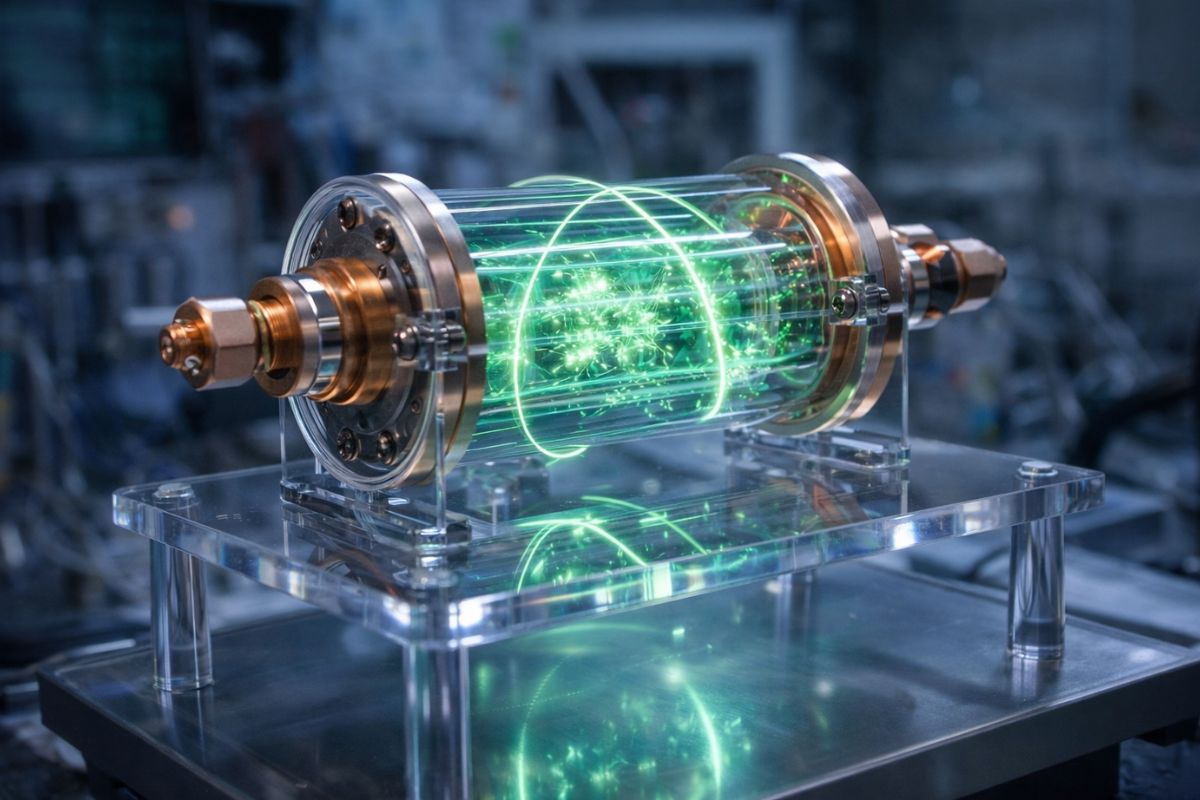
Scientists from CSIRO, RMIT University, and the University of Melbourne built the first functional prototype of a quantum battery that charges, stores, and releases energy using principles of quantum physics, with the surprising feature of charging faster as it grows in size.
The batteries that power cell phones, electric cars, and practically everything that uses electricity operate based on chemical reactions. Scientists have just built a prototype of a quantum battery that operates on a completely different principle: instead of chemistry, it uses effects of quantum physics such as superposition and interactions between light and electrons to charge, store, and release energy. The device, developed in partnership between CSIRO (Australia’s national science agency), RMIT University, and the University of Melbourne, represents the most significant advancement to date in building a functional quantum battery.
The research, published in the journal Light: Science & Applications, revealed a characteristic that challenges the logic of conventional batteries. The quantum battery charges faster as it grows in size, exactly the opposite of what happens with current technologies, where scaling a battery does not improve charging efficiency. Daniel Tibben, co-author of the study and a PhD student at RMIT, explained that this discovery is a sign that quantum batteries may one day surpass conventional energy storage technologies.
What is a quantum battery and how does it differ from everything that exists
A quantum battery stores energy using principles of quantum mechanics, including superposition and entanglement, instead of the electrochemical processes of lithium or sodium batteries.
-
New technology allows payment with the palm of the hand and may replace cards and cell phones in Brazil; The system is in development and uses the unique patterns of the veins in the hand to make the payment.

-
Scientist who “predicted” the pandemic issues new warning, says the world may be entering a phase of disintegration and urges us to prepare for what is to come.

-
NASA released a photo taken from the International Space Station showing a lightning bolt shooting upwards into space instead of falling to Earth, reaching nearly 100 kilometers in altitude at the top of a storm.

-
Forget the idea that your brain stops developing at 25: a study with over 4,000 people proved that it continues to rebuild itself until 32 and goes through five phases throughout life.

The prototype built by the scientists is a small layered organic device that can be charged wirelessly using a laser, demonstrating that energy can be transmitted without direct physical connections. It is a radically different approach from anything the battery industry has developed to date.
The fundamental difference is that while a conventional battery relies on ions moving between electrodes through an electrolyte, the quantum battery utilizes quantum states of matter to store energy in a way that classical physics simply does not allow.
The effects of superposition allow the system to exist in multiple energy states simultaneously, opening up possibilities for energy storage and release that traditional batteries will never be able to achieve due to chemical limitations.
The surprising discovery: the quantum battery charges faster the larger it becomes
This is perhaps the most counterintuitive characteristic of the prototype. In conventional batteries, increasing the size does not make charging more efficient. A larger battery simply stores more energy but does not charge proportionally faster.
The quantum battery built by the Australian scientists behaves oppositely: as the system grows, the charging speed increases.
Daniel Tibben summarized the importance of the discovery: “Our study found that quantum batteries charge faster as they increase in size, which does not correspond to how current batteries operate.” This behavior is possible because of the quantum interactions between the components of the system.
The more units are added, the more strongly they interact with each other, accelerating the charging process of the quantum battery in a way that classical physics cannot replicate.
The prototype that proved the quantum battery works in practice
Until recently, quantum batteries were purely theoretical concepts discussed in academic papers. What the team led by Dr. James Quach from CSIRO achieved was to build a real device that demonstrates the three essential functions: charging, storing, and discharging energy.
Daniel Gómez, a professor of Physical Chemistry at RMIT and co-author of the study, described the moment as a milestone in the transition from theory to practice.
The quantum battery prototype operates at room temperature, which is a relevant technical detail, as many quantum physics experiments require cooling to temperatures near absolute zero.
Charging is done wirelessly, through a laser that transfers energy to the layered organic device. Gómez expressed optimism, stating that he hopes quantum batteries will soon cease to be a theoretical idea and become something routinely built in laboratories.
What is needed for the quantum battery to leave the laboratory and reach the market
The research team is clear about the current stage of the technology: there is still much work ahead. The main challenge is to increase the charge storage time of the quantum battery, which is currently too short for practical applications.
Improving this duration will be crucial for the technology to become commercially viable and compete with the lithium batteries that dominate the market.
Dr. James Quach pointed out the long-term vision of the project: “My greatest ambition is a future where we can charge electric cars much faster than gasoline cars, or charge devices over long distances wirelessly.”
Although this vision is still distant, the functional prototype published in Light: Science & Applications lays the necessary scientific foundations. The quantum battery has ceased to be science fiction. It is now early-stage engineering with concrete results and a visible development path.
Why the quantum battery could change the future of energy if science advances
The potential impact of this technology goes beyond fast charging cell phones. If the properties observed in the prototype are confirmed at larger scales, the quantum battery could transform renewable energy storage, electric transportation, and even wireless electricity distribution.
The feature of charging faster as it grows reverses the economic equation: the larger the system, the more efficient it becomes.
The quantum battery represents a frontier where physics, engineering, and energy meet in a way that has never happened before. It is not about incrementally improving existing batteries.
It is a paradigm shift, where the rules of quantum mechanics replace chemistry as the foundation of energy storage. If it works at scale, it will be the biggest revolution in the energy sector since the invention of the lithium battery. And the first concrete step has already been taken in a laboratory in Australia.
What do you think of the idea of a quantum battery that charges faster as it grows? Do you believe this technology will reach the market or remain confined to laboratories? Leave your opinion in the comments. Few topics combine physics, energy, and the future as well as this one.









Seja o primeiro a reagir!