





 Portuguese
  English
  Spanish
  5 min of reading
  0 comments


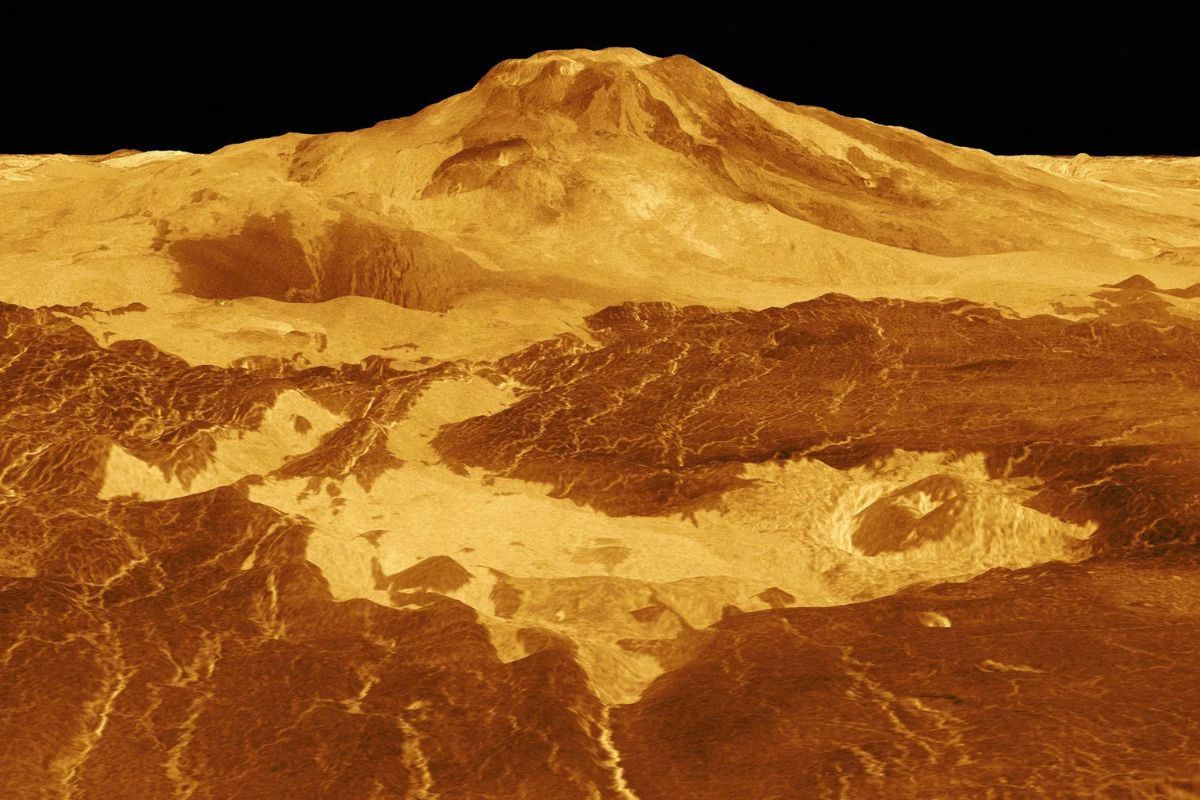
Researchers from the University of Trento identified beneath the volcano on Venus, Nyx Mons, the first direct evidence of a volcanic cave on the planet, about one kilometer wide and 375 meters high, reanalyzing radar images from NASA’s Magellan mission forgotten for three decades.
A gigantic cave was hidden beneath the surface of Venus billions of years ago, and the clue to finding it was kept in NASA’s archives for over three decades. Scientists from the University of Trento in Italy reanalyzed radar images from the Magellan mission and identified what appears to be a massive lava tube beneath the volcano on Venus known as Nyx Mons. The study, published in the journal Nature Communications, represents the first direct evidence, obtained by radar, of the existence of a subterranean conduit on the neighboring planet of Earth.
According to EcoNews, the structure impresses with its dimensions. The lava tube is approximately one kilometer wide on average, with a ceiling at least 150 meters thick and an empty space below it at least 375 meters high. The radar echoes show the signal traveling inside the tube for at least 300 meters from the opening in the ceiling. Based on the alignment of nearby craters and the slope of the terrain, the entire system beneath the volcano on Venus could extend for about 45 kilometers, a scale that surpasses any known lava tube on Earth.
What scientists found beneath the volcano on Venus, Nyx Mons
The newly described structure is located on the western slope of Nyx Mons, a shield volcano about 362 kilometers wide. In the radar images, the main feature resembles a dark crater surrounded by a chain of similar collapses.
-
They were brilliant! Scientists discover that our ancestors in China were already making super advanced tools 160,000 years ago, changing everything we knew.

-
Scientists unveil 3 million years of climate secrets hidden in the ice of Antarctica.

-
Ancient farmers created “aggressive plants” that changed nature forever.

-
Astronomers find a “backward” solar system that ignores all the rules of space and leaves scientists scratching their heads!


The researchers named this depression “Crater A” and noticed that it behaved differently from a common crater when analyzed by radar signals.
In most craters, the radar signal simply shows the image of a steep hole.
Crater A exhibited a bright and asymmetric band that extended well beyond the edge, a pattern that, according to the team, corresponds to what happens when radar waves enter through a skylight, ricochet along a subterranean tunnel, and scatter back to the spacecraft’s sensors. In other words, Crater A is likely the collapsed ceiling of a lava tube that transported molten rock beneath the volcano on Venus.
How scientists read a cave using 30-year-old radar echoes
Venus is shrouded in clouds so dense that conventional cameras cannot capture its surface.
The Magellan probe used Synthetic Aperture Radar in the early 1990s to create a global map of the planet, and it is exactly this data, collected over 30 years ago, that the Italian team repurposed with modern analysis techniques. What once appeared to be just another crater revealed itself to be the entrance to a cave of colossal dimensions.
The team treated the radar image as a kind of X-ray of the terrain beneath the volcano on Venus. By measuring the length of the brightness within Crater A and the size of the projected shadow, the researchers were able to estimate the shape of the hidden void.
The techniques used were initially tested on lava tubes on the Moon and Earth, which gave confidence in the results. For comparison, famous lava tunnels on Earth, such as the Cueva de los Verdes in Lanzarote, reach widths of only a few dozen meters. The Venusian tunnel surpasses them on an incomparable scale.
Why a cave beneath a volcano on Venus matters to science
Lava tubes are more than geological curiosities. They preserve a record of how a planet’s volcanoes erupted and cooled over time. On Mars and the Moon, similar structures are seen as potential natural shelters for future explorers, as solid rock walls can block radiation and micrometeorites.
On Venus, with surface temperatures above 450 degrees Celsius and atmospheric pressure more than ninety times that of Earth, no one will explore this cave in person anytime soon.
But the discovery has scientific value that goes beyond physical exploration. Venus is often described as Earth’s twin that took a radically different path, with an atmosphere dominated by carbon dioxide and clouds of sulfuric acid.
Understanding how volcanoes function on this planet helps researchers unravel how Venus lost its oceans and transformed into the extreme world we know today. The volcanic system is directly linked to how gases move between the interior and the atmosphere, a fundamental process for long-term climate evolution.
What may be hidden in NASA archives beyond this cave
If a lava tube of this size was hidden in radar images collected over 30 years ago, the research team believes that many other similar structures may be waiting in the archives and on the surface of the volcano on Venus and other volcanoes on the planet.
Radar data shows that lava channels and collapse chains are common on the Venusian surface, suggesting that the discovery of Nyx Mons is likely just the beginning.
The analysis published in Nature Communications represents, in the words of the researchers themselves, the tip of the iceberg. With modern image processing tools and enhanced radar reading techniques, scientists around the world can revisit the data from the Magellan mission and find structures that have gone unnoticed for three decades.
The volcano on Venus holds secrets that the technology of the time was unable to reveal, but that current methods can decipher with increasing accuracy.
The future missions that will map the volcano on Venus with unprecedented details
The next generation of space missions promises to examine this cave and other structures with much higher resolution. The EnVision mission from the European Space Agency and NASA’s VERITAS will carry radar instruments with resolutions of up to a few dozen meters, a huge leap from the Magellan data.
The EnVision’s Subsurface Radar Sounder is designed to send radio waves hundreds of meters below the surface, exactly the depth of the tube beneath Nyx Mons.
In practice, this means that future spacecraft will not only be able to confirm the size of the cave but also map intact lava tubes that show no visible collapse on the surface. Step by step, scientists will build a three-dimensional image of the Venusian volcanic systems, something that has never been possible.
The more we learn about the volcanoes and subterranean tunnels of Venus, the better we can understand how rocky planets similar to Earth can go from habitable to completely hostile. And this understanding begins with a gigantic cave found in images forgotten for 30 years.
What do you think about the discovery of a cave nearly one kilometer wide beneath a volcano on Venus? Do you believe that NASA’s archives still hide more surprises, or do we need new missions to truly understand our neighboring planet? Leave your opinion in the comments. Discoveries like this show that science still has much to reveal about the solar system.









Seja o primeiro a reagir!