





 Portuguese
  English
  Spanish
  3 min of reading
  0 comments


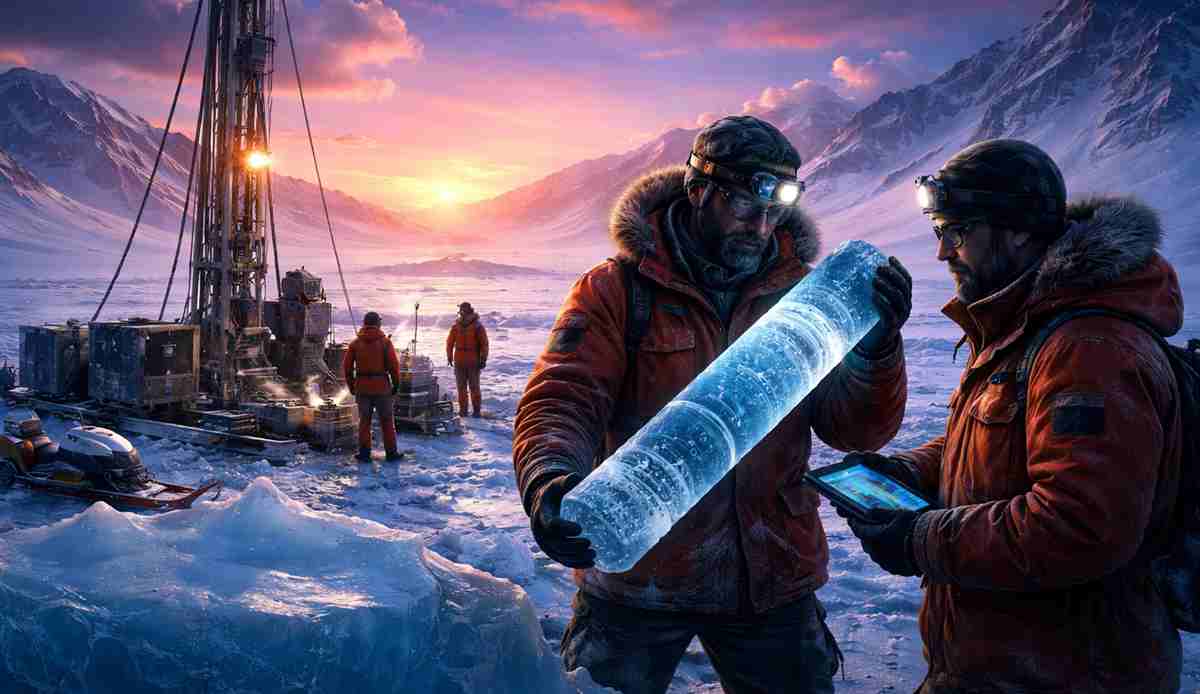
The time capsule preserved within the oldest glacial layers on the planet. Air bubbles trapped in the blue ice of the Allan Hills function as a direct atmospheric archive, allowing for a comparison of current warming with the climate of the Pliocene.
Scientists have reached a historic milestone by uncovering climate records from 3 million years ago preserved in Antarctic ice. The discovery, made through drilling in blue ice areas in the Allan Hills, allows for an unprecedented understanding of how carbon dioxide levels influenced global temperatures in the distant past.
These samples represent the oldest ice ever recovered on the planet, far surpassing previous records of 800,000 years obtained from deep drilling sites. The study of this material is crucial for understanding the climatic transition that occurred during the Pliocene, when global temperatures were significantly higher than today. Monitoring these gases trapped in Antarctic ice provides a direct window into the state of the Earth’s atmosphere during times of natural warming.
Air bubbles and the composition of the ancient atmosphere
At the core of this scientific investigation are tiny air bubbles trapped within the ice layers. These bubbles act as time capsules, preserving actual samples of the Earth’s atmosphere from millions of years ago. Through the chemical analysis of these samples, researchers have been able to accurately measure concentrations of greenhouse gases such as carbon dioxide and methane.
-
Ancient farmers created “aggressive plants” that changed nature forever.

-
Astronomers find a “backward” solar system that ignores all the rules of space and leaves scientists scratching their heads!

-
China’s neighbor has a plan to gather thousands of kamikaze drones and cheap missiles with a range of over 1,000 km, putting both Shanghai and Taiwan within striking distance.

-
Ancient boreal forests in Sweden reveal a climate secret by storing 72% more carbon than managed areas, proving that soil preservation is much more effective against global warming than commercial replanting.

The dating process of these deep layers uses isotopes of rare gases to determine the exact age of each segment of Antarctic ice. This technique allows scientists to reconstruct the timeline of climatic variations with detailed resolution. The consistency of the obtained data reveals how the Earth’s climate system responded to subtle changes in the planet’s orbit and volcanic activity over eras.
Blue ice samples are found in regions where glacial flow is forced upward against mountains, exposing ancient layers near the surface. This geological phenomenon has facilitated access to records that, in other parts of the continent, would be buried under kilometers of accumulated snow. The study of these formations in Antarctic ice circumvents the need for extremely costly and time-consuming kilometer-deep drilling.
Climatic transition and the threshold of the Pliocene
One of the most significant findings of this research is the confirmation that CO2 levels in the Pliocene were comparable to the levels recorded by current human activity. At that time, however, sea levels were much higher and polar ice caps were considerably smaller. These data suggest that the Earth’s climate system has long-term response mechanisms that are still ongoing in the contemporary scenario.
The records show that the Earth’s climate underwent drastic changes from glacial cycles of 41,000 years to cycles of 100,000 years. The analysis of Antarctic ice suggests that carbon dioxide played a central role in regulating this transition in climatic frequency. Understanding this historical trigger helps experts model future predictions about the stability of current polar ice layers.
The discovery also indicates that the East Antarctic ice sheet may be more resilient than suggested by some previous climate models. Even during extreme heat periods in the past, significant portions of Antarctic ice remained stable, although the coastal margins experienced significant retreats. This distinction is crucial for planning global coastal adaptation strategies.
Perspectives for future climate modeling
Access to these 3 million-year-old records allows climate models to be tested against real data from a warmer world. So far, many simulations have relied on indirect estimates obtained from ocean sediments, which are less accurate than direct air bubbles. The material extracted from Antarctic ice provides the “real proof” needed to calibrate these atmospheric forecasting tools.
Fieldwork in the Allan Hills continues to seek even older samples that may date back to the beginning of the Pleistocene. Each new meter of analyzed ice adds layers of knowledge about the sensitivity of the Earth system to gas balance. The ongoing preservation of these areas is seen as an international scientific priority to ensure the continuity of studies on planetary evolution.
In the long term, researchers hope to find cores that cover existing temporal gaps in the geological record. The ability to predict the future behavior of the oceans and atmosphere entirely depends on how clearly we can read the history written in Antarctic ice. The secrets revealed so far are just the beginning of a new era in understanding Earth geophysics.
Click here to see the study.






Seja o primeiro a reagir!