





 Portuguese
  English
  Spanish
  5 min of reading
  0 comments


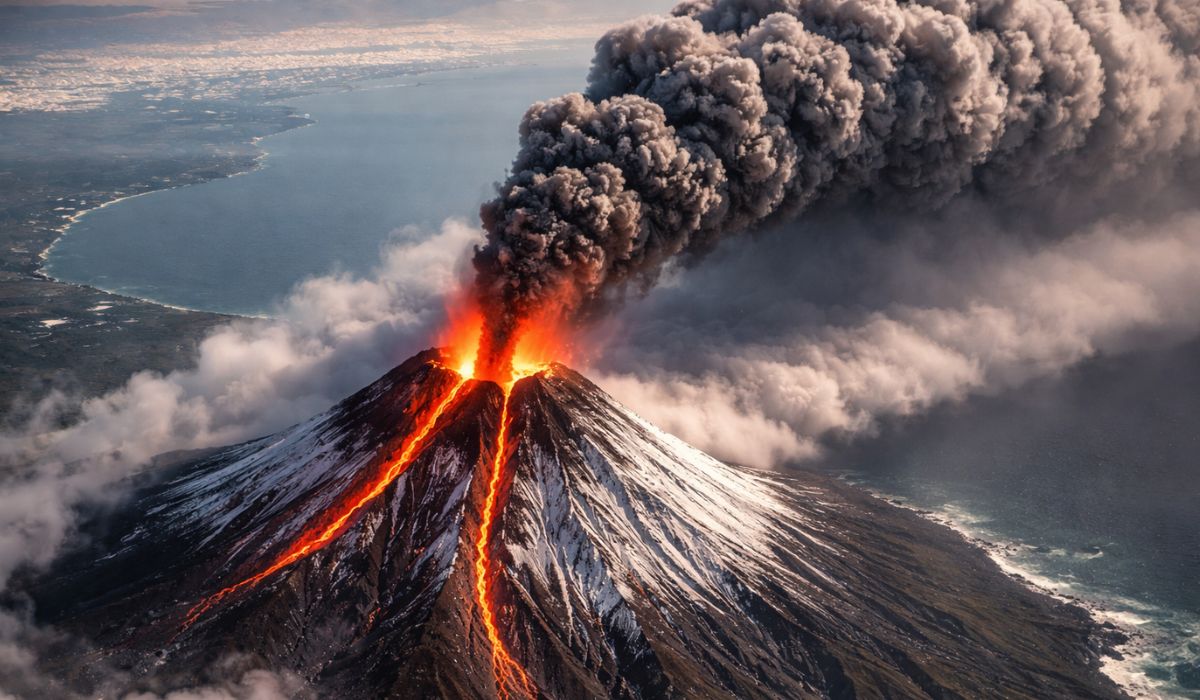
NASA satellite image reignited interest in one of the most active volcanoes in Kamchatka, in a record that united giant plume, lava flows, and constant monitoring in the Pacific Ring of Fire.
A satellite image from NASA drew attention back to the Klyuchevskoy volcano, on the Kamchatka Peninsula in the far east of Russia, by capturing an eruptive column that reached about 1,600 kilometers into the Pacific.
The episode, observed on November 1, 2023, showed the volcano releasing ash and gases at high altitude, while two lava fronts highlighted by false color formed a pattern that visually resembled horns.
Although the scene was captured in 2023, the topic remains relevant because Klyuchevskoy continues to be among the most active volcanoes in Kamchatka and resumed intense activity in 2025.
-
Expedition 501: Scientists drill into the ocean floor and discover a giant reserve of fresh water hidden beneath the sea, extracting nearly 50,000 liters and revealing an invisible system that could reshape the map of water scarcity.

-
Archaeologists find an intact tomb over 2,500 years old, with more than 100 preserved objects, weapons, jewelry, and human remains never touched.

-
Volcanic lava transforms into threads as fine as human hair that travel over 30 kilometers by wind and fall like cutting rain on roofs and backyards in Hawaii and Iceland.

-
NASA issues a warning for the feared Godzilla El Niño that could change the planet’s climate in 2026 with extreme warming of the Pacific capable of causing devastating droughts in some regions and historic floods in others simultaneously.


In August of that year, new images from NASA showed ash plumes moving towards Alaska, in yet another episode accompanied by aviation alerts.
The scientific interest surrounding Klyuchevskoy goes beyond the visual impact of the images.
According to the Global Volcanism Program of the Smithsonian Institution, it is an active stratovolcano with frequent eruptions, over 100 flank eruptions in the last 3,000 years, and recurring changes in the morphology of the main crater since the late 17th century.
The same source describes it as the tallest and most active volcano on the Kamchatka Peninsula.
NASA image showed ash plume and lava flows at Klyuchevskoy
The photograph that sparked recent attention was obtained by the MODIS sensor aboard NASA’s Aqua satellite during a moment of eruptive intensification in the second half of 2023.

According to the agency’s Earth Observatory, the ash plume reached 12 kilometers in altitude and extended east-southeast for approximately 1,600 kilometers.
In the false-color version published by NASA, the clouds appear blue, the eruptive plume emerges in gray tones, and the lava stands out in red due to the shortwave infrared signal.
This processing does not alter the event but facilitates the visual distinction between lava, clouds, and material expelled by the volcano.
It was this combination of elements that led some international coverage to describe the two lava fronts as “horns.”

From a geological perspective, however, the image shows lava flows associated with an eruptive phase that also produced large volumes of ash, with the potential to interfere with air routes in the region.
NASA reported that the aviation code was raised to red level during that episode, and reports at the time indicated school closures in two nearby cities as a precautionary measure.
Klyuchevskoy volcano remains among the most monitored in Kamchatka
The eruptive history helps explain why Klyuchevskoy frequently appears in scientific bulletins and satellite images.
The Smithsonian notes that the previous eruptive phase ended in November 2022, and a new sequence of activity began in June 2023, with Strombolian explosions, lava flows, and ash plumes over several months.
More recently, the system intensified again in April 2025.
According to reports from the Global Volcanism Program and the Kamchatka volcanic eruption response group, thermal anomalies were detected by satellite, lava sources in the summit crater, and visible incandescence.
The eruptive activity that began in April 2025 ended on August 16 of that year, although the volcano continued to emit gas and steam.
Still in August 2025, NASA’s Earth Observatory published a new image showing ash plumes coming from Klyuchevskaya Sopka, another name used for the same volcano.
According to the agency, the plumes observed between August 4 and 13 reached altitudes of up to 9 kilometers, and the volcanic ash advisory center in Anchorage issued red alerts for aviation on several occasions.
This set of recent records prevents the topic from being restricted to an old image.
The 2023 photograph remains relevant because it documents a significant phase of the volcano and simultaneously connects to an eruptive pattern that remained active in the following years and continues to be monitored by satellites and specialized teams.


Kamchatka Peninsula concentrates one of the most active volcanic areas on the planet
The Kamchatka Peninsula is one of the most well-known volcanic areas in the world.
NASA reports that the region hosts more than 300 volcanoes, several of them active, while Klyuchevskoy is part of the “Volcanoes of Kamchatka” site, recognized as a World Heritage Site by UNESCO.
Klyuchevskoy is not isolated.
The Bezymianny volcano is located nearby, and the Global Volcanism Program also mentions the presence of other volcanic centers in the vicinity, such as Ushkovsky and Tolbachik.
This grouping helps explain why the area is continuously monitored by monitoring networks, especially when there is an increase in ash at altitude.
Activity in the peninsula is linked to Kamchatka’s position in the so-called Pacific Ring of Fire, a tectonic belt that encircles much of the Pacific Ocean.
According to the United States Geological Survey, this is the zone of highest seismic and volcanic activity on the planet.
National Geographic reports that about 90% of earthquakes occur along this belt and that approximately 75% of the Earth’s active volcanoes are distributed throughout it.
Height of the volcano and risk to aviation amplify international repercussions
Another fact that supports the international repercussions is the size of Klyuchevskoy.
NASA coverage defines it as the tallest active volcano in Eurasia, and the altitude reported in recent news articles is around 4,754 meters above sea level.

This combination of high altitude and frequent activity increases the visibility of the volcano in both orbital images and aviation alert systems.
In eruptions of this type, the problem is not limited to the visual aspect of the phenomenon.
NASA reminds us that volcanic ash particles are small, abrasive, and capable of damaging aircraft.
Therefore, satellite observations are used by warning centers to guide airlines and reduce the risk of incidents on routes crossing the northern Pacific.
The image of the so-called “devil’s horns” gained attention because it captured, in a single record, the unusual shape of the lava flows, the scale of the atmospheric plume, and the geological context of one of the most active volcanic systems on the planet.
More than just an unusual photo of Earth from space, the record has been treated by agencies and monitoring centers as yet another example of the persistent activity of Kamchatka, one of the most observed regions in the study of volcanism.








Seja o primeiro a reagir!