





 Portuguese
  English
  Spanish
  5 min of reading
  1 comment


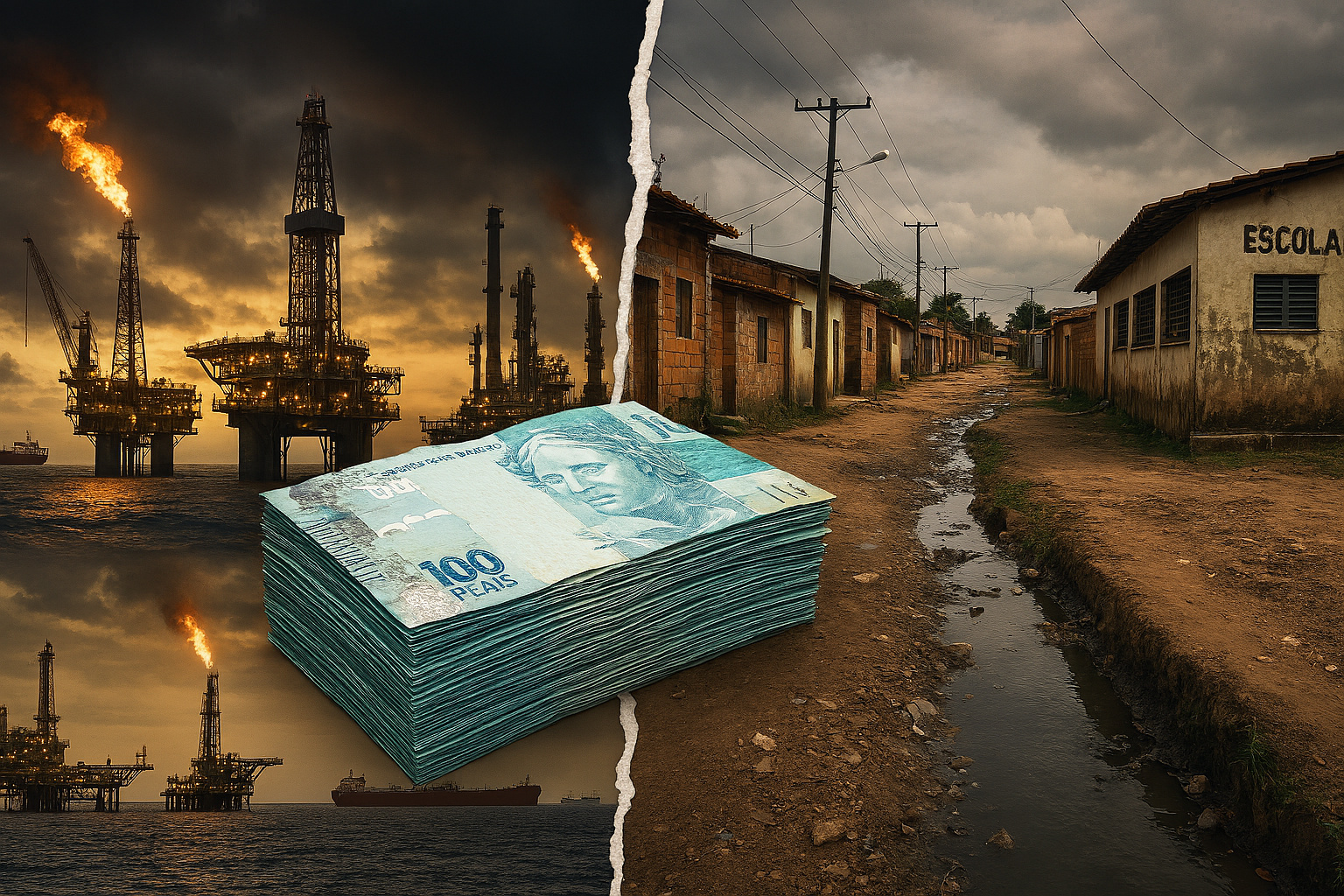


According to IPS Brazil, municipalities that receive millions in oil royalties continue with low indices of sanitation, education, and quality of life, revealing a social paradox in the country.
For decades, oil royalties were presented as a kind of passport for local development. The logic seemed simple: municipalities that receive millions of reais every year from oil and gas exploration would have sufficient resources to invest in sanitation, education, health, and basic infrastructure. However, the latest data from the Social Progress Index (IPS Brazil) shows that this promise has failed in several concrete cases.
Even with high revenues from oil, some municipalities continue to occupy extremely low positions in quality of life rankings, revealing a disturbing paradox: money comes in, but social progress does not follow.
What Is IPS Brazil and Why It Matters
The IPS Brazil is one of the most comprehensive indicators for measuring quality of life in the country because it does not rely on income or GDP, but rather on real outcomes for the population. The index assesses three broad dimensions: basic human needs, foundations of well-being, and opportunities.
-
Lula responds directly to Trump and says that Pix is from Brazil and will not change under pressure from anyone, after a report from the United States pointed out the Brazilian payment system as an American trade barrier.

-
Amazon has just announced a new fee on all deliveries, and your online purchases will become more expensive starting April 17, including for those buying from the United States here in Brazil.

-
He sold his share for R$ 4 thousand, saw the company become a giant worth R$ 19 trillion, and missed the opportunity of a lifetime.

-
Elon Musk’s Starship megafrocket puts $8 billion at risk, raises alarms in the market, and could affect technology, mining, and space internet startups in the coming years.


This includes access to clean water, sanitation, adequate housing, basic education, health, security, social inclusion, and individual rights. In other words, the IPS measures how people live, not how much money circulates in the local economy.
When wealthy municipalities in royalties appear among the lowest-ranked in the IPS, the data is particularly revealing.
High Royalties, Low Social Indicators
Brazil has dozens of municipalities that receive <strong multi-million or even billion-dollar in royalties and special participations from oil, mainly in states like Rio de Janeiro, Espírito Santo, Rio Grande do Norte, and Bahia. Still, IPS Brazil indicates that some of these cities show low performance in basic sanitation, education, and access to essential services.
In some cases, less than half the population has access to treated sewage. In others, indicators of school dropout, avoidable mortality, and food insecurity remain high, even with municipal budgets well above the national average.
The contrast between revenue and social reality exposes a structural problem that goes beyond a mere lack of resources.
Where Money Does Not Turn Into Quality of Life
The data from IPS Brazil shows that the problem is not just the volume of revenues, but the ability to convert revenue into effective public policies. Municipalities dependent on royalties often face:
– low technical planning capacity
– inefficient or dispersed use of resources
– prioritization of short-term spending
– excessive dependence on a single source of revenue
Moreover, since royalties are not necessarily tied to specific areas like sanitation or education, their use ends up being subject to political decisions that do not always prioritize long-term social impact.
The Effect of the “Resource Curse”
Economists and social scientists often refer to this phenomenon as the “resource curse”. Countries and cities rich in commodities, such as oil, often exhibit worse social indicators than regions with fewer natural resources, precisely because of excessive dependence on these revenues.
In the Brazilian case, IPS Brazil highlights that some producing municipalities have not diversified their economy or invested consistently in human capital. When royalties fall, whether due to variations in oil prices or decreased production, social problems become even more evident.
Sanitation: The Most Visible Bottleneck
Among all the indicators analyzed by IPS Brazil, basic sanitation stands out as one of the most critical issues in municipalities rich in royalties and poor in quality of life. Lack of treated sewage, irregular water supply, and improper waste disposal remain a reality for thousands of residents.
This data is particularly serious because sanitation is one of the investments with the highest social and economic returns, reducing diseases, improving school performance, and decreasing public health expenditures.
Education and Limited Opportunities
Another recurring factor in poorly ranked municipalities in the IPS is the low quality of basic education. Even with robust budgets, many cities have not managed to improve indicators like literacy, school retention, and student performance.
This creates a vicious cycle: young people grow up in municipalities rich in natural resources but poor in real opportunities, perpetuating inequality, dependence on low-skilled jobs, and economic fragility in the long term.
Comparisons That Reveal the Problem
IPS Brazil also shows that municipalities without oil, but with good public management, achieve much better social results even with fewer resources. This reinforces the conclusion that money is not the deciding factor, but rather planning, governance, and focus on structuring policies.
While some producing cities remain at the bottom of the ranking, medium-sized municipalities with more modest revenues rank among the best in terms of quality of life.
With the ongoing energy transition and the prospect of reducing global dependence on fossil fuels in the coming decades, the alert from IPS Brazil gains even more weight. Municipalities that do not turn royalties into lasting social legacy may face fiscal and social collapses in the future.
Oil is a finite resource. Sanitation, education, and human capital are not.
What the Data from IPS Brazil Really Reveals
More than exposing specific cities, IPS Brazil reveals a troubling pattern: extraordinary revenue does not guarantee social progress. Without planning, transparency, and focus on effective public policies, even billions of reais can dissolve without delivering real benefits to the population.
The ranking thus serves as an uncomfortable mirror for public managers and as a powerful tool for the debate on how Brazil deals with its natural wealth.
The good news is that the scenario is not irreversible. The data from IPS Brazil show clear paths: invest in sanitation, strengthen basic education, diversify the local economy, and improve municipal governance.
While this does not happen, the paradox remains. Cities sitting on billions in oil continue to rank among the worst in the country in quality of life, not due to a lack of money, but due to a lack of real transformation.









Quais são esses municípios, devemos saber para auxiliar os moradores nos projetos de qualidade de vida.