





 Portuguese
  English
  Spanish
  4 min of reading
  17 comments


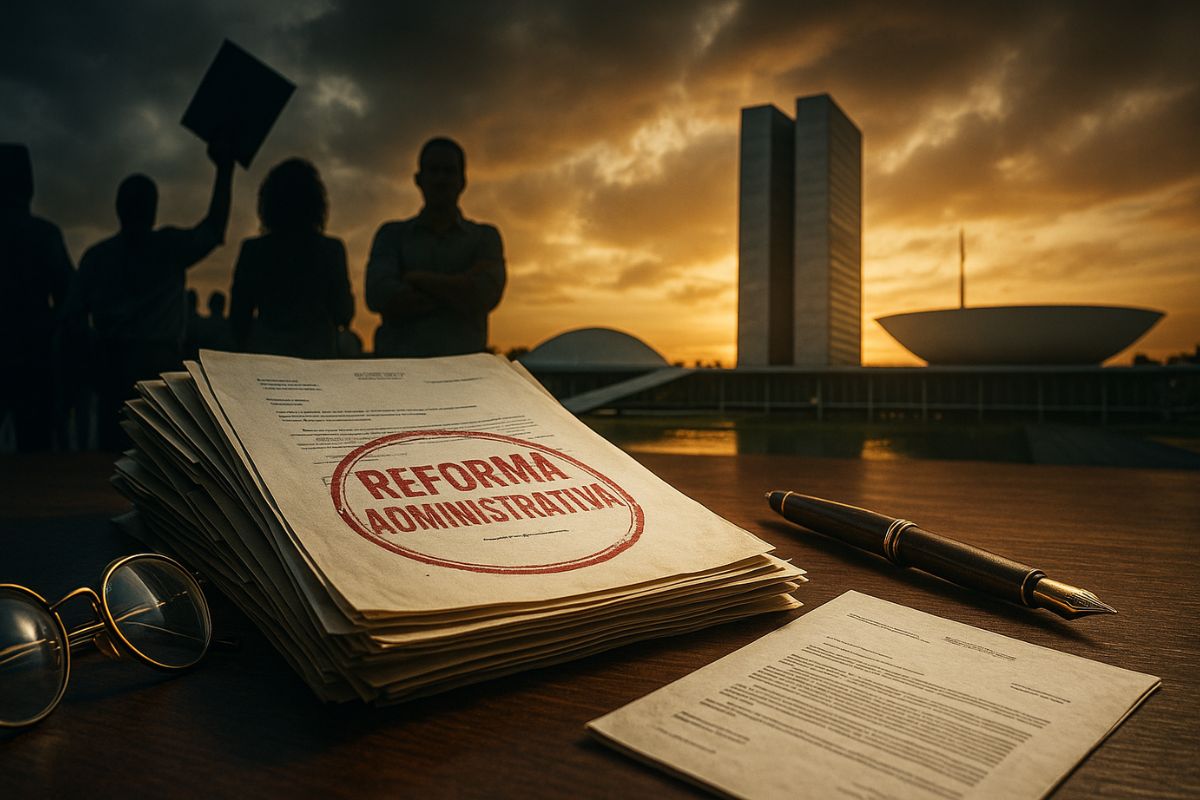


The Administrative Reform Proposal, Still Under Development, Already Generates Criticism for Foreseeing Cuts in Initial Salaries, Greater Use of Temporary Workers, and Progressions Tied to Annual Evaluations. For Public Servants, Changes Represent Precarization; for the Government, Modernization.
The administrative reform has not yet officially reached Congress, but it is already stirring public debate. According to the rapporteur, Congressman Pedro Paulo (PSD-RJ), the package will be divided into a PEC, a complementary law project, and an ordinary one, with around 70 measures. The declared aim is to increase the productivity of the State, but public servants accuse precarization, claiming that the proposal alters historical pillars of entry, stability, and progress in public careers.
Among the most sensitive points, are the reduction of initial salaries, the possibility of direct entry at intermediate levels, the expansion of temporary contracts, and the transformation of performance evaluations into a real condition for permanence and promotion in the public service.
Entry and Probationary Period in Focus
The text proposes a reformulation of the probationary period, which would cease to be merely a formality.
-
BRICS is building its own payment system that could be operational by 2030, and experts say it could increase trade between the countries by up to 10% per year and add 3% to the GDP of each member of the bloc.

-
Government suspends over 3 million traffic fines in Brazil and drivers breathe a sigh of relief.

-
Iran has just approved toll charges for ships in the Strait of Hormuz and has completely prohibited the passage of vessels from the United States and Israel in the world’s most important maritime route for the global energy market.

-
Government cancels R$ 25 million “celebration” for Brasília’s anniversary and allocates funds to health.


Today, only 0.19% of public servants were rejected between 2014 and 2024, according to the Ministry of Management.
The reform foresees objective criteria, with a risk of dismissal if performance is insufficient.
For specialists, such as Fernando Coelho (USP), the change would transform the probationary period into an extension of the public competition, reinforcing continuous selection.
This opens up space for hiring at intermediate levels, reducing the time to positions of greater responsibility.
This flexibility worries unions, which see a risk of favoring political appointments at the expense of transparent competitions.
Lower Initial Salaries and Slower Progressions
Another controversial point is the rule that limits the initial salary to 50% of the career ceiling.
In practice, new public servants will start earning less and will take longer to reach the top.
The design also foresees longer careers, with several stages of progression.
For Gustavo Tavares (Insper), the measure will only be fair if accompanied by clear and transparent merit evaluations.
If not, the effect may be demotivation and a sense of injustice. States and municipalities will have up to ten years to align their tables with the federal reference.
Temporaries, Goals, and Performance Bonuses
The administrative reform also regulates temporary contracts.
Currently used irregularly in many areas, such as education, they would have maximum terms, a waiting period between contracts, and simplified selection to curb nepotism.
Proponents of the proposal, such as Jessika Moreira (Movimento Pessoas à Frente), claim that the regulation brings minimum rights and legal certainty.
Another point is the creation of mandatory goals for managers and the possibility of annual bonuses tied to results.
Although seen as an incentive for efficiency, specialists warn that without robust metrics, such mechanisms may create distortions and reward artificial results.
Super Salaries and Privileges Under Discussion
The text foresees measures to curb super salaries, such as standardizing indemnity funds and prohibiting the sale of part of the vacation.
It also establishes that directors of state-owned companies not dependent on the Treasury must respect the constitutional ceiling.
Critics, such as Alketa Peci (FGV), point to the risk of losing talent in areas where the private sector pays much more.
Another innovation is to allow the dismissal of judges through an administrative process, without the need for a definitive judicial decision.
The measure is seen as a step forward in transparency but faces resistance for breaking with the tradition of compulsory retirement.
Mandatory Annual Evaluation
The creation of the Sidec (Career Development System) will make performance evaluation mandatory across all spheres and Powers.
The model provides for goal agreements at the beginning of the year, periodic feedbacks, and scores that directly influence career progression.
For entities like República.org, the measure brings transparency; unions claim that the system can be used as a tool for political persecution.
Modernization or Precarization?
For the government, the administrative reform modernizes the public service, reduces salary inequalities, and strengthens meritocracy.
For public servants, it dismantles the logic of stability, expands temporary ties, and weakens the attractiveness of careers, putting the quality of the service provided to the population at risk.
And you, do you believe that the administrative reform is necessary to modernize the State or do you see it as a risk of precarization of public careers? Leave your opinion in the comments — your perspective can enrich this debate.









Torna precário o que já existe,
Nosso problema em relação a Administração não está na base da pirâmide, essa reforma é uma desculpa pra alcançar o alvo principal, que são os super salários e os penduricalhos , então pra que fazer cerimônia ?
Vá direto ao ponto, ataque quem tem que ser atacado.
Agora dá essa volta toda e atinge quem não tem nada com isso.
O petismo dando cria aos petistas públicos.
Interessante é que essa reforma está sendo formulada e apoiada pelos grupos da direita e extrema direita do Congresso.
Quando essa turma de políticos não acha o que fazer, procura sempre mexer em direitos dos trabalhadores, especialmente do serviço público. Isso é um jeito que querem dar para acabar de vez com a estabilidade e escravizar o servidor propondo metas que com serteza, serão abusivas e com finalidade de demissão, caso o novo servidor não agrade a gestão executiva. É a volta do apadrinhamento como era antes da Constituição de 1988.