





 Portuguese
 Spanish


The Rosmari-Marjoram project began producing natural gas on November 17, 2026, and uses 240 solar panels, batteries that can provide power for up to three days, and emergency generators. The offshore facility operates remotely, while a new onshore unit processes the fuel destined for Petronas’ LNG complex.
A permanently uncrewed natural gas platform powered mainly by solar energy has started operating about 220 kilometers off the coast of Malaysia. Developed by Shell, the Rosmari-Marjoram project combines offshore production, remote control and a 207-kilometer subsea pipeline to transport the fuel to an onshore processing facility.
Production began on November 17, 2026, after years of development of the Rosmari and Marjoram fields, which were discovered in 2014.
The facility has a designed capacity of up to 800 million standard cubic feet of natural gas per day, a volume Shell says is equivalent to the average daily consumption of about 5 million people in Malaysia.
-
Oil and gas discovery at 2,289 meters deep surprises explorers in Ghana, reveals a reservoir type never before confirmed in the country and opens a new exploration frontier off Africa’s coast

-
Discovered in 1974, North Sea oil field has gone more than 50 years without producing a single barrel despite holding about 1 billion barrels underground; new technology could finally make development viable
-
ANP proposes new rules for natural gas auctions under pressure from Petrobras, paving the way for Braskem to join Gas Release program
-
BNDES Sells R$3.6 Billion in Petrobras Shares, Reduces State Company Exposure to 20% of Net Worth, Prepares for New Lending

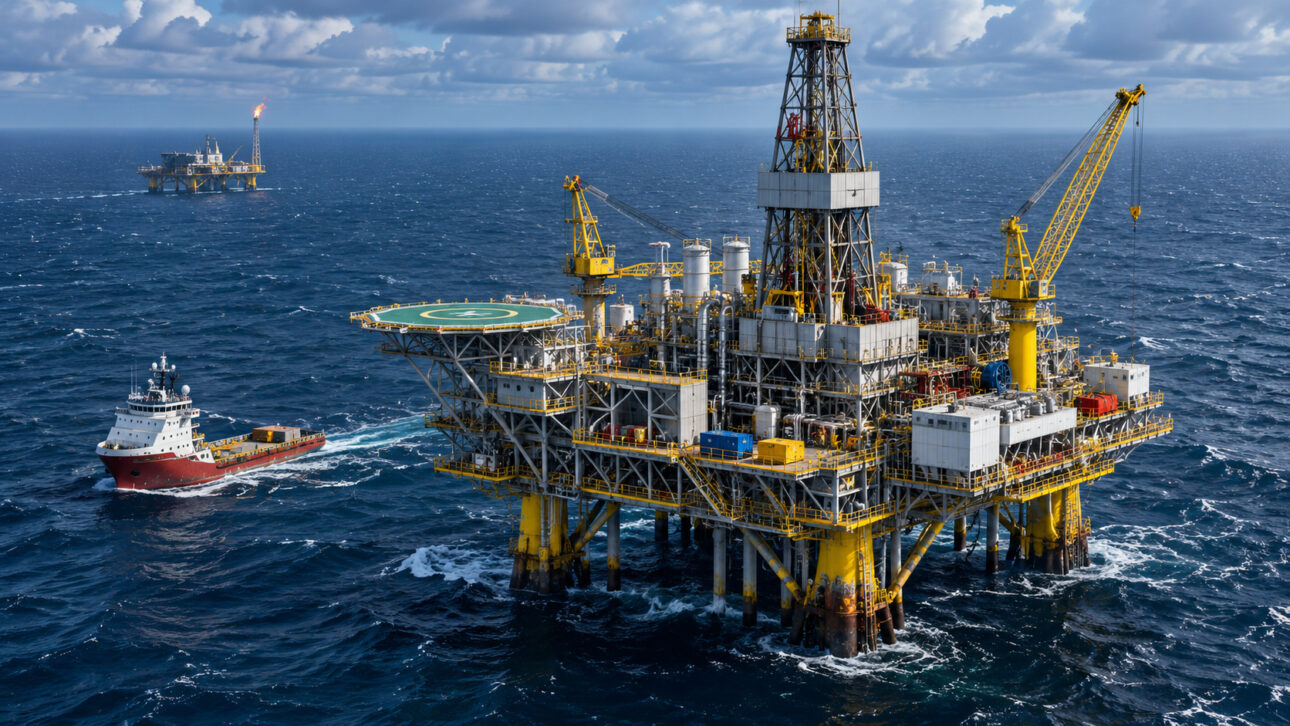


The most unusual feature is how the platform operates. Unlike large oil facilities that keep dozens of workers offshore, this unit was designed to operate remotely, with technical crews visiting for maintenance.
Electricity for routine operations comes mainly from solar panels, backed by batteries and diesel generators.
According to the official statement Shell published on November 17, the gas is transported to Bintulu, in the Malaysian state of Sarawak, where it is processed before being sent to Petronas’ liquefied natural gas complex.
How can a gas platform operate offshore without permanent workers?
The Rosmari-Marjoram offshore unit was designed to keep producing without a crew on board at all times.
The facility brings together control systems, production equipment and safety infrastructure that allow its operating conditions to be monitored remotely.
In practice, the wells produce natural gas, which passes through gathering and flow-control equipment before entering the subsea pipeline.
Remote operation reduces the need for workers to travel frequently to a location more than 200 kilometers from shore.
That marks a significant shift for the offshore industry.
On conventional platforms, living quarters, support equipment and onboard life-support systems take up space and require energy.
A facility designed to operate without a permanent crew can reduce some of those requirements, though it still needs inspections, specialized maintenance and rigorous safety procedures.
Shell uses a similar approach at other facilities in Malaysia. In 2023, the company brought the Timi field online, served by a permanently uncrewed platform with hybrid solar and wind power generation.
Rosmari-Marjoram builds on that experience with a project capable of supplying far greater volumes of gas.
Platform uses 240 solar panels and batteries that can store power for three days
The electricity supply is one of the facility’s most notable features.
The platform has 240 solar panels, which generate most of the electricity used during uncrewed operations.
The system includes batteries sized to store enough energy for up to three days of operation.
This reserve helps keep the equipment running during periods of low solar generation.
Diesel generators provide an additional source of electricity and can meet higher demand when maintenance crews visit the facility.
The configuration demonstrates how renewable energy systems can be applied directly to fossil fuel production operations.
Solar power supplies the platform’s equipment, while the product extracted remains natural gas.
The distinction matters: using renewable electricity at facilities reduces reliance on conventional power generation during operations, but the fuel produced still carries emissions associated with its processing and consumption.
The project was designed to combine the reliability required for offshore production with electrical infrastructure that has lower operating demands.
A 207-kilometer subsea pipeline carries gas from offshore fields to a new onshore plant
Gas extracted at Rosmari-Marjoram travels a long way before reaching the market.
Production passes through the offshore platform and then travels along a 207-kilometer subsea pipeline to a new processing facility in Bintulu.
Building this infrastructure was essential to connecting the offshore fields to Malaysia’s industrial system.
The reservoirs are in an area with a water depth of about 800 meters. The collection platform, in turn, was designed for a shallower area connected to the other subsea equipment.
The development brings fields, subsea facilities, a platform and an onshore facility together in a single production system.
In Bintulu, the gas is treated to remove unwanted components before being sent to Petronas’ liquefied natural gas infrastructure.
The project’s location also supports the supply of Asian markets, which use natural gas for power generation and industrial activity.
Gas from the fields contains hydrogen sulfide and requires special treatment
The Rosmari and Marjoram fields have another significant technical feature: they produce what is known as sour gas.
This type of gas contains hydrogen sulfide, a toxic and corrosive substance that must be removed during processing.
The presence of this component requires suitable equipment, monitoring systems and specific procedures to ensure the integrity of the infrastructure.
At Rosmari-Marjoram, treatment takes place at the new onshore facility in Bintulu.
Hydrogen sulfide is separated and converted into sulfur, which can be used in industrial applications, including fertilizer production.
This operation adds to the project’s complexity.
Shell must transport the gas over a long subsea distance, maintain operational safety and ensure that the fuel meets the specifications required for commercial use.
The project therefore combines two distinct technologies: automated offshore production and onshore industrial processing of sour gas.
Onshore facility uses electricity from a hydropower-based grid
Renewable energy is also part of the onshore operation.
The Bintulu facility receives electricity from Sarawak’s regional grid, which is powered predominantly by hydropower.
Shell uses renewable energy certificates to supplement electricity drawn directly from the grid and account for an equivalent of 100% renewable power supply to the onshore facility.
This strategy differs from the one used on the offshore platform.
At sea, power is generated by solar panels installed on the structure itself. Onshore, electricity comes from the grid, alongside the certification instruments used by the company.
This combination makes it possible to reduce the direct use of conventional fuels to power some of the facilities.
The system is part of a natural gas production project that incorporates electrification solutions and the use of renewable energy sources.
Shell controls 71% of the project and expands natural gas supply to Asia
The operation is run by Sarawak Shell Berhad, a Shell subsidiary that holds a 71% stake in the project.
The other partners are Petronas Carigali, INPEX Malaysia E&P 2E and SEARAH Malaysia.
The final investment decision was made in September 2022, and the project began production in November 2026.
The start of operations marks a new source of supply for Malaysia’s liquefied natural gas value chain.
Gas produced at Rosmari-Marjoram will be processed and sent to Petronas’ complex in Bintulu, where LNG is prepared for commercial distribution.
The capacity of 800 million standard cubic feet per day represents the project’s projected potential, while actual production will depend on how operations at the fields develop.
Shell also plans to apply the experience gained at these facilities to other projects combining automation, remote operations and alternative electricity sources.
Permanently uncrewed platforms point to a transformation in the offshore industry
The Rosmari-Marjoram project shows how natural gas development is incorporating solutions that previously played a more limited role in offshore facilities.
Solar panels, storage batteries and remote operating systems are now integrated directly into production infrastructure.
The project also highlights the challenges of this transformation.
Reducing the permanent presence of workers requires reliable control and monitoring systems, as well as careful planning for maintenance and emergency response.
Renewable energy must be combined with backup sources capable of maintaining operational safety.
With production underway, Shell is operating a system that connects offshore fields 220 kilometers from the coast, a platform powered mainly by solar energy, and an onshore facility that processes the gas.
The project’s architecture is its key innovation: a facility capable of producing natural gas at scale without keeping a crew aboard permanently, using solar power to support routine operations at sea.
The facility’s performance over the coming years will help show how this model could be applied to other offshore production projects.


