Portuguese
  Spanish


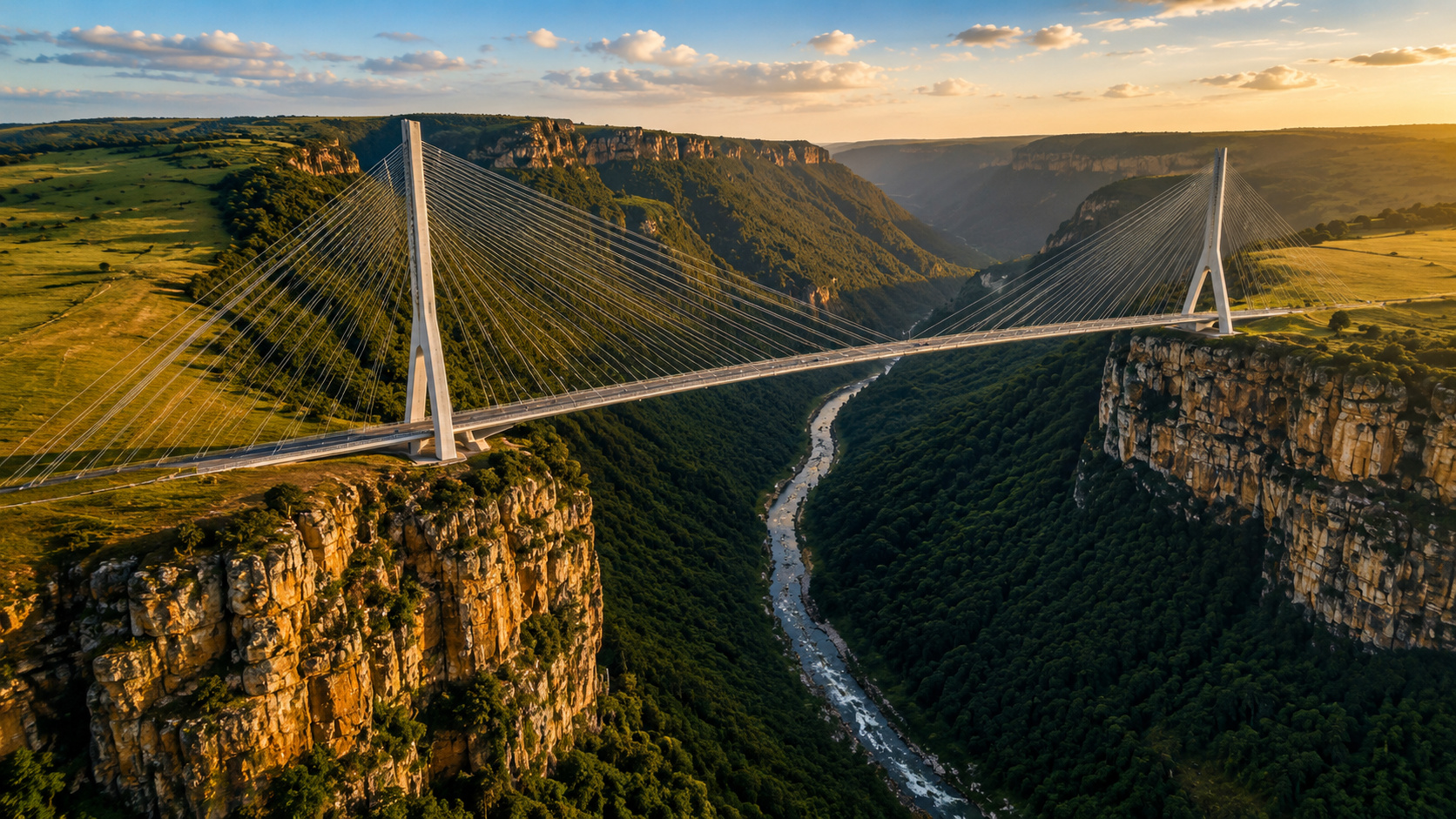


The Msikaba Bridge advances over a deep valley in South Africa, will have 580 meters in length, a deck at 194 meters high, and promises to reinforce the N2 Wild Coast Toll Road in a hard-to-reach region, where engineering, transportation, and regional development meet in a project of rare scale on the African continent
The Msikaba Bridge is being erected in South Africa to span a deep valley with 580 meters in length and a deck at 194 meters high over the Msikaba River gorge.
The project is part of the N2 Wild Coast Toll Road, a strategic route that connects important areas of the country and includes a new section of 112 km between Port St Johns and Port Edward. The report was published by Engineering News, a portal specialized in engineering and infrastructure.
The project draws attention because it combines height, remote landscape, and a cable-stayed structure. In practice, this means a bridge supported by cables attached to large towers, without relying on multiple supports at the bottom of the valley.
-
EPS duplex house is ready in up to 5 days without conventional pillars and beams: fair in Espírito Santo showcases sand made from mining waste, a 250 m² modular house assembled in 15 days, and technologies that can change the time, cost, and waste on construction sites.

-
Dubai will invest US$ 22 billion in sewage tunnels up to 90 meters deep, replacing pumps with gravity and replacing more than 100 old stations, in an attempt to save a city of skyscrapers, artificial islands, and rapid growth from an underground problem that has already overflowed into the streets.

-
The history of the Hercílio Luz Bridge involves controversies, love, and renewal: From its iconic construction to its reopening, it is a symbol of Santa Catarina.
-
General Motors Replaces Over a Thousand Workers with 50 Cobots at Electric Vehicle Plant, UAW Union Criticizes Move Amid Industry’s Automation Push


Msikaba Bridge will be 580 meters and will stand almost 200 meters above the valley
The Msikaba Bridge will be built over the Msikaba River gorge, near Lusikisiki, in the Eastern Cape province, South Africa.


The size of the structure is impressive. It will be 580 meters in length, with the deck at 194 meters above the valley. The deck is the part of the bridge where vehicles pass.
This height explains the complexity of the project. It is not just about building a common road, but creating a safe crossing over a deep natural void.
The bridge will also have a great visual impact. Seen from afar, the structure is expected to mark the landscape with towers, cables, and a suspended deck over the gorge.
Cable-stayed structure uses cables to support the deck over the gorge
The Msikaba Bridge will be a cable-stayed bridge. This type of bridge uses cables to hold the deck, with the cables connected to tall towers on the sides of the structure.
In the project, construction advances from both sides of the gorge. Each half will be 290 m and the two parts are expected to meet in the middle of the valley.
Each side will be supported by 17 pairs of cables attached to Y-shaped inverted pillars. In simple terms, these cables help distribute the weight of the bridge and keep the deck stable.
This solution avoids direct interference with the valley floor, which is almost 200 m below. The preservation of the gorge is an environmental requirement linked to the construction.
N2 Wild Coast Toll Road gains one of the most remarkable works of the route
The N2 Wild Coast Toll Road is an important road for South Africa. It connects the provinces of Western Cape, Eastern Cape, KwaZulu Natal, and Mpumalanga.
The route passes through cities and regional centers such as Cape Town, George, Gqeberha, East London, Mthatha, Durban, and Ermelo.
Within this corridor, the Msikaba Bridge stands out as one of the most striking works. It is part of a new 112 km stretch between Port St Johns and Port Edward.
This stretch includes two major bridges and other structures over rivers and crossings. Toll collection is planned only for the new part built in an area without a previous road.
Engineering News detailed why the Msikaba Bridge is so relevant in Africa
Engineering News, a portal specialized in engineering and infrastructure, detailed the main figures of the Msikaba Bridge and its position within the N2 Wild Coast Toll Road project.
The bridge will have the largest main span in Africa built by the cable-stayed method. It will be second only to the Maputo Catembe suspension bridge in Mozambique among the largest main spans on the continent.
With the deck 194 m above the valley, the Msikaba Bridge is expected to become the third highest bridge in Africa and the 133rd highest in the world.
These data show why the work surpasses local interest. The bridge combines road, major engineering, and a landscape that helps explain the visual strength of the project.
Work continues, but faces delays related to production and cash flow
The construction of the Msikaba Bridge continues, but progress is slower than planned. The contract remains in effect and there is a budget reserved for the work.
The construction is under the responsibility of a partnership between Concor, from South Africa, and Mota Engil Construction South Africa.
The spokesperson for Sanral, Lwando Mahlasela, stated that the work is ongoing. He described the single-span, cable-stayed bridge, over half a kilometer long, as a complex but feasible engineering work.
The main difficulties involve cash flow and production limitations. These problems are mainly linked to the manufacturing of board parts in the steel sector of Mpumalanga.
Local jobs and regional companies are also part of the impact
The Msikaba bridge also boosts work and companies linked to the region. About R86 million of the contract value was reserved for targeted local labor.
Another R515 million was allocated for subcontracting targeted companies. So far, R553 million has been spent on 157 targeted companies.
This group includes 44 suppliers, 52 service providers, and 61 subcontractors. Additionally, about R93 million has been paid in wages to local workers.
Of the 453 full-time equivalent jobs created on the Msikaba bridge so far, 391 are held by local residents. The impact, therefore, is not limited to concrete and cables.
Msikaba bridge summarizes the challenge of bringing roads where the landscape imposes limits
The Msikaba bridge brings together strong numbers in a single project: 580 meters in length, a roadway at 194 meters high, and a cable-stayed structure over a deep valley in South Africa.
Within the N2 Wild Coast Toll Road, the bridge represents a strategic link and also a visual landmark of African engineering. The project still faces delays but remains one of the most important structures of the project.
In a region where the terrain imposes enormous obstacles, the Msikaba bridge shows how far engineering can go to shorten paths. Do you think projects of this size justify the impact when they can improve regional connections and generate local jobs?